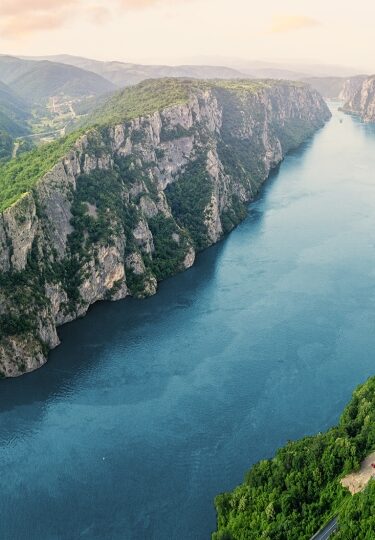
The Danube narrows into an almost unrecognizable river as it flows through the Iron Gates, an 83-mile gorge where giant cliffs tower up from the riverside and the current picks up speed beneath your feet. For guests sailing on a Danube River cruise between Serbia and Romania, some of the most dramatic scenery throughout the entire route unfolds before your eyes while you watch from the deck. This guide explores what the Iron Gates are, the region’s history, how ships navigate the gorge’s narrowest points, and what to expect on board as you pass through.
What the Iron Gates Are (and Where You Can See Them)
The Iron Gates are a series of gorges along the Danube River, drawing the border between Serbia and Romania as the river carves through the southern Carpathian ranges. At the gorge’s narrowest bend, it compresses to 492 feet wide, with cliffs climbing up to 984 feet on either side. Historically, the region’s crags and intense current made it virtually impossible for river traffic to pass through, hence the name, “Iron Gates.” It wasn’t until the 20th century that modern engineering tamed the current, allowing safe, more predictable thoroughfare. Even though danger has eased, the drama and excitement remain throughout the passage. The stretch is often among the most memorable experiences for guests cruising through the gorge between the Danube’s riverside cities.
Landmarks and Vistas Around the Iron Gates
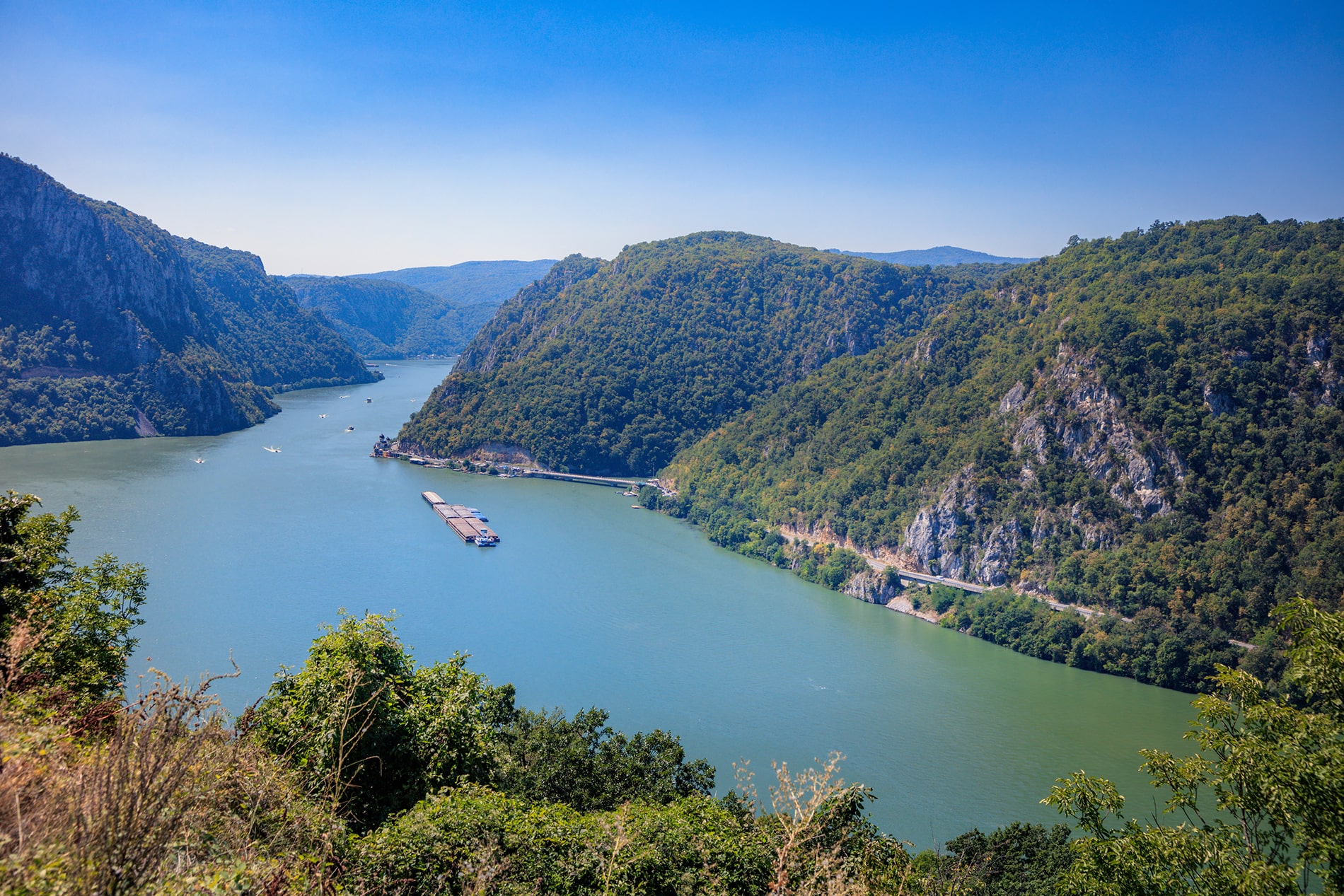
The Danube River carves a dramatic blue path through towering, forest-covered limestone cliffs in Serbia’s Iron Gate Gorge.
As you’re sailing down the Danube through Romania toward Vidin, you’ll pass a lot of rural farmlands, forested hills, and flatlands. The Iron Gates gorge provides a stark contrast in both scale and landscape composition, making it a highlight of the passage.
Not far past Golubac, the river begins to narrow dramatically as the cliff faces jut into the skies. A few miles on, the river spreads back out into a wide, glassy basin enveloped by forested hills, before narrowing again as the next gorge closes in. By standing on deck as you move through, you’ll see the water and light change with a 360-degree view, watching the cliffs’ shadows give way to open skies before closing back in again.
There’s a second advantage to taking in the scenery from outside: you’ll familiarize yourself with ancient monasteries, displaced townships, and modern engineering marvels along the way. Below are a few recognizable landmarks worth the wait:
Djerdap and Porțile de Fier National Parks
The gorge itself sits inside two protected parks that mirror each other from across the border. Djerdap is on the Serbian bank, and Porțile de Fier is on the Romanian side. They preserve the steep, forest-laden terrain surrounding the river, and they’re home to golden eagles and wild goats, both of which you can spot as you sail through.
Lepenski Vir
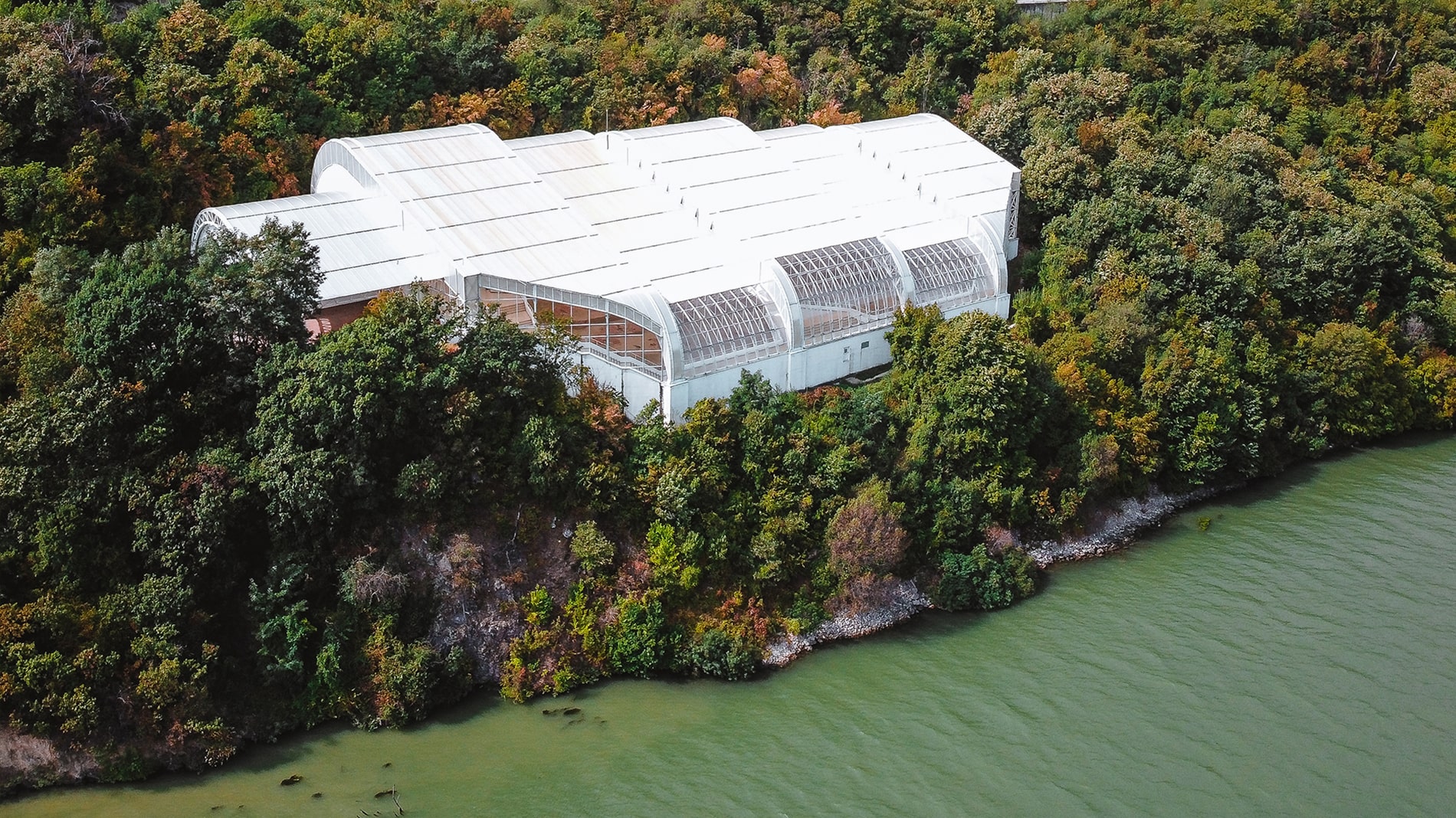
The modern white protective enclosure of the Lepenski Vir archaeological site rests on the lush banks of the Danube River beneath steep, rocky slopes.
Before the cliffs take hold on the Serbian side of the gorge, you’ll pass Lepenski Vir, a Mesolithic archaeological site dated between 8,000 and 11,500 years ago. In the 1970s, during the Iron Gates dam construction, archaeologists relocated the original site uphill to preserve it from rising water levels. You’ll still see the original settlement, just slightly removed from its original location.
Tabula Traiana
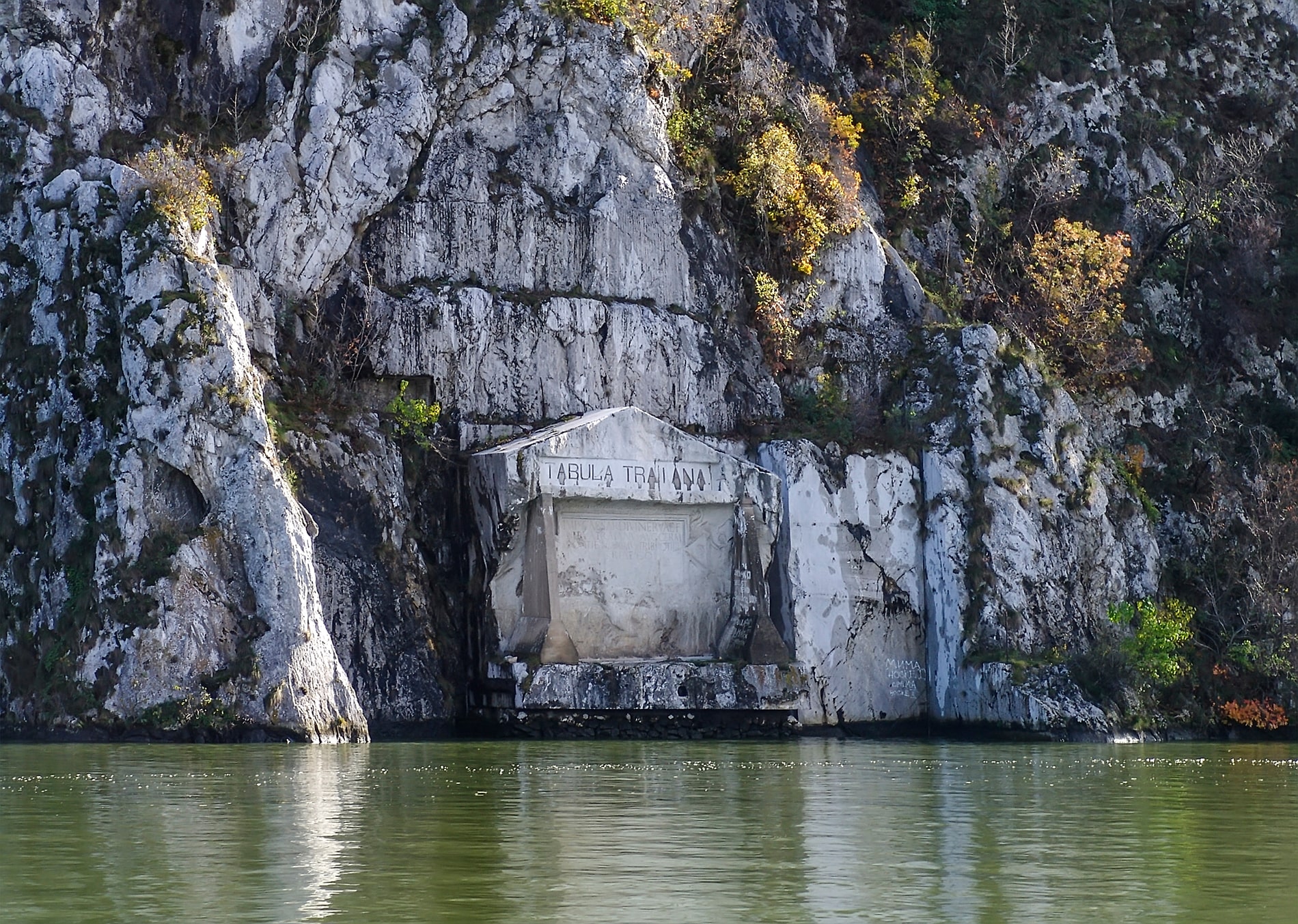
Etched into the towering Serbian cliffs, the Tabula Traiana remains an enduring Roman memorial, positioned just above the Danube’s glassy surface.
As you near Orșova in Romania, you’ll see the Tabula Traiana, a Roman memorial plaque carved into the Serbian cliff face which commemorates a military road Roman Emperor Trajan built ahead of his descent into Dacia. From the ship, you’ll see a close-up view, with inscriptions also visible from the water.
Decebalus Rock Sculpture
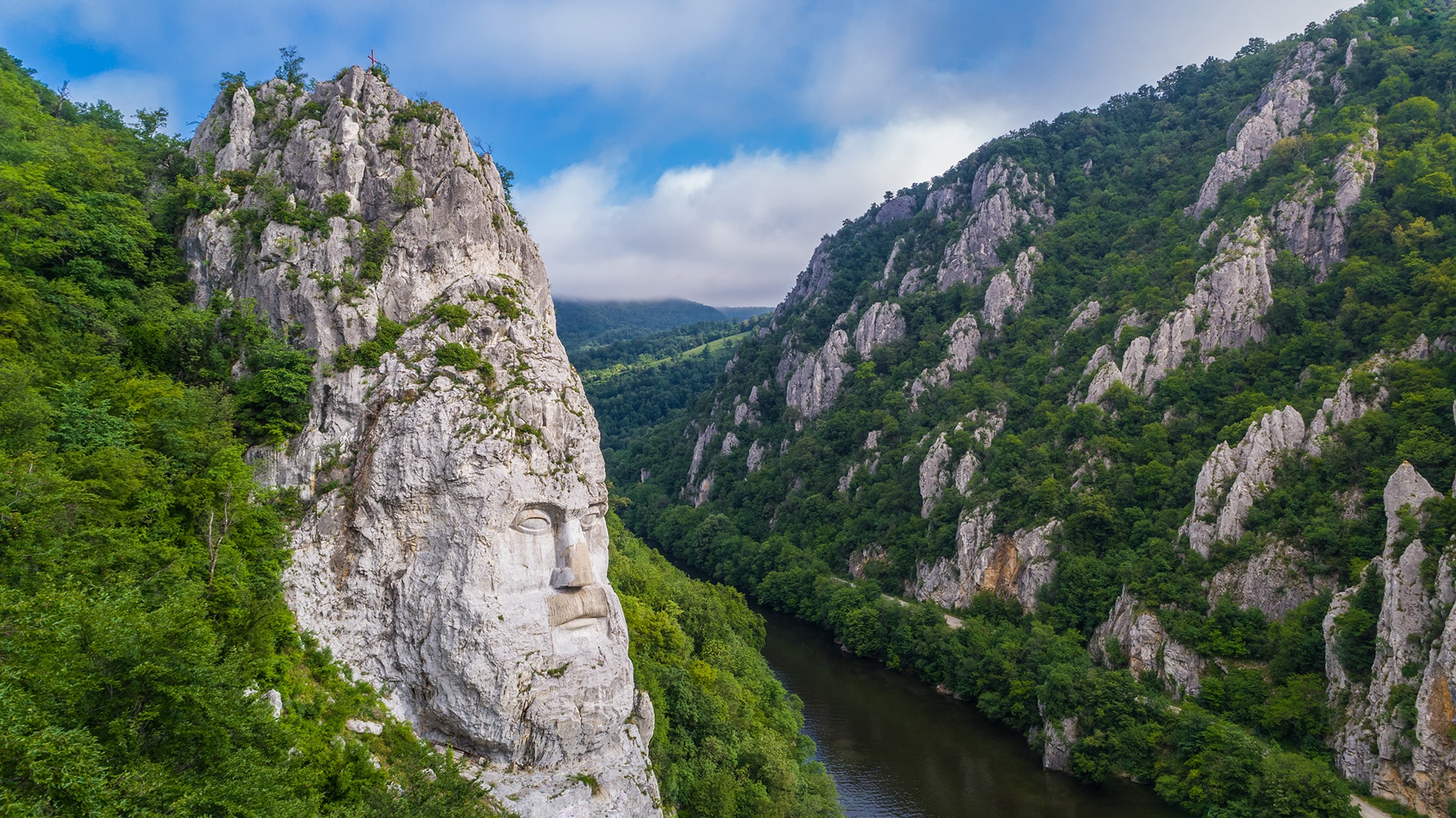
The monumental stone portrait of King Decebalus, chiseled into the towering Romanian cliffs, watches over the verdant depths of the Danube Gorges.
Almost directly opposite the Tabula Traiana, you can view the Decebalus Rock Sculpture etched 180 feet up in the cliff face. While it appears as ancient as its neighboring Danube River landmarks, it’s not. Commissioned by Iosif Constantin Drăgan, it was carved between 1994 and 2004 to honor the last king of Dacia, Decebalus. His face now watches the Roman inscription left by the empire that tore down his kingdom from across the water.
The Gorges (The Kazans)
The Kazans are the narrowest and fastest-moving section of the entire passage. As you approach, you’ll notice the riverbed drop and feel the current pressing more intensely against the ship’s hull. The cliffs on both banks close to their tightest point here, and it’s this stretch—more than any other along the Danube—that gives the Iron Gates their name and their reputation. Onward toward Belgrade or downriver toward Bucharest, the cliffs eventually loosen their grip and the Danube settles back into open farmland. Through that changing scenery, you’ll still come across yet another intriguing aspect integrated into the river cruise experience: passing through the locks.
What It’s Like To Cruise Through the Iron Gates
While dynamic riverside landscapes and plenty of historic landmarks set the tone for your cruise, there are a few more river-specific and equally captivating experiences to discover. As part of a broader river cruise itinerary, both the locks and commercial thoroughfare provide an amusing sideshow as you travel between cities.
Lock Systems
Navigating through locks is a common part of river cruising. The lock system works like an elevator, with valves used to fill and empty water in fixed chambers, allowing the ship to move through river slopes safely.
The Iron Gates passage has lock systems split across two hydroelectric dam sites. Iron Gates I has a double-lock system acting like a “staircase” to adjust for varying water levels. At Iron Gates II, you’ll pass through a single lock, with a much smaller water level distance to cover. River traffic is well-coordinated, even in peak summer, so seasonally low water levels and upstream draft are the only real (if unlikely) potential causes for delays.
Industrial Ship Traffic
You’ll also notice, in comparison to rivers like the Rhine, there are fewer commercial ships and barges sailing along the Danube, creating minimal visual distraction from the open-air scenery.
A major reason is that the Iron Gates are in a more rural location, isolated from major trade routes. Another reason is the complexity of moving high-volume trade traffic through the locks—which are also fundamental infrastructure facilitating the thoroughfare in the first place.
History and Significance of the Iron Gates
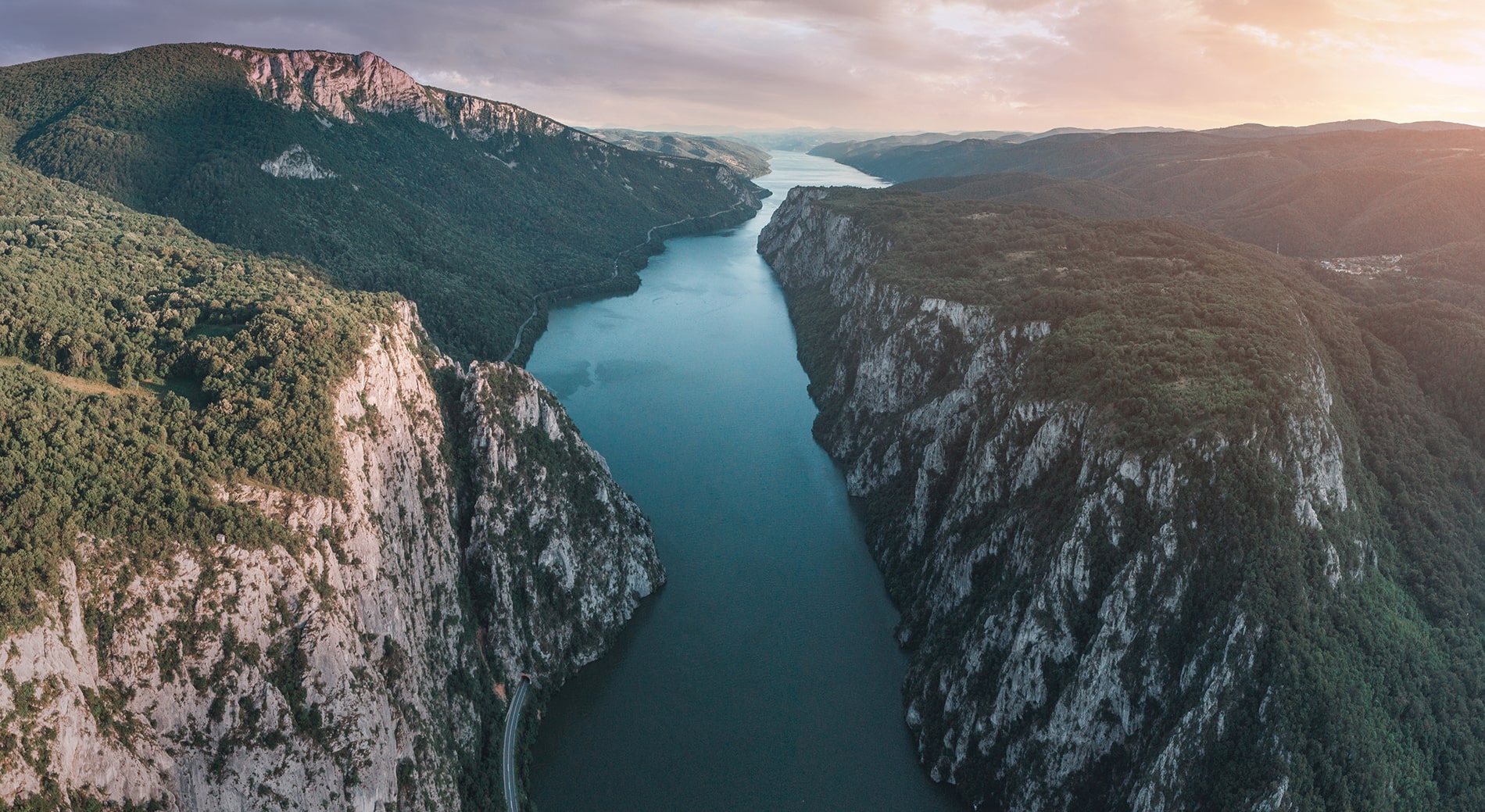
Aerial view captures the Danube River winding through the dramatic Iron Gates gorge, flanked by sheer limestone cliffs and lush green forests under a soft, golden sky.
For many thousands of years, the Iron Gates’ narrow channels, hidden rocks, and rough torrents dictated who could move through this stretch of the Danube—and who couldn’t. As one of the most challenging river passages to pass through, the Iron Gates have affected trade routes, military actions, and border identity throughout history. There’s archaeological evidence of Mesolithic fishing settlements, as well as Roman, Ottoman, and Habsburg fortresses dotted along the banks, now half-engulfed by the hillsides. In the late 19th century, Austro-Hungarian engineers blasted a navigable channel near the Kazans, although submerged rocks and fierce currents kept the passage treacherous. Later, the governments of Romania and the Socialist Federal Republic of Yugoslavia constructed some of the largest hydroelectric dams on European rivers, facilitating deep-draft navigation. Both were completed by 1984. These dams now supply renewable energy and water for industrial usage across both Serbia and Romania.
FAQs: Cruising Through the Iron Gates
Are the Iron Gates worth seeing on a Danube river cruise?
Yes. The gorge reveals stunning cliffs, ancient landmarks, and hydroelectric locks, making it a highlight of most Danube itineraries.
What are the Iron Gates of the Danube and why are they famous?
The Iron Gates are a Danube gorge on the Serbia-Romania border, well-known for their narrow limestone cliffs and centuries-long reputation as a challenging river passage.
What do you actually see when sailing through the Iron Gates gorge?
Expect steep limestone cliffs, national parkland, the Tabula Traiana, the Decebalus Rock Sculpture, and the gorge’s narrowest stretch, the Kazans.
Can you see the Decebalus Rock Sculpture from a Danube cruise through the Iron Gates?
Yes. The 180-foot carving sits directly on the riverside, visible from the deck as cruise ships pass through the gorge.
How long does it take to cruise through the Iron Gates?
Full transit through the gorge, including lock passage at the Iron Gates dams, typically takes several hours from entry to exit.
Which Danube cruises go through the Iron Gates?
Celebrity Danube River cruises connecting Serbia and Romania, routed through Belgrade or Bucharest, include passage through the Iron Gates.
What are the best stops before and after the Iron Gates on a Danube cruise?
Belgrade makes an excellent stop before the gorge, while Vidin and Bucharest are natural follow-on destinations afterward.
Sail Through the Danube’s Best-Kept Secret
The Iron Gates hold as much history and excitement as the port stops you’ll cross along the way. Cruising along this passage with Celebrity River Cruises℠ offers front-row seats to some of the most fascinating, historically significant stories in the region, alongside impressive dam engineering.
Explore Danube River cruises and set sail through one of Europe’s hardest-won stretches of water.