A Danube River cruise can take you through several countries in a single journey, sailing past vineyard-covered hillsides, medieval towns, grand European capitals, and dramatic gorges along the way. Looking at a Danube River cruise map before you sail helps put the journey into perspective and makes it easier to understand just how much you can experience along one river.
The Danube begins in Germany’s Black Forest and winds nearly 1,800 miles across Europe before reaching the Black Sea. Along the way, it passes through or borders 10 countries and flows through four capital cities: Vienna, Bratislava, Budapest, and Belgrade. From the Wachau Valley and Danube Bend to the Iron Gates and Danube Delta, the scenery changes considerably as the river moves through its Upper, Middle, and Lower sections.
Use this map to follow the Danube from west to east, see where its major cruise ports and scenic stretches are located, and better understand the routes you’ll encounter when choosing a Danube River cruise.
Danube River at a Glance
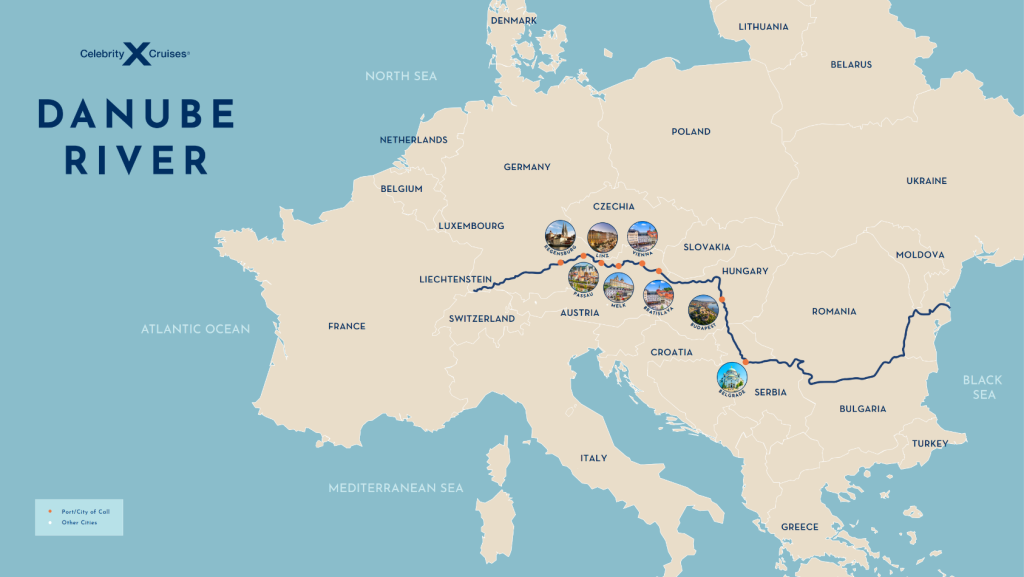
- Length: Approximately 1,770 miles
- Starting point: Germany’s Black Forest
- End point: The Black Sea via the Danube Delta
- Countries: Germany, Austria, Slovakia, Hungary, Croatia, Serbia, Romania, Bulgaria, Moldova, and Ukraine
- Key cities: Vienna, Bratislava, Budapest, and Belgrade
- Main sections: Upper Danube, Middle Danube, and Lower Danube
Follow the Danube from the Black Forest to the Black Sea
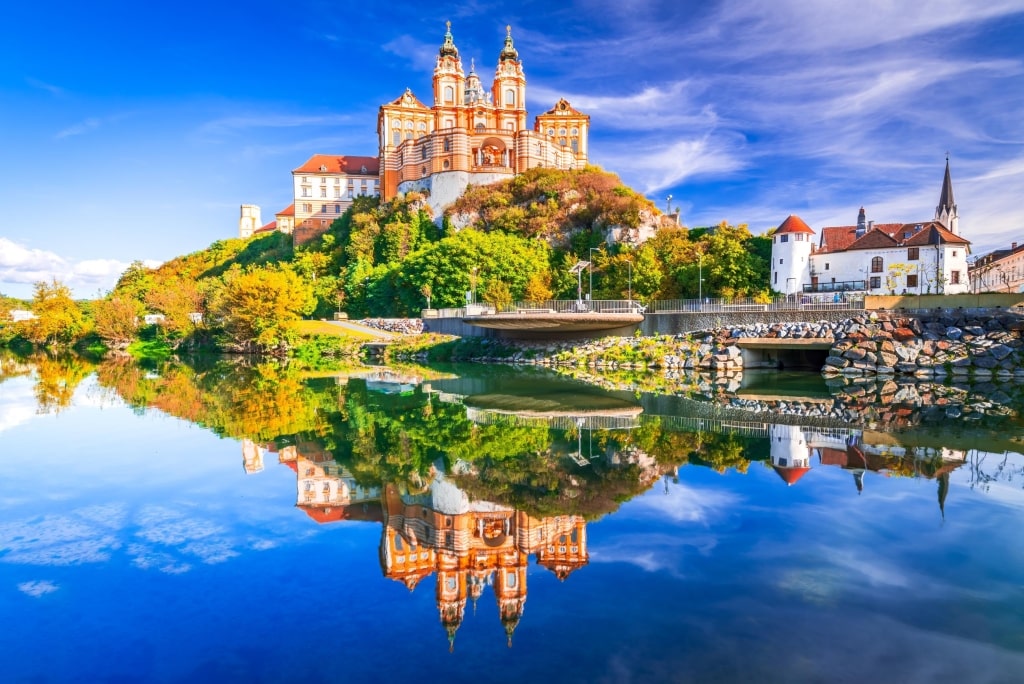
Melk Abbey, Austria. The abbey is reflected in the water of the Danube River on a sunny autumn day in the scenic Wachau Valley.
The Danube flows generally west to east, making its way from Germany across Central and Southeastern Europe. For river cruisers, dividing the river into its Upper, Middle, and Lower sections makes it easier to understand not only the geography, but also how the scenery, ports, and experience change as you sail downstream.
The Upper Danube
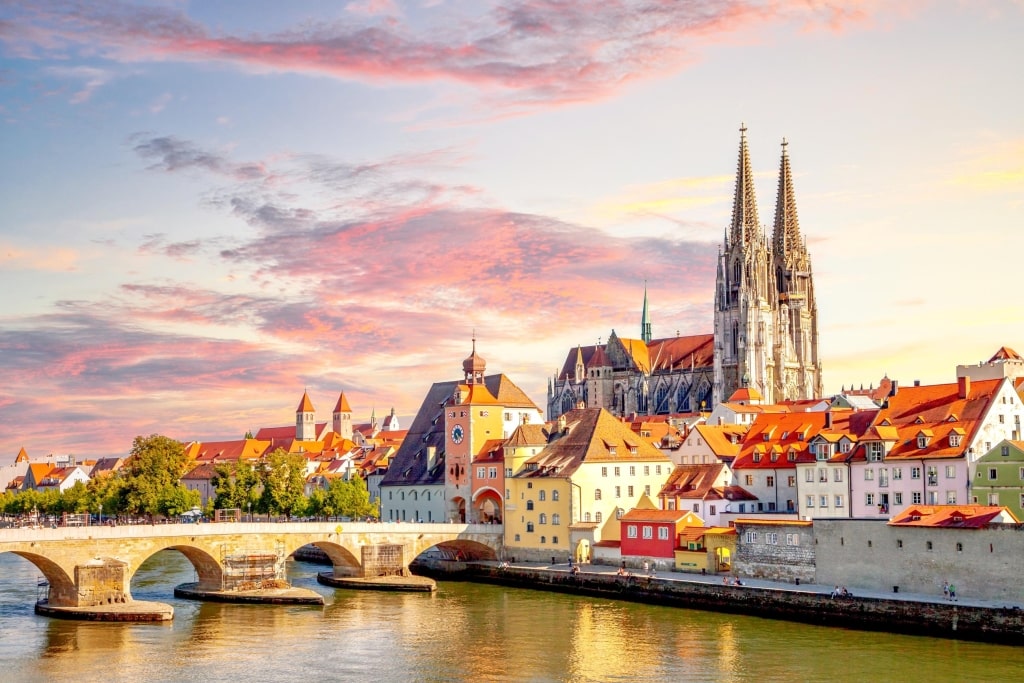
Sunset over the historic Old Town of Regensburg, featuring the medieval Stone Bridge spanning the Danube River and the twin spires of Regensburg Cathedral.
The Danube originates in Germany’s Black Forest, traditionally associated with the meeting of the Brigach and Breg rivers near Donaueschingen. From there, it flows through southern Germany.
Regensburg is one of the first major historic cities encountered along the river. Its beautifully preserved medieval center and 12th-century Stone Bridge show just how important the Danube has been as a trade and transportation route for centuries.
Farther downstream is Passau, set near Germany’s border with Austria. Known as the City of Three Rivers, Passau sits at the confluence of the Danube, Inn, and Ilz rivers. The Inn is one of the Danube’s major tributaries, and one of the more interesting facts is that it carries so much water that its pale, Alpine-fed waters can sometimes be distinguished from those of the Danube where the rivers meet.
Crossing into Austria, the Danube continues toward Linz before reaching one of its most beautiful stretches, the Wachau Valley. This is the kind of scenery that makes a river cruise as much about the time spent sailing as the ports themselves. Steep hills rise directly from the water with vineyards, orchards, medieval villages, church spires, and castle ruins along the banks.
Melk is a standout stop in the Wachau, largely thanks to Melk Abbey, the immense Baroque monastery perched high above the Danube. Farther east, the river reaches Vienna, the first of four national capitals directly on the banks.
Austria’s capital pairs centuries of imperial history with one of Europe’s most important waterways. The Danube then continues toward Slovakia and Bratislava, where the historic center and hilltop Bratislava Castle sit close to the river.
The Middle Danube
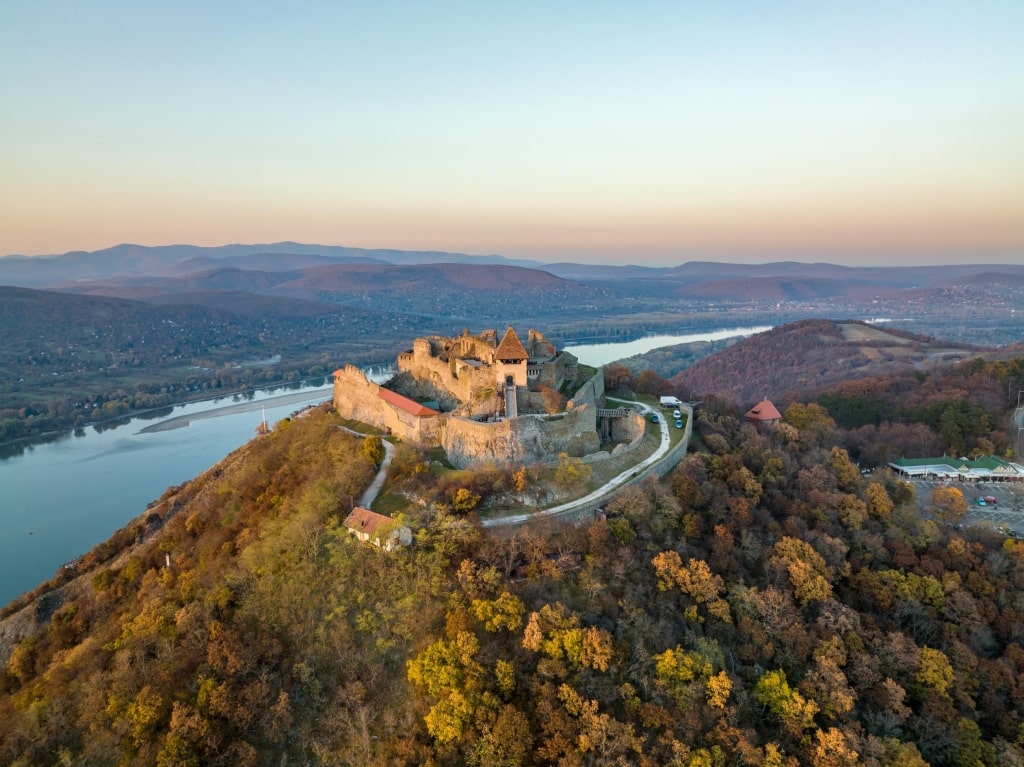
Aerial panoramic drone view of the beautiful high castle of Visegrad on a moody autumn sunset. Danube Bend (Dunakanyar) and an amazing golden sunset in the background.
East of Bratislava, the Danube moves toward Hungary and one of its most photogenic sections.
The Danube Bend north of Budapest marks a dramatic change in direction as you cruise through forested hills. Historic towns such as Esztergom and Visegrad add castles, cathedrals, and hilltop views to the river scenery.
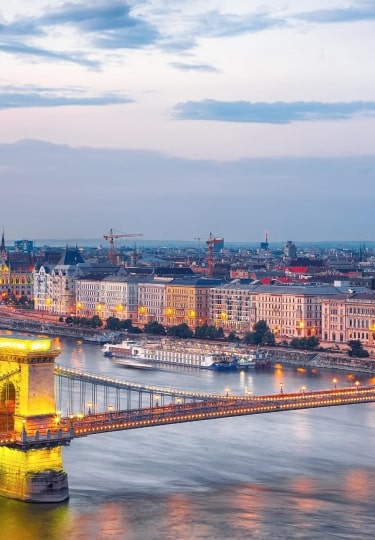
Then comes Budapest. Few arrivals illustrate the appeal of river cruising quite like sailing into the Hungarian capital. The Danube divides Budapest between Buda and Pest, and some of the city’s best-known landmarks rise directly above its banks. The Hungarian Parliament Building faces the river from Pest, while Buda Castle and Fisherman’s Bastion sit high on the opposite side. The Chain Bridge links the two halves of the city.
Continuing south, the river moves through Hungary before forming or passing along portions of Croatia and Serbia. Major tributaries join the Danube in this region, including the Drava and Tisza.
In Serbia, Novi Sad lies along the river beneath the imposing Petrovaradin Fortress, a landmark visible above the Danube as you approach the city. Further downstream, the river reaches Belgrade, the fourth capital along its course. Here, the Sava meets the Danube beneath Belgrade Fortress.
Beyond Belgrade, the river heads toward one of its most dramatic natural landmarks, the Iron Gates. This series of gorges cuts between the Carpathian Mountains of Romania and the Balkan Mountains of Serbia, narrowing the river between cliffs. For passengers sailing along the Danube, the Iron Gates is one of the river’s signature scenic-sailing experiences and a dramatic transition between the Middle and Lower Danube.
The Lower Danube
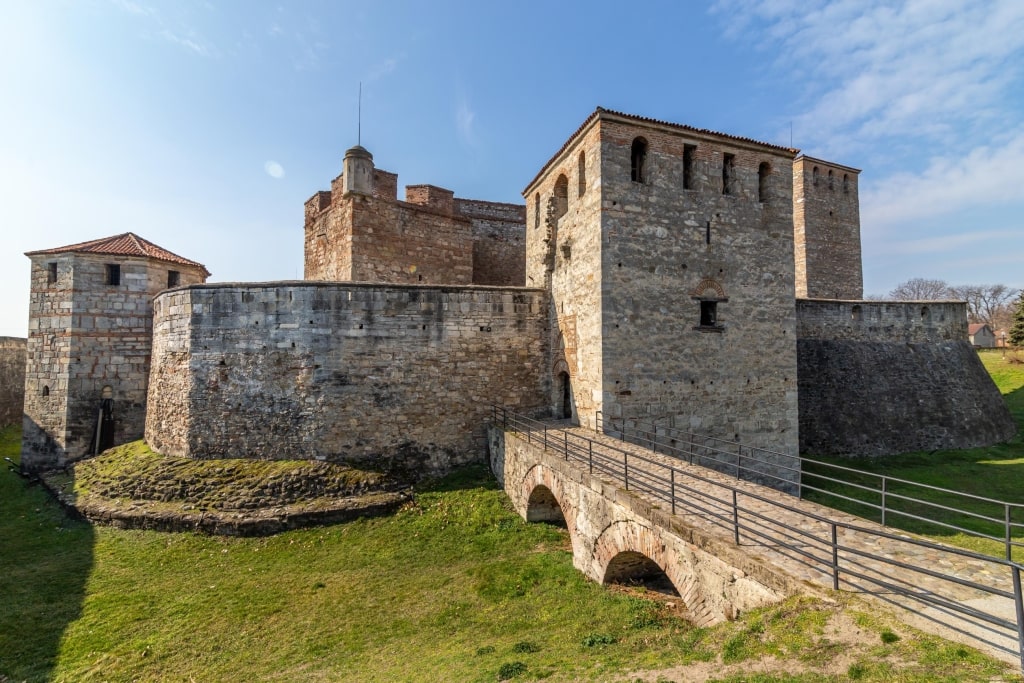
The preserved medieval fortress Baba Vida, located on the Danube River near Vidin city in Bulgaria.
Beyond the Iron Gates, the Danube enters its Lower section, and cruisers begin to see a very different side of the river.
The Danube flows along Romania and Bulgaria, often forming the border between the two countries. Cities and ports along this stretch include Vidin and Ruse in Bulgaria, as well as Romanian communities with long connections to Danube trade.
This portion of the river generally feels less like the compact procession of imperial capitals found farther upstream. The Danube broadens, the landscape opens up, and stretches of sailing between ports reveal a quieter, more rural side of Southeastern Europe.
As it continues east, the Danube reaches areas associated with Moldova and Ukraine before beginning its final transformation into the Danube Delta.
Rather than reaching the Black Sea as a single channel, the river spreads into a vast network of waterways, lakes, marshes, and islands. The delta is one of Europe’s most important wetland ecosystems and provides a strikingly different finale to a river cruise that may have begun in Central Europe.
Find Your River Route
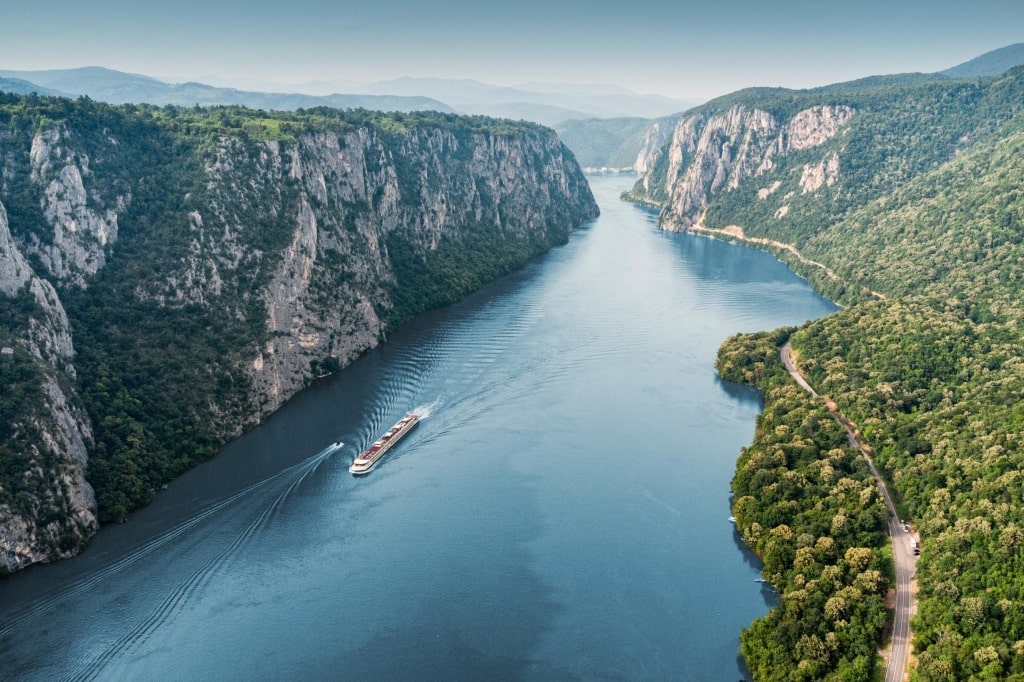
Aerial view of a cruise ship traveling through the Danube River’s Iron Gate between Serbia and Romania.
With 1,770 miles of river and so many possible itineraries, choosing a Danube River cruise comes down to what you most want to experience. Rather than simply counting the number of ports on an itinerary, use the map to see how those stops fit together and how much of the river you’ll actually explore.
If this is your first Danube cruise, consider which destinations are must-sees. An itinerary that includes several major cities may appeal if sightseeing, museums, architecture, and dining are priorities, while one with smaller ports and longer scenic stretches may be a better fit if you want more time watching Europe unfold from the ship.
Also look at the pace. Does the ship sail during the day, when you’ll be able to enjoy the scenery, or cover more distance overnight? How long will you have in each port? A longer itinerary can take you through more countries and introduce you to less-visited destinations, while a shorter cruise may allow you to concentrate on a particular region.
Finally, pay attention to where your cruise begins and ends. Embarkation and disembarkation cities can add considerably to your trip, particularly if you’d like to spend a few days exploring before or after your cruise. When you view the complete itinerary on a map rather than as a list of ports, it’s easier to see not only where you’re going, but what kind of Danube experience the route will give you.
With Celebrity River Cruises℠, you can extend your vacation with a Before and After Stays package. On select Danube sailings, you can add a pre- or post-cruise stay in Budapest or Prague to spend more time exploring these destinations. Each stay includes hotel accommodations, daily breakfast, travel to and from your cruise ship, and daily excursions led by locals who know exactly how to bring the city to life.
Danube River FAQs
Where does the Danube River start and end?
When looking at a map of the Danube River’s location, you’ll find it begins in Germany’s Black Forest and flows approximately 1,770 miles before reaching the Black Sea through the Danube Delta.
Which countries does the Danube River flow through or border?
The Danube River passes through or forms part of the borders of 10 countries: Germany, Austria, Slovakia, Hungary, Croatia, Serbia, Romania, Moldova, Bulgaria, and Ukraine.
Which capital cities are on the Danube River?
Four national capitals lie directly on the Danube: Vienna (Austria), Bratislava (Slovakia), Budapest (Hungary), and Belgrade (Serbia).
What are the major tributaries to the Danube River?
The Danube has numerous tributaries across its vast river basin. Among the most significant are the Inn, Morava, Drava, Tisza, and Sava rivers.
Explore the Danube with Celebrity River Cruises
A map of the Danube River reveals just how much can change over the course of a single river cruise. One stretch connects imperial capitals and vineyard-covered valleys; another takes you past medieval fortresses and through mountain gorges; and farther east, the river broadens before disappearing into the wetlands of the Danube Delta.
Explore Danube River cruises to find the combination of cities, scenery, and stretches of the river you most want to experience.