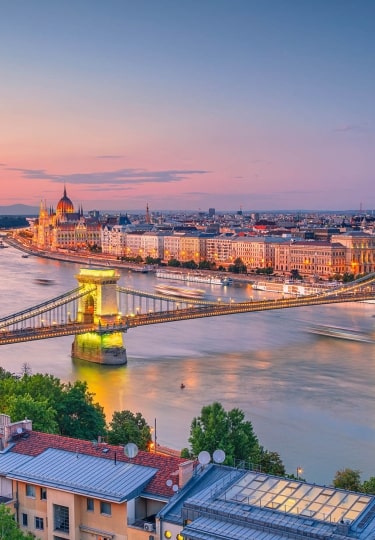
Rising in Germany’s Black Forest and winding eastward to the Black Sea, the Danube River travels nearly 1,800 miles through a remarkably diverse region of vineyard-covered valleys, medieval towns, imperial cities, and sprawling wetlands.
Along its banks, Roman legions once guarded the empire’s frontier, and powerful dynasties built palaces, fortresses, and grand cities. Today, the Danube is still an essential waterway, but for many travelers, its greatest appeal lies in the opportunity to experience multiple countries, cultures, and histories while following one of Europe’s most scenic routes.
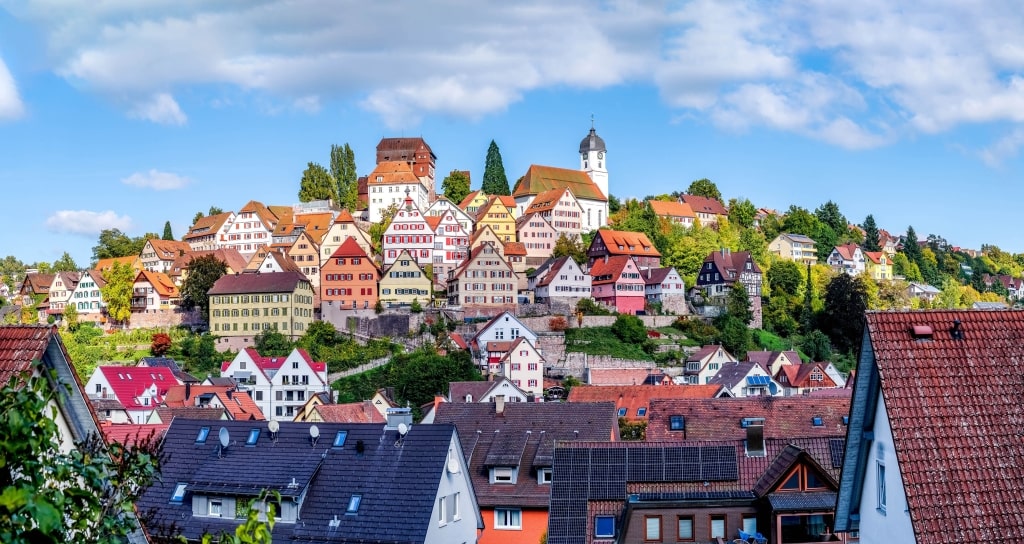
View over Altensteig, Black Forest, Germany
Before exploring the Danube on a river cruise, learn these Danube River facts.
Where Is the Danube River Located?
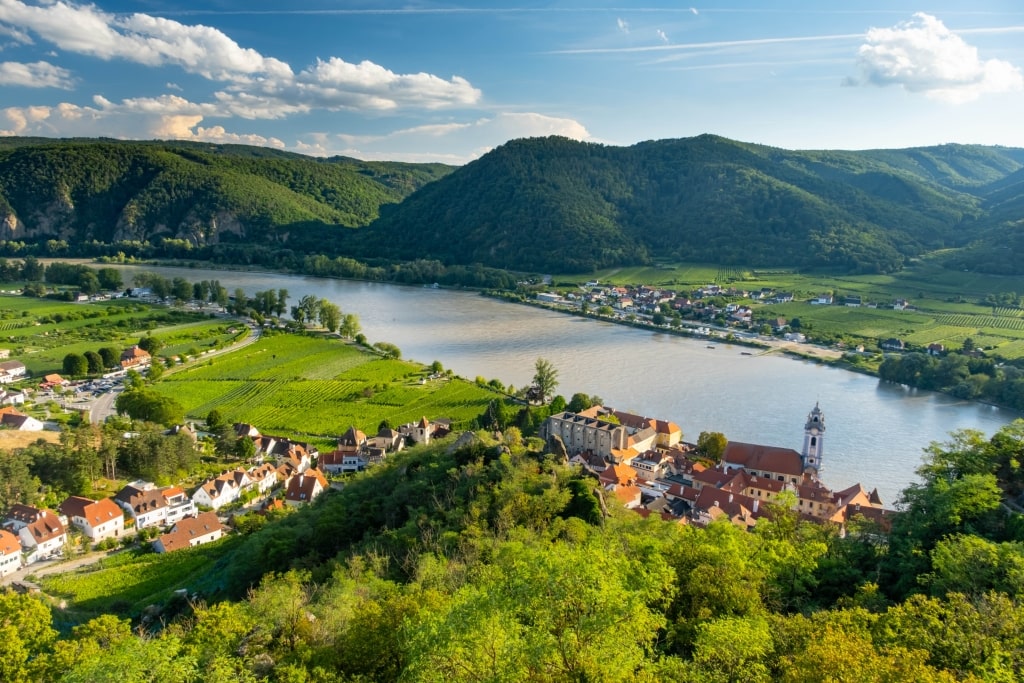
Panorama of Wachau Valley with Danube River near Duernstein village in Lower Austria
To understand the Danube’s location, it helps to look at where the river begins, the countries it connects, the landscapes it traverses, and the scenic regions that have developed along its banks. The wider Danube River basin also reaches far beyond the main channel, with tributaries and waterways that help connect much of Central and Eastern Europe. These facts reveal how the Danube became one of Europe’s defining waterways.
1. The Danube Begins in Germany’s Black Forest
The Danube begins in Germany’s Black Forest, near the town of Donaueschingen. Here, the Breg and Brigach rivers converge to form the Danube, creating the headwaters of one of Europe’s most famous rivers. These early tributaries help form a waterway that will eventually cross much of the continent.
2. The Danube Flows All the Way to the Black Sea
After leaving Germany, the Danube continues its journey across Central and Eastern Europe before emptying into the Black Sea through the Danube Delta in Romania. Forested hills give way to vineyard-covered valleys, charming cities rise along its banks, and agricultural plains stretch across the horizon farther east. By the time the river reaches the delta, it has become a vast network of channels, marshes, and lagoons that support a variety of wildlife.
3. The Danube Flows Through or Borders 10 Countries
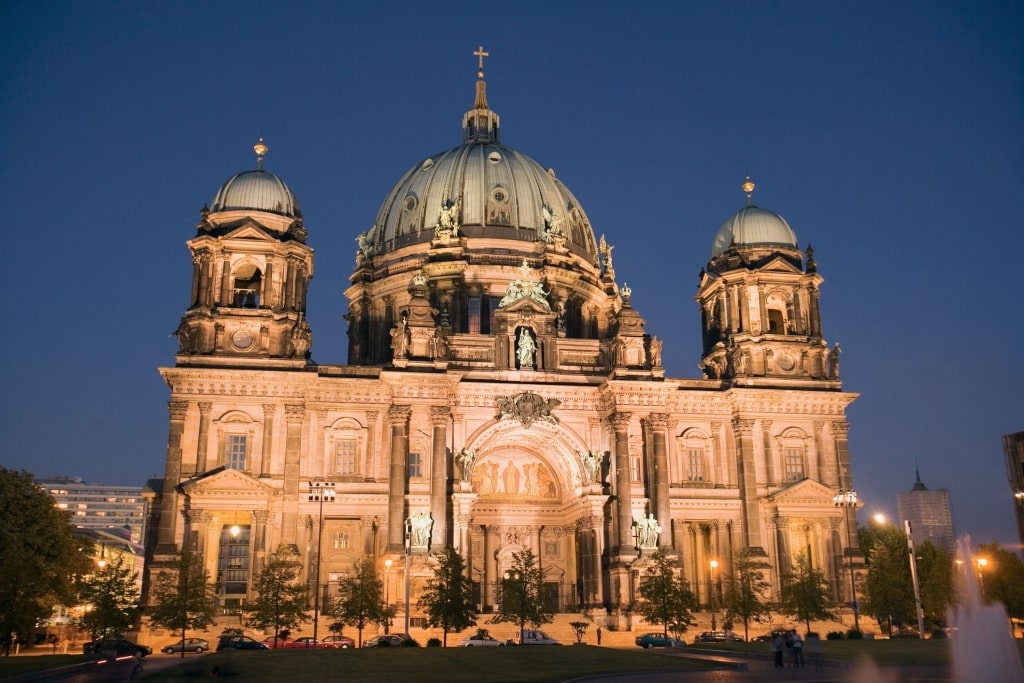
Berlin Cathedral, Museum Island in Berlin, Germany
Few rivers connect as many nations as the Danube. Along its route, it runs through or forms part of the border of Germany, Austria, Slovakia, Hungary, Croatia, Serbia, Romania, Bulgaria, Moldova, and Ukraine. As the river moves from country to country, different architectural styles, languages, cuisines, and traditions build a rich collage of experiences along its banks.
4. The Danube Is Europe’s Second-Longest River
At approximately 1,770 miles in length, the Danube is the second-longest river in Europe, bested only by Russia’s Volga River. Its size helps explain its historic importance as a transportation route linking communities across the continent.
5. The Danube River Valley Is One of Europe’s Great Scenic Regions

A group of friends celebrating with a wine tasting in the picturesque Wachau Valley in Austria.
While the Danube passes through a wide variety of landscapes, some of its most memorable scenery can be found in Austria’s Wachau Valley. This UNESCO World Heritage Site is known for its terraced vineyards, baroque abbeys, medieval villages, and castle ruins overlooking the river.
Capital Cities Along the Danube
One of the Danube’s greatest distinctions remains the number of important cities that line its banks. From grand capitals to picturesque riverside towns, the river provides a fascinating look at the customs and histories of Central and Eastern Europe.
6. Four European Capitals Sit Directly on the Danube
The Danube flows directly through four national capitals: Vienna, Bratislava, Budapest, and Belgrade. No other river in the world passes through as many capital cities, making the Danube unique among Europe’s great waterways.
7. Budapest May Be the Danube’s Most Dramatic Cityscape
With Buda’s castle-crowned hills on one bank and Pest’s grand architecture on the other, Budapest presents one of Europe’s most striking urban panoramas. The Hungarian Parliament Building, Chain Bridge, and illuminated waterfront have made the Hungarian capital one of the Danube’s defining landmarks.
8. Vienna’s Danube Connection Helped Shape the Habsburg Empire
For more than six centuries, Vienna served as the capital of the Habsburg Empire, one of Europe’s most powerful dynasties. Generations of emperors transformed the city into a center of politics, culture, music, and the arts, leaving behind an extraordinary collection of palaces, churches, and public buildings, including Schönbrunn Palace and the Hofburg. Vienna’s relationship with the river also helped inspire one of the world’s most famous waltzes, The Blue Danube, composed by Johann Strauss II.
9. Bratislava Is One of Europe’s Smallest Capitals
Tucked along the Danube between Vienna and Budapest, Bratislava is often one of the river’s most pleasant surprises. Slovakia’s capital is considerably smaller than its neighbors, yet its compact historic center is filled with colorful buildings, inviting squares, and centuries of history.
10. Smaller Danube Towns Are Just as Memorable as the Capitals
While the great capitals often steal the spotlight, many of the Danube’s most memorable moments take place in its smaller towns. In Austria’s Wachau Valley, Dürnstein enchants with its blue church tower and castle ruins overlooking the river, while nearby Melk is home to one of Europe’s most magnificent and colorful abbeys. Farther upstream, Passau in Germany sits at the meeting point of three rivers and is known for its colorful Old Town and baroque architecture.
Danube History Facts
Castles, fortresses, and historic cities line the Danube today, but their stories stretch back thousands of years.
11. The Danube Once Formed Part of the Roman Empire’s Frontier
At the height of Ancient Rome, much of the Danube marked the empire’s northern frontier. This defensive boundary stretched across large sections of Central Europe, helping protect Roman territories from tribes living beyond the empire’s borders.
12. Roman Ruins Still Line Portions of the River
To secure the frontier, Danubius Roman forts, watchtowers, and military settlements were constructed along the river. Evidence of these can still be found along the Danube. In some places, Roman foundations lie beneath modern cities, while elsewhere, preserved ruins hint at life 2,000 years ago.
13. The Danube Became One of Europe’s Great Trade Routes
Long after the fall of Ancient Rome, the Danube continued to shape the development of Europe. The river served as a route for transporting grain, wine, salt, timber, and other valuable goods, helping to connect inland communities with major markets across the continent.
14. WWII Shipwrecks Remain Beneath Parts of the Danube
During the final stages of World War II, retreating German forces deliberately sank dozens of ships in sections of the river, especially near Serbia, in an effort to slow advancing Soviet troops. Many of these sunken ships remain on the riverbed today. During periods of exceptionally low water, portions of the vessels have reappeared above the surface.
15. The Danube Helped Shape Borders and Empires for Centuries
For much of its history, the Danube served as both a connection and a dividing line between competing powers. The river played an important role in the expansion of the Habsburg and Ottoman Empires, which controlled different stretches of the waterway and left lasting marks on the region’s cultures.
Nature and Wildlife Along the Danube
The Danube is more than a ribbon connecting Europe’s great cities. Along its course, the river passes through vineyard-covered valleys, dramatic gorges, fertile plains, and one of the continent’s most important wetland ecosystems.
16. The Danube Delta Is One of Europe’s Most Important Wetlands
At the end of its journey to the Black Sea, the Danube spreads into a vast network of channels, lakes, marshes, and reed beds known as the Danube Delta. Recognized as a UNESCO World Heritage Site, the delta is one of the largest and best-preserved wetland ecosystems in Europe. The delta is also an important habitat for fish, birds, and other wildlife, making it one of the most ecologically significant areas in the Danube region.
17. The River Is Famous for Birdwatching
Thousands of migratory birds pass through the Danube Delta region each year, while many others nest in its protected wetlands and waterways. Danube River cruise passengers may spot pelicans, herons, egrets, cormorants, and dozens of other species from birdwatching spots in the Danube Delta.
18. The Scenery Changes Dramatically Along the River
The Danube features a variety of landscapes along its course, beginning amid Germany’s Black Forest, winding through Austria’s vineyard-covered valleys, passing imposing cliffs and gorges, and ultimately emptying into the wetlands of the Danube Delta. For example, Austria’s Wachau Valley is famous for its abbeys, villages, and castle ruins set close to the water.
19. The Danube Supports Europe’s Wine Regions
Some of Europe’s most celebrated wine regions have developed along the Danube and its tributaries. Austria’s Wachau Wine Valley is particularly famous for its terraced vineyards overlooking the river, while Hungary is home to several respected wine-producing regions, including areas known for both crisp white wines and distinctive sweet varietals.
Culture and Experiences Along the Danube
The Danube is as much a cultural journey as it is a scenic one. Along its banks, travelers can discover centuries of music, architecture, cuisine, and local traditions while exploring some of Europe’s most iconic destinations.
20. ‘The Blue Danube’ Made the River Famous Worldwide
Few rivers have inspired a piece of music as recognizable as Johann Strauss II’s The Blue Danube. First performed in Vienna in 1867, the waltz became one of the most famous orchestral compositions ever written and remains closely associated with Austria’s capital and the river itself. Although the Danube is not always blue, the music helped cement the river’s place in popular culture.
21. Danube Cruises Pass Castles, Abbeys, and Fortresses
Many of the Danube’s most memorable landmarks rise directly from its banks. Along the river, passengers witness medieval fortresses, riverside castles, hilltop ruins, and magnificent religious sites that reflect centuries of European history.
22. Danube Cuisine Changes From Country to Country
The Danube connects a remarkable variety of cultures, and nowhere is that more apparent than at the dining table. From Austrian pastries and Hungarian goulash to Balkan specialties farther downstream, the cuisine evolves throughout the journey.
23. The Danube Is Popular for Biking and Walking Trails
One of Europe’s most famous cycling routes, the Danube Cycle Path, follows the river through several countries and attracts riders from around the world. Walking trails also twist through many of the river’s most scenic regions.
24. Danube Christmas Markets Transform the River in Winter
During the holiday season, many of the Danube’s cities and towns host festive Christmas markets filled with sparkling lights, handcrafted gifts, seasonal treats, and traditional music. The popularity of these markets has helped make Danube Christmas market cruises one of Europe’s most sought-after winter travel experiences.
25. River Cruising Is One of the Best Ways To Experience the Danube
Many Danube itineraries dock within easy reach of historic city centers, allowing more time to explore and less time spent in transit. Instead of packing and unpacking between destinations, guests on a river cruise can settle into one stateroom while the landscapes and cities unfold outside their window.
Experience the Danube on a River Cruise
From the Black Forest and the Wachau Valley to the imperial capitals of Vienna and Budapest, these facts only scratch the surface of what makes the Danube one of Europe’s most fascinating rivers. A river cruise offers an easy way to experience the history, culture, and landscapes that have shaped the Danube for centuries, with the option to extend your journey in destinations such as Prague or Budapest.
With Celebrity River Cruises℠ Before and After Stays, guests can add more time before or after their river cruise to explore select cities at a more relaxed pace. The package includes hotel accommodations, daily breakfast, transfers between the airport, hotel, and ship, and one daily excursion, making it easier to discover more of each destination while enjoying a seamless travel experience.
Explore Danube River cruises and discover the river for yourself.