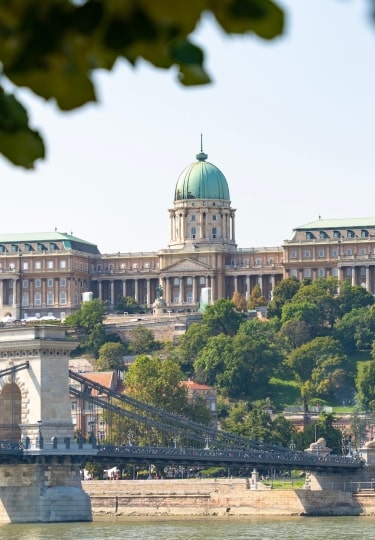
A Baroque-style facade and distinct green dome dominate the Budapest skyline, rising in magnitude as you draw closer to the city. Buda Castle, the region’s most prominent historic castle and palace complex, perches atop Castle Hill, peeking out over the Danube River. It has captured the hearts of locals and visitors alike through more than 750 years of history.
Yet, its physical salience isn’t the main reason so many travelers prioritize a visit. This complex has held the Hungarian royal seat for centuries, built and rebuilt throughout time. Today, it holds UNESCO World Heritage status.
In this guide, explore Buda Castle’s history, learn where to find the best views, and discover how to plan a visit to this symbol of Hungarian resistance.
Quick Facts: Visiting Buda Castle, Budapest
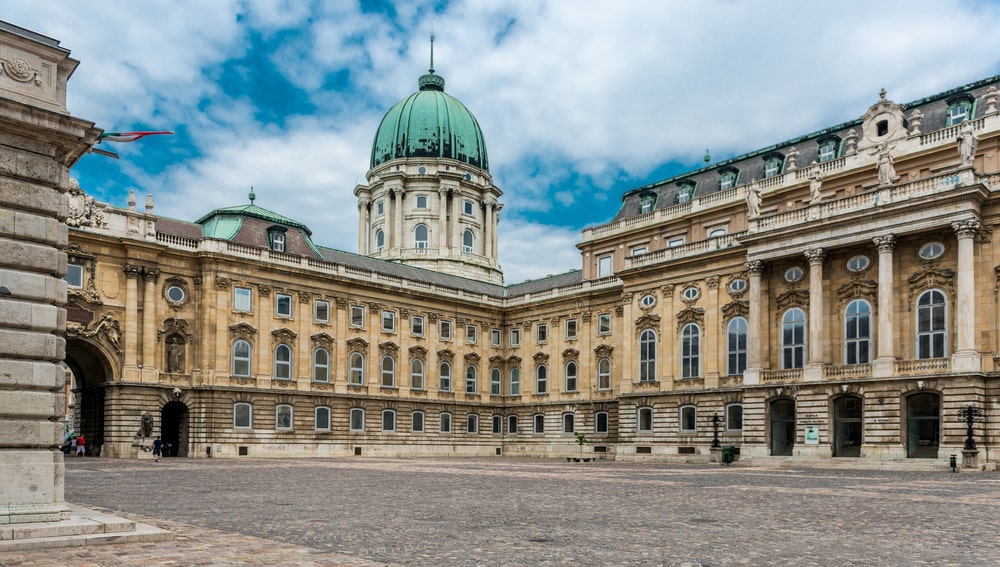
The inner courtyard of Buda Castle (Budavári Palota) featuring its iconic central green dome and surrounding Baroque palace wings.
Buda Castle is a prominent palace complex that crowns Castle Hill and overlooks the Danube River in Budapest. It has been the residence of Hungarian kings for centuries and holds UNESCO World Heritage status, drawing visitors from around the world.
Here’s what you need to know before visiting:
- King Béla IV founded Buda Castle between 1247 and 1265. It morphed into a Gothic palace, then a Renaissance masterpiece under Matthias Corvinus, and finally a Baroque residence by 1769. World War II damage led to its most recent rebuild between the 1950s and 1970s.
- The castle sits within Budapest’s UNESCO World Heritage site. It was inscribed in 1987 and covers the Danube’s banks, the Castle Quarter, and, since 2002, Andrássy Avenue.
- Inside the Royal Palace, you can visit the Hungarian National Gallery, the Budapest History Museum, and St. Stephen’s Hall. The courtyards and terraces are open for public visitation, but you’ll need to buy tickets to the museums separately.
- Museums are open Monday to Sunday, from 10 a.m.to 6 p.m. during summer hours. You’ll want to allow one to two hours without accounting for the museums.
Why Buda Castle Is Worth Visiting

A close-up view of the majestic green dome of Buda Castle (Budavári Palota) framed by vibrant golden autumn leaves.
Buda Castle offers breathtaking views over the Danube and Budapest’s skyline. It holds deep royal and wartime history, and it’s a jaw-dropping architectural marvel. Basically, if you like anything cultural, it’s worth a visit.
While Buda Castle is the only actual castle on the hill, you’ll see plenty of other fortress-like buildings in Budapest Castle District—all well worth taking a moment to admire. As you’re taking it all in, here’s what you can discover:
Extensive Royal History
Buda Castle was established in the 13th century as a medieval fortress, reaching its cultural peak as a Renaissance palace under King Matthias Corvinus. After centuries of destruction in Ottoman and Habsburg wars, it was remodeled into a massive Baroque royal complex by 1769, before being converted into a modern cultural hub after World War II and, in 1987, becoming part of Budapest’s UNESCO World Heritage site.
A Variety of Museums

History Museum in Buda Castle Royal Palace and Hungarian National Gallery.
Trace regional history back almost 2,000 years to Roman times at the Budapest History Museum (Castle Museum), located in Building E of Buda Castle. Pore over the largest collection of Hungarian fine art at the Hungarian National Gallery, or explore the nearby National Széchényi Library and the Museum of Military History, also in the Castle District.
Panoramic Vistas
Catch a fairytale overlook of the Danube River and the Hungarian Parliament Building at the nearby Fisherman’s Bastion, or at the Castle Garden Bazaar at the base of Castle Hill, featuring neo-Renaissance gardens and upward perspectives of Buda Castle’s grandeur.
Proximity to Other Castle District Attractions
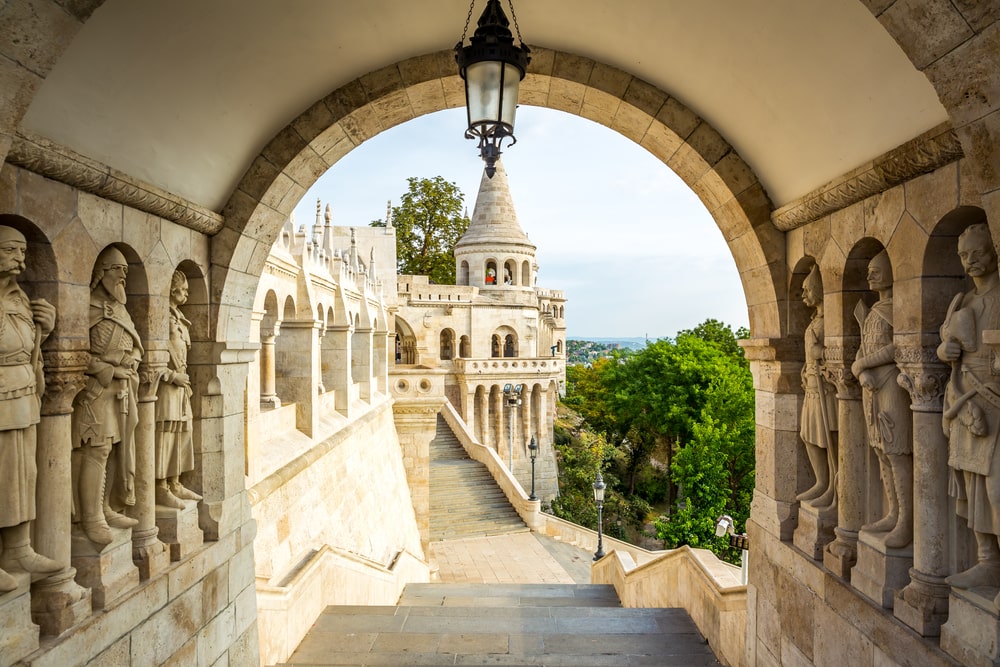
Stone archway lined with statues leading to the Neo-Romanesque towers and staircases of Fisherman’s Bastion.
From Buda Castle, reach the Fisherman’s Bastion in a 10- to 15-minute walk through the Castle District’s cobblestone roads, or take a quick 10-minute walk to the Matthias Church.
History of Buda Castle
Buda Castle’s interwoven history begins between 1247 and 1265, when King Béla IV constructed the first stone fortresses to protect the area from Mongol attacks. The original Gothic palace was erected in the 14th century and expanded into a larger Gothic complex between 1410 and 1430.
Nearing the end of the 15th century, King Matthias Corvinus remodeled the palace in Renaissance style, which was later destroyed during the Ottoman wars and the 1686 siege. Work on a Baroque palace began in 1715 and was expanded under Queen Maria Theresa between 1749 and 1769, with further expansion in the late 19th and early 20th centuries.
Following extensive damage during World War II, the palace was reconstructed in a simple Baroque style in the era of Hungary’s communist rule.
Highlights at Buda Castle, Budapest
You’ll find no shortage of history, viewpoints, and things to do as you explore Buda Castle along your Budapest river cruise. Below are a few ideas to add to your list:
- Hungarian National Gallery: Explore Hungary’s largest fine art collection, including pieces by Mihály Munkácsy and Pál Szinyei Merse. You’ll also find international works from the likes of Monet, Cézanne, and Renoir.
- Budapest History Museum: Learn about the enduring history of Buda Castle and the Castle Hill district.
- St. Stephen’s Hall: See Hungarian applied arts as they’ve been painstakingly recreated to the umpteenth detail following WWII destruction, using original plans, photos, and artifacts.
- Courtyards and terraces: Stroll through the outer confines of Buda Castle and enjoy the walkways, Danube River views, and exterior facades. This is a great option if you’re short on time.
- Matthias Church: A 10-minute walk away from the palace, you’ll find Matthias Church, featuring a striking tiled roof, a soaring spire, and extensively painted interiors.
- Fisherman’s Bastion: Save your camera battery for the beautiful turrets at Fisherman’s Bastion and panoramic views of the Danube, a 10- to 15-minute walk from the castle.
- Nearby viewpoints: Within walking distance of the cruise port is Chain Bridge, well worth a picture by day or night. The best view of the Parliament Building is from Fisherman’s Bastion, or you could look east from Castle Hill’s terraces for the Pest skyline.
If you have a day to spare in Budapest, the Royal Palace of Gödöllő is also well worth a visit to explore restored 19th-century Hungary and portraits detailing the Habsburg and Grassalkovich periods.
How To Visit Buda Castle
To get to Buda Castle from the Danube River cruise port, you can take a taxi, use the funicular, or cross the river and walk up the hill. Here’s how each one works:
While the grounds of Buda Castle remain accessible to the public 24/7, the Budapest History Museum opens daily and the Hungarian National Gallery opens Tuesday through Sunday, both from 10 a.m. to 6 p.m. In winter, the doors usually close at 4 p.m. If you’re short on time, walking the grounds and seeing a few nearby sights generally takes one to two hours—but if you plan to visit the museums, leave an extra couple of hours. Entry into St. Stephen’s Hall, the Hungarian National Gallery, and the Budapest History Museum costs in the range of 3,800 Ft to 5,800 Ft each. Buy your tickets online in advance or on-site at Buda Castle in Building C (for the Gallery) and Building E (for the Hall and Museum). Note that the cobblestoned paths can be uneven, so plan for comfortable walking shoes. |
The Best Way To See Buda Castle
Watching Buda Castle’s green dome come into view as you arrive along the Danube River is the picture-perfect introduction to its aesthetic and the centuries of history it holds. It also provides an exquisite cultural contrast to the polished Vienna or the verdant Wachau Valley you may also visit during your cruise.
To get better acquainted, Budapest is an excellent destination to explore more broadly on either side of your sailing. If a dip in the Széchenyi Thermal Baths or a visit to the awe-inspiring Dohány Street Synagogue is on your radar, arranging a longer city stay in Budapest can deepen the cultural experience.
With Before and After Stays by Celebrity River Cruises℠, you can extend your vacation with premium or ultra-premium hotel accommodations in the heart of the city. Explore Budapest with the help of a Destination Insider℠ and Local Storyteller℠ who can take you where the guidebooks can’t, truly immersing you in the local culture. Grab complimentary breakfast at your hotel each morning, then set out for an included excursion to discover the best of Budapest.
FAQs: Buda Castle in Budapest
What is Buda Castle and why is it important in Budapest?
Buda Castle is the royal palace in Budapest, crowning Castle Hill above the Danube. It’s been home to Hungarian kings for centuries, and still presides over the city’s UNESCO-recognized skyline.
What is inside Buda Castle today?
Buda Castle houses the Hungarian National Gallery, Budapest History Museum, and the National Széchényi Library. The courtyards are free to wander, while each museum charges separate admission.
Is Buda Castle worth visiting on a Budapest river cruise stop?
Absolutely. Castle Hill’s Danube views, the courtyards, and cobblestoned alleyways fit comfortably into a port day. If you’re short on time, skip the museums and take in the labyrinth of Buda Castle, Budapest.
Buda Castle or Fisherman's Bastion: which is better if you only have a few hours?

The fairy-tale Neo-Romanesque towers and open courtyard of Fisherman’s Bastion (Halászbástya) glowing in warm sunlight.
Go for Fisherman’s Bastion (beside Matthias Church) if you’re interested in fairy-tale turrets and Danube views. Or, choose Buda Castle if you’re craving fine arts and Hungarian history.
Can you combine Buda Castle with a walking tour of Castle Hill?
Yes, absolutely. You can stroll the palace courtyards, then wander cobbled lanes to Matthias Church and Fisherman’s Bastion. At a relaxed pace, it takes about half a day.
Visit Buda Castle on a Danube River Cruise
Buda Castle holds significant European history, and its city claims the title of a UNESCO World Heritage skyline—both compelling reasons to visit. Yet, the main draw for many travelers is being whisked into a hilltop fairytale setting in the flesh, where a sense of human and cultural endurance has been built and rebuilt, one stone at a time.
Explore cruises to Budapest and wander the grounds of Buda Castle to experience it for yourself.