Set along the Danube River in northern Serbia, Novi Sad is the capital of Vojvodina and one of the country’s largest cities. Travelers come for Petrovaradin Fortress, its compact historic center, café-lined streets, cultural landmarks, and a pace that feels distinctly relaxed beside the river.
For those exploring the Lower Danube, Novi Sad offers something different from the region’s larger capitals. You can take in centuries of history from a hilltop fortress, explore the Old Town on foot, and still have time to slow down and enjoy the city’s parks and riverfront.
Novi Sad Blends Culture With a Relaxed Danube Setting
Novi Sad has long been an important cultural center in Serbia. Its nickname, the “Serbian Athens,” reflects its history as a hub of Serbian cultural and intellectual life, a legacy you can still see in institutions such as Matica Srpska.
The city’s setting is just as important to its character. The Danube separates the historic center from Petrovaradin Fortress, while pedestrian streets, parks, squares, and cafés make central Novi Sad easy to explore at a leisurely pace.
Some of the top sights in Novi Sad include:
- Petrovaradin Fortress: The city’s signature landmark, with centuries of history and sweeping views over the Danube
- Liberty Square and Old Town: The heart of the historic center, surrounded by architecture, cafés, and pedestrian streets
- Danube Park: A peaceful green space close to the city center
- Štrand Beach: A popular riverside spot that comes alive during the warmer months
- Sremski Karlovci: A nearby historic town worth considering if you have more time in the region
The Danube has shaped cities and communities across Central Europe for centuries. Learning a few Danube River facts before your trip can add useful context to the places you’ll encounter along the way.
Petrovaradin Fortress Defines Novi Sad’s Skyline

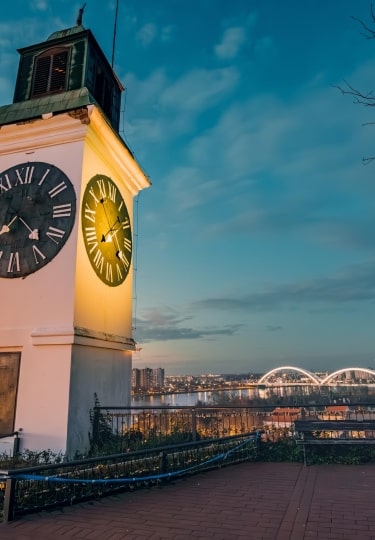
As dusk falls, warm sunbeams illuminate Petrovaradin Fortress perched gracefully above the Danube.
Rising above the Danube on the river’s right bank, Petrovaradin Fortress is the landmark most closely associated with Novi Sad.
The modern fortress was built by the Habsburg Monarchy between 1692 and 1780, following the end of Ottoman rule in the area. Covering roughly 276 acres, the enormous complex was designed as a strategic defensive stronghold and became one of the most important fortifications in the Habsburg Empire.
Today, exploring Petrovaradin Fortress is less about military strategy and more about experiencing its remarkable scale and setting.
The Upper Fortress is home to the famous Clock Tower, whose hands are reversed: the larger hand indicates the hour and the smaller hand the minutes. The unusual design reportedly made it easier for people on the Danube to read the hour from a distance.
From the terraces surrounding the tower, you can look across the river toward the rooftops of Novi Sad and the plains of Vojvodina beyond. It’s one of the best places to appreciate how closely the city and river are connected.
Below ground is another side of the fortress. Petrovaradin contains approximately 10 miles of underground military galleries arranged across multiple levels. Sections can be explored on guided tours, offering a closer look at the fortress’s defensive design.
Elsewhere within the complex, former military spaces have taken on new roles. The fortress now houses the City Museum of Novi Sad as well as galleries, studios, restaurants, and other cultural spaces. It is also known internationally as the setting for the EXIT Festival, one of the city’s major cultural events.
If your time in Novi Sad is limited, make Petrovaradin Fortress a priority. Its combination of history, architecture, and Danube views makes it an ideal introduction to the city and a memorable stop among the many Danube River cities.
Novi Sad’s Historic Center Is Made for Exploring on Foot

Historic architecture and a soaring spire define Novi Sad’s vibrant central square.
Across the Danube from the fortress, Novi Sad’s historic center offers a very different experience.
Liberty Square is a natural place to begin. The broad central square is framed by two of the city’s most recognizable buildings: the neo-Renaissance City Hall and the Name of Mary Church, with its tall Gothic Revival tower.
A statue of Svetozar Miletić, an influential 19th-century Serbian political figure, stands at the center of the square.
From here, continue along Zmaj Jovina Street, one of Novi Sad’s main pedestrian thoroughfares. Named for Serbian poet Jovan Jovanović Zmaj, the street leads past cafés, shops, and historic façades toward the Bishop’s Palace and Dunavska Street.
Dunavska Street provides another easy route through the Old Town, connecting the central streets with Dunavski Park, or Danube Park. With mature trees, walking paths, and a small lake, the park offers a quieter counterpoint to the surrounding streets.
Novi Sad’s architecture reflects the city’s Central European history and centuries of cultural exchange. Baroque, neoclassical, and later Austro-Hungarian architecture sit alongside Serbian cultural landmarks, creating a cityscape that reveals several layers of the city’s past.
Culture remains central to Novi Sad today. Depending on your interests and available time, you might visit the Gallery of Matica Srpska, explore the city’s museum collections, or see the Serbian National Theatre.
The advantage of the center is its scale. Many of these sights are relatively close together, so you can experience several sides of Novi Sad without spending your visit moving from one distant attraction to another.
This combination of history, culture, and riverfront scenery is just one of the many reasons why the city is among Celebrity’s top river cruise destinations.
Novi Sad Offers a Different Side of Serbia From Belgrade
Novi Sad and Belgrade are separated by a relatively short distance, but they offer travelers noticeably different experiences.
Belgrade is Serbia’s capital and largest city, with a faster pace and a much larger urban footprint. Novi Sad is smaller, with many of its best-known attractions concentrated around a compact historic center and Petrovaradin Fortress.
That difference makes the two cities complementary rather than interchangeable.
In Belgrade, travelers can experience the energy and scale of the national capital. In Novi Sad, the appeal lies in slowing down: walking through café-lined streets and public squares, enjoying views across the Danube, and exploring a fortress that feels inseparable from the city around it.
For travelers drawn to historic architecture, walkable centers, museums, café culture, and river views, Novi Sad adds another perspective on Serbian culture.
If you’re spending additional time in Serbia, both cities can fit naturally into a broader trip. Find more inspiration with these things to do on the Danube River before or after your cruise.
Novi Sad Fits Naturally Into a Lower Danube Journey

A striking bridge crosses the gentle waters of the Danube, guiding the eye toward Novi Sad’s picturesque skyline.
Novi Sad’s position on the Danube makes the river more than scenery. It has shaped the city’s development, defenses, commerce, and cultural identity.
That becomes particularly clear at Petrovaradin Fortress. From its elevated position, you can see the river cutting between the fortress and the city center, much as it has for centuries.
Novi Sad also adds variety to a Lower Danube itinerary. Rather than another large European capital, it offers a smaller city where major landmarks, historic streets, cultural attractions, and the waterfront can be experienced within a relatively compact area.
The surrounding region offers even more possibilities. Travelers with additional time can venture toward Sremski Karlovci, known for its historic center, or explore the landscapes around Fruška Gora. Sremska Kamenica, across the river from central Novi Sad, is another part of the broader metropolitan area.
Danube River cruises offer opportunities to experience destinations along this storied waterway, while Celebrity River Cruises℠ explores other cities and landscapes across Europe’s rivers.
A Few Practical Tips Make Novi Sad Easy to Explore

Weathered stone steps ascend alongside ivy-draped fortress walls toward Petrovaradin’s famed clock tower.
A little planning can help you make the most of your time in Novi Sad.
- Location: Novi Sad is in northern Serbia, in the autonomous province of Vojvodina, along the Danube River
- Prioritize the highlights: If your visit is short, focus on Petrovaradin Fortress and the historic center
- Explore on foot: Central sights around Liberty Square, Zmaj Jovina Street, Dunavska Street, and Danube Park are well suited to walking
- Currency: Serbia uses the Serbian dinar
- Consider the season: Štrand Beach and other outdoor riverside experiences are especially appealing during warmer months
- Have more time: Sremski Karlovci and Fruška Gora offer opportunities to see more of the surrounding region
If you’d like to add time to your vacation, learn more about planning Before and After Stays around a river cruise. With these packages, you can extend your journey on select itineraries, staying in the heart of cities like Prague, Budapest, Amsterdam, or Lausanne. Each package includes hotel accommodations in a central location, daily breakfast, and daily shore excursions led by locals.
Novi Sad FAQs
What is Novi Sad, Serbia, known for?
Novi Sad is particularly known for Petrovaradin Fortress, its historic center, cultural institutions, and setting along the Danube. Its long-standing role in Serbian cultural life also earned it the nickname “Serbian Athens.”
Is Novi Sad worth visiting on a Danube trip?
Novi Sad offers a rewarding combination of history, architecture, culture, and river views. Petrovaradin Fortress is the city’s signature attraction, while its compact Old Town makes it possible to experience several major sights during a shorter visit.
Its smaller scale and relaxed atmosphere also provide a contrast to larger cities elsewhere along the Danube.
How is Novi Sad different from Belgrade?
Belgrade, Serbia’s capital, is larger and more energetic, while Novi Sad is smaller and generally easier to explore on foot. Novi Sad is especially known for Petrovaradin Fortress, its compact historic center, and its cultural identity as the capital of Vojvodina.
Visiting both offers two different perspectives on Serbia rather than two versions of the same experience.
How much time do you need to see Novi Sad?

A visitor takes in sweeping vistas of Petrovaradin Fortress across the Danube.
A shorter visit can focus on Petrovaradin Fortress and the historic center, including Liberty Square and the surrounding pedestrian streets. With more time, you can add museums, Danube Park, the riverfront, seasonal attractions, or a trip beyond the city to Sremski Karlovci or Fruška Gora.
Explore the Danube With Celebrity River Cruises
Novi Sad brings together some of the experiences that make the Danube so compelling: a fortress overlooking the river, centuries of history, a lively cultural identity, and a city center that invites you to explore at your own pace.
Experience Novi Sad as part of a broader journey through Serbia and the Lower Danube with Celebrity River Cruises.
Explore river cruises to Belgrade and discover where the Danube can take you next.