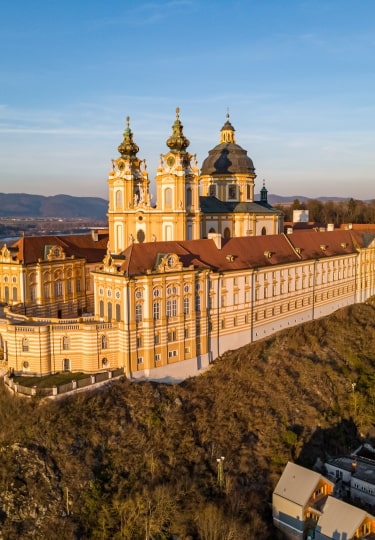
Melk Abbey is one of the world’s most famous and stunning Benedictine monasteries. Located in the town of Melk, Austria, it is a highlight of Danube River journeys.
The impressive site dates back to 1089, with a major Baroque reconstruction in the 18th century. It overlooks the river and the scenic Wachau Valley from its perch on a massive rocky cliff. The site is not only steeped in historical significance, but also adorned with breathtaking art pieces and design.
Planning to visit Melk Abbey? Discover its history, highlights, tours, and visitor tips, plus how it fits into a Danube River journey.
Highlights of a Visit to Melk Abbey
This premier example of European High Baroque architecture overlooks the Danube River. Founded in 1089, Melk Abbey remains a working Benedictine monastery today. A monastic school has operated here since the 12th century, adding another layer to the abbey’s long history. As part of the UNESCO-listed Wachau Cultural Landscape, Melk Abbey draws visitors to explore its grounds, artwork, and magnificent Baroque interiors.
The Abbey Library
Abbey in Melk
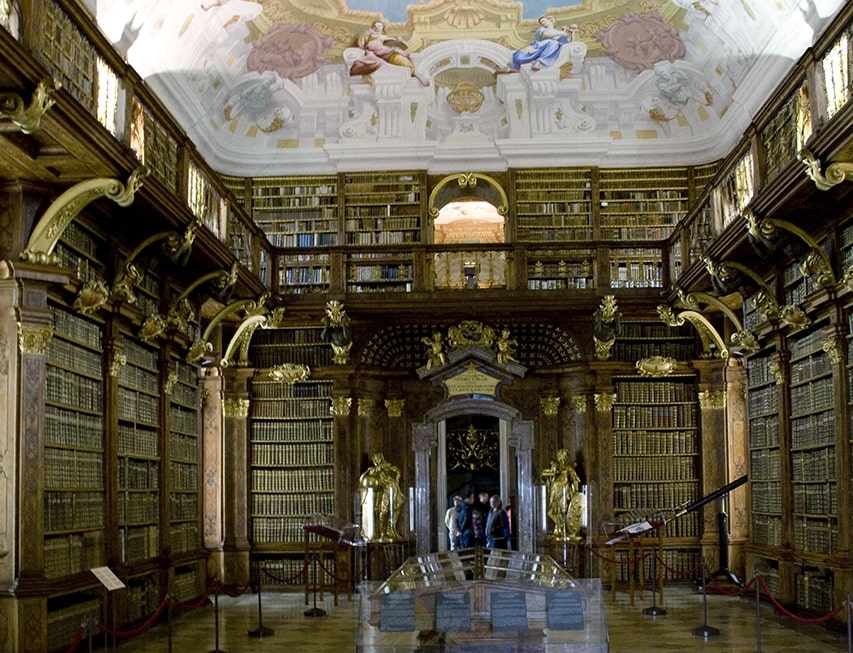
The Melk Abbey Library is home to around 130,000 volumes, including 750 incunabula, or early printed books. Dating from the earliest years of European printing, these rare works represent an important chapter in the development of the printed book.
The library is a work of art in itself, part of the 18th-century Baroque redesign of the abbey by architect Jakob Prandtauer. Its highlights include a breathtaking ceiling fresco by Paul Troger depicting faith and reason, along with gilded dark-wood details throughout the rooms. The library remains open during its current restoration project, though portions may be temporarily affected by the work. A carved wooden spiral staircase connects to additional library rooms below and above.
The Marble Hall
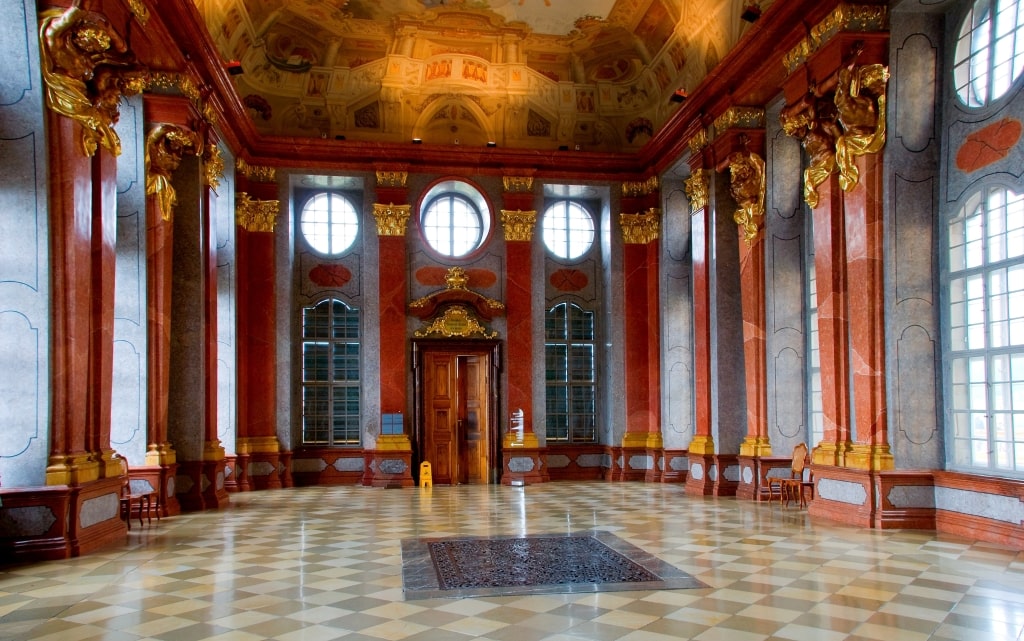
The Marble Hall at Melk Abbey features gold details and majestic red marble columns.
The Marble Hall served as both a festival hall and dining hall for the imperial family and other distinguished guests. Visitors enter beneath marble doorframes inscribed with “Hospites tamquam Christus suscipiantur” (“Guests should be received as Christ would be”) and “Et omnibus congruus honor exhibeatur” (“And to each the honor given which is his due”).
A 1731 ceiling fresco by Paul Troger features Pallas Athena on a chariot drawn by lions as a symbol of wisdom and moderation. Hercules appears nearby, conquering the three-headed hound of hell, night, and sin, while both figures allude to Emperor Charles VI and the ideals associated with his rule. The doorframes are made of genuine marble from Adnet and Salzburg’s Untersberg, while the walls are marble stucco. A balcony connects the Marble Hall and library.
The Abbey Church
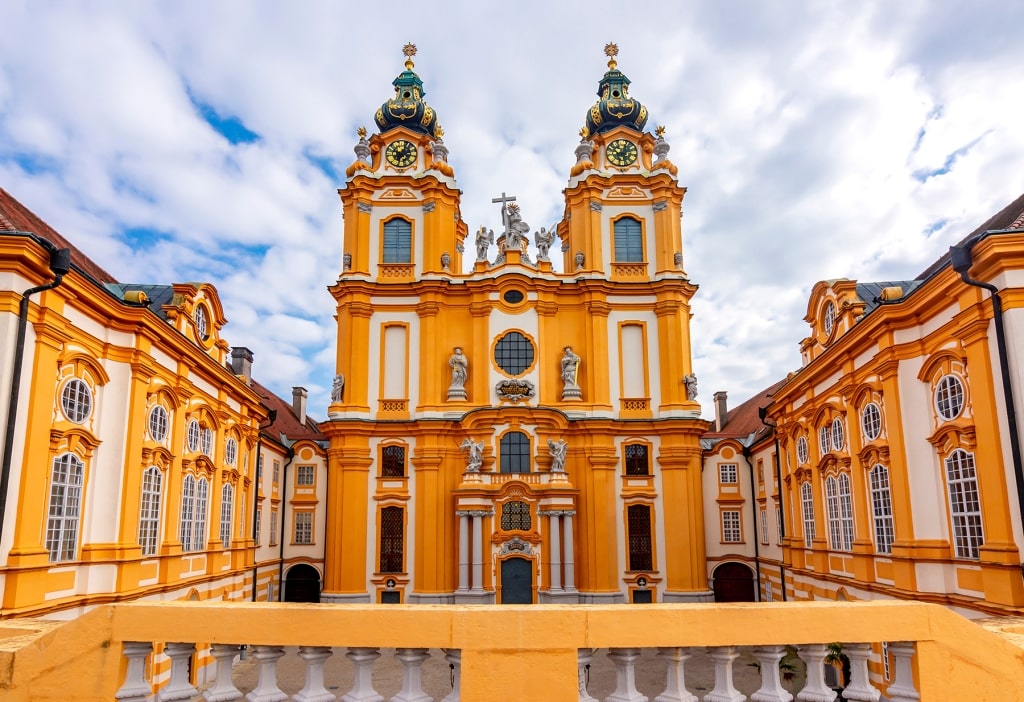
A pair of soaring towers flanks the brilliant ocher-yellow Baroque exterior of the Abbey Church.
The high point of the Baroque monastery is the abbey church, designed to make the religious purpose of the complex and its orientation toward God clearly visible. The left-side altar in the transept contains the mortal remains of St. Coloman in a sarcophagus.
Beginning in 1701, a complete reconstruction of the church took place under architect Jakob Prandtauer. Leading artists and craftsmen contributed to the project, including Giuseppe Galli-Bibiena, Lorenzo Mattielli, Peter Widerin, Johann Michael Rottmayr, Paul Troger, and Antonio Beduzzi. Gold leaf, stucco, and marble create an ornate interior in shades of gray, gold, ocher, orange, and green.
Melk Abbey Park Gardens
Melk Abbey Park is a nearly 300-year-old historic multi-level garden, open April through October. The design of the scenic outdoor space melds formal Baroque notes with romantic English landscape. An 18th-century pavilion on the property is adorned with frescoes by Johann Wenzel Bergl depicting the seasons.
Tree-lined walking trails offer sweeping views of the Danube and valley below. St. Benedict’s Path provides a more contemplative route through the grounds, while the Garden of Paradise draws inspiration from the writings of 9th-century monk Walafrid Strabo. An Oriental Garden features a wooden pavilion, and other landscaped areas and contemporary installations add variety throughout the park.
History and Architecture of Melk Abbey
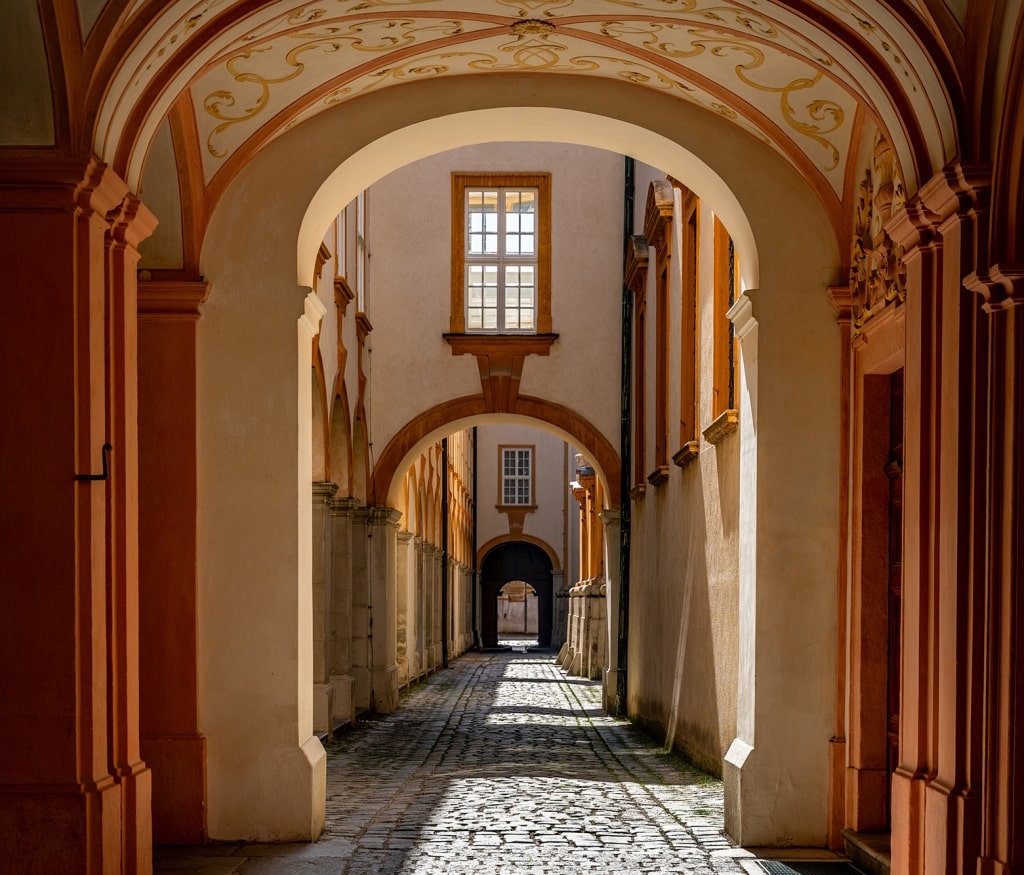
Sunbeams filter through vaulted arches along the historic stone path at Melk Abbey.
The river cities of the Danube are heavy with history, and Melk is no different. Margrave Leopold II of Austria gave his castle to Benedictine monks from Lambach Abbey in 1089, starting the story that still lives on today. Throughout the region’s tumultuous timeline, Melk Abbey managed to ride the wave of religious and political upheaval to survive.
In 1418, the abbey became the starting point for a monastic reform movement across southern Austria and Germany, realigning the monastery’s spiritual goals and practices. The complete Baroque reconstruction, finished in 1736, led into a period when Melk Abbey embraced Enlightenment thought, helping it avoid closure by Emperor Joseph II in the late 18th century.
The building towers over the valley, its ocher-yellow and white exterior accented by soaring towers and the grand copper-and-gold dome of the St. Peter and Paul Abbey Church. Gardens and processional courtyards feature sculptures of saints and an ornate gate with intricate stone accents.
Planning a Visit to the Melk Abbey Region
Melk Abbey is located in Lower Austria, overlooking the banks of the Danube and the town of Melk below. During the holiday season, the town draws visitors to the charming Melk Christmas Market.
Melk’s railway and bus stations are only a few minutes’ walk from the abbey. The route leads through the town center to the abbey’s main entrance. There are regular train connections to Melk from Vienna and St. Pölten. Melk is also located directly on the Danube Cycle Path and is easily reached by bicycle, with bike parking available.
Melk Abbey is just one hour west of Vienna by train or car. This makes the UNESCO World Heritage Site a perfect place to explore during Before and After Stays in Vienna, along with other regional highlights of the Wachau Valley. This 25-mile stretch along the Danube River is known for its terraced vineyards, medieval towns, and Baroque architecture.
Practical Advice for Visiting Melk Abbey
Visiting Melk Abbey is one of the best things to do on the Danube, and a little planning can help make your visit easier.
Guided summer tours are available in Spanish, French, and Italian, with English tours offered year-round. The guided tour takes guests through the former Imperial guest rooms, Marble Hall, the balcony, and the abbey library. Afterward, guests can visit the abbey church, Northern Bastion, and abbey park independently.
Tickets are available at discounted rates for students up to age 27, families, and groups. Visitors can explore the park alone, the full Melk Abbey complex, or choose combination tickets with Schloss Artstetten, Schallaburg, or Stift Göttweig. Tours and admission are generally available from 9 a.m. to 5 p.m., with later closing times during the summer months.
Most of the abbey visit is wheelchair-accessible, including the restaurant. For areas that are not directly accessible without barriers, wheelchair users and guests with limited mobility can receive assistance from abbey staff.
Melk Abbey FAQs
Why is Melk Abbey famous?
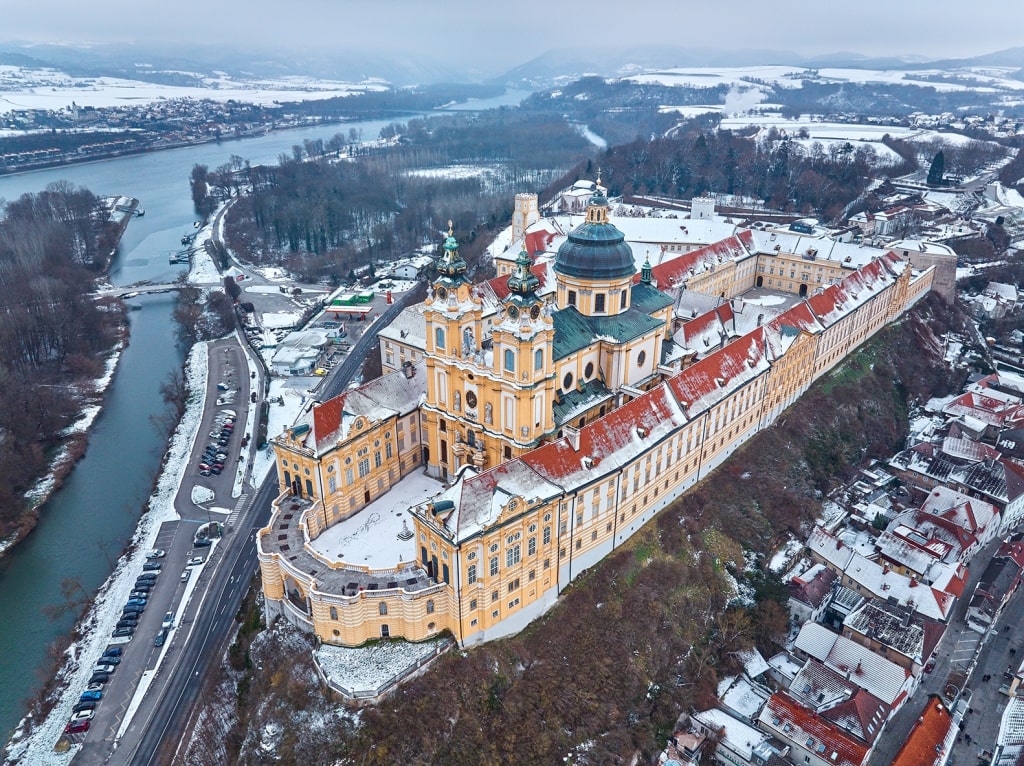
A blanket of winter snow covers the historic town and the towering Benedictine monastery from an aerial perspective.
Melk Abbey is a stunning example of Baroque architecture and an important historic site in the region. Its history dates back to 1089, and it remains home to Austria’s oldest continuously operating school.
What are the top highlights at Melk Abbey?
The top highlights include the library, church, Marble Hall, and the park’s multi-layered gardens.
Can you tour Melk Abbey? How long do you need to visit Melk Abbey?
Yes, you can tour the main areas of Melk Abbey or visit just the park gardens. Plan to spend at least two hours exploring the site.
Is Melk Abbey part of a Danube or Wachau Valley trip? Can it be visited from Vienna?
Melk Abbey sits along the Danube in the Wachau Valley, about one hour west of Vienna by rail or car, making it a convenient day trip from the city.
Is Melk Abbey accessible for travelers with mobility needs?
Yes, most of the complex is accessible, including the restaurant. Abbey staff can assist guests with limited mobility in areas that are not directly barrier-free.
Book Your Visit to Melk Abbey on a Danube River Cruise
Melk Abbey’s rich history spans over nine centuries. This UNESCO World Heritage highlight of a Danube River cruise tour can also be enjoyed during Before and After Stays in Vienna, just one hour to the east. Discover the history, highlights, tours, and visitor tips to explore Melk Abbey, and learn how it can enhance your Danube River journey.
Explore cruises to Melk, Austria with Celebrity River Cruises℠.