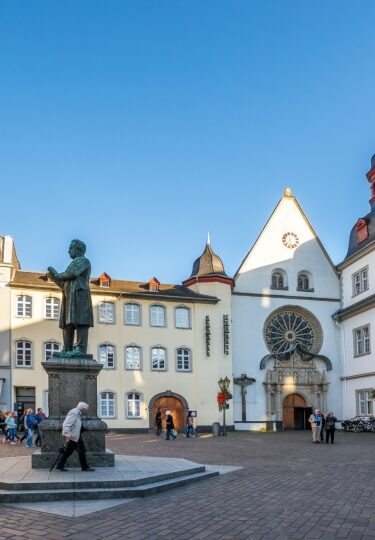
Koblenz lies at the confluence of the Rhine and Moselle rivers in western Germany’s castle-filled Rhineland-Palatinate region. Founded by the Romans, this charming city has been shaped by 2,000 years of history. It’s surrounded by gorgeous vineyards that drape the terraced riverbanks like green garlands, interspersed with famous castles, pretty towns, and villages of the Upper Middle Rhine Valley.
There is plenty to see and do on a visit to Koblenz, including riding the cable car to the city’s hilltop fortress and wandering the cobbled Old Town. As a lesser-known German city, Koblenz is a wonderful surprise to visitors, with excellent museums, cozy cafés, and ancient churches where time stands still.
Why Visit Koblenz?
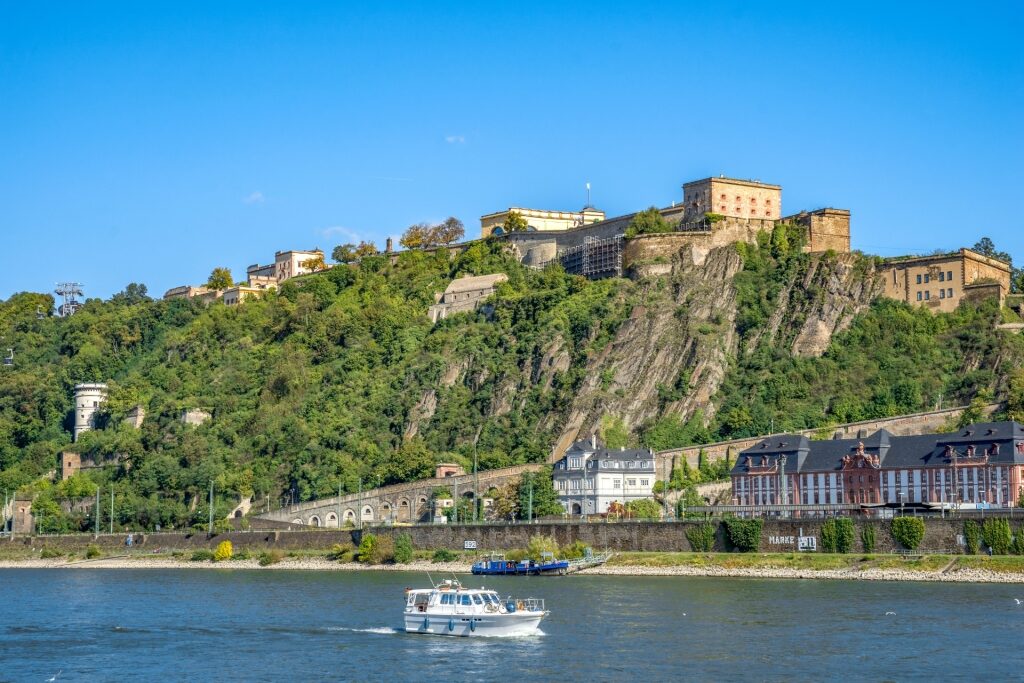
Ehrenbreitstein Fortress
More under-the-radar than Germany’s big-hitting cities, Koblenz is steeped in history and offers plenty of reasons for curious, culture-thirsty travelers to visit.
One of the many great things about Koblenz is its size. It’s compact, and packs plenty into its ancient streets, meaning you can go from a characterful church to a fascinating wine museum before savoring a bite to eat, or imbibing regional ales in a local tavern.
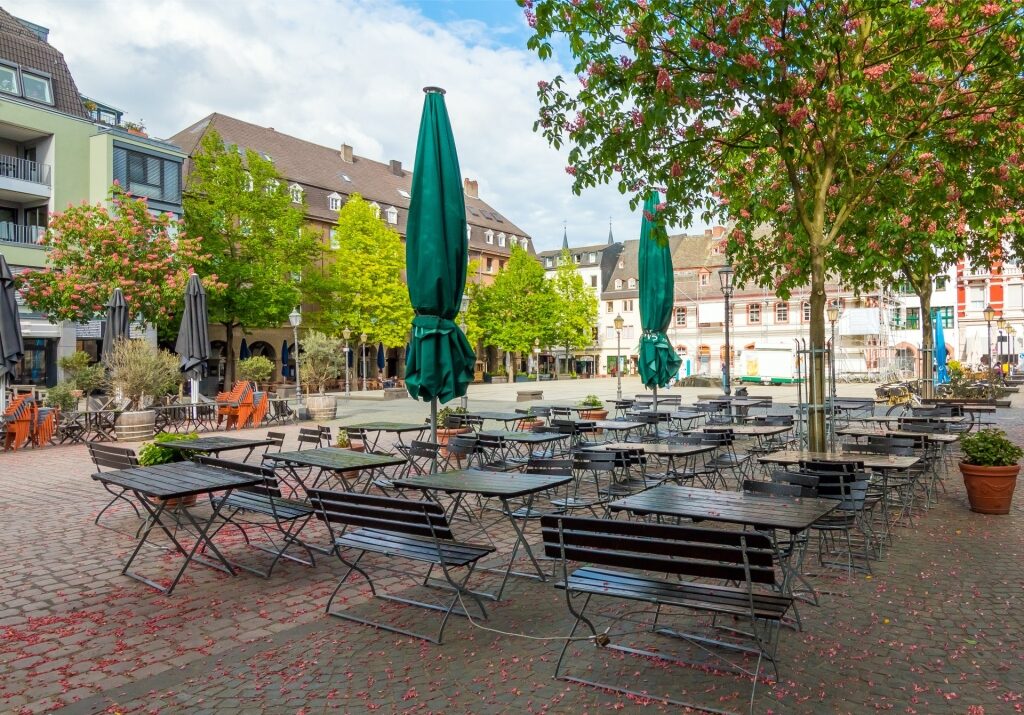
Old Town
Take it easy on a riverside walk, spend time browsing boutiques in the Old Town, or scale Koblenz’s lofty fortress, which looms almost 400 feet above the city at the northernmost point of the UNESCO-listed Upper Middle Rhine Valley.
During winter, soul-warming Christmas markets add to the fairytale feel of Koblenz, with festive ornaments, candies, and mulled wine giving even more reason to visit.
History & Culture
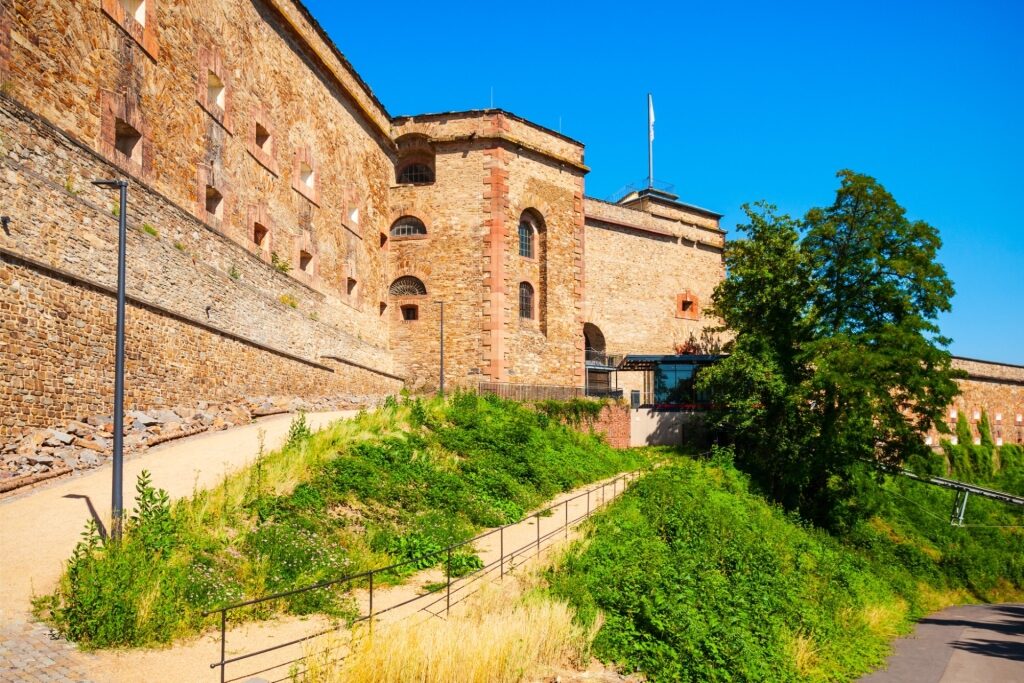
Ehrenbreitstein Fortress
This time capsule city, once part of France, is layered with history. Koblenz was founded by the Romans in 8 B.C. as a military outpost and aptly named Castellum apud Confluentes, meaning Castle at the Confluence. A fortress was built and a settlement created at this strategic spot, at the meeting point of the Rhine and Moselle rivers.
After the Romans came the Medieval period, with Koblenz part of the Frankish Empire—the largest post-Roman kingdom in western Europe—from the 5th to the late 10th century. Koblenz’s oldest preserved church, the Basilica of St. Castor, was built in 836.
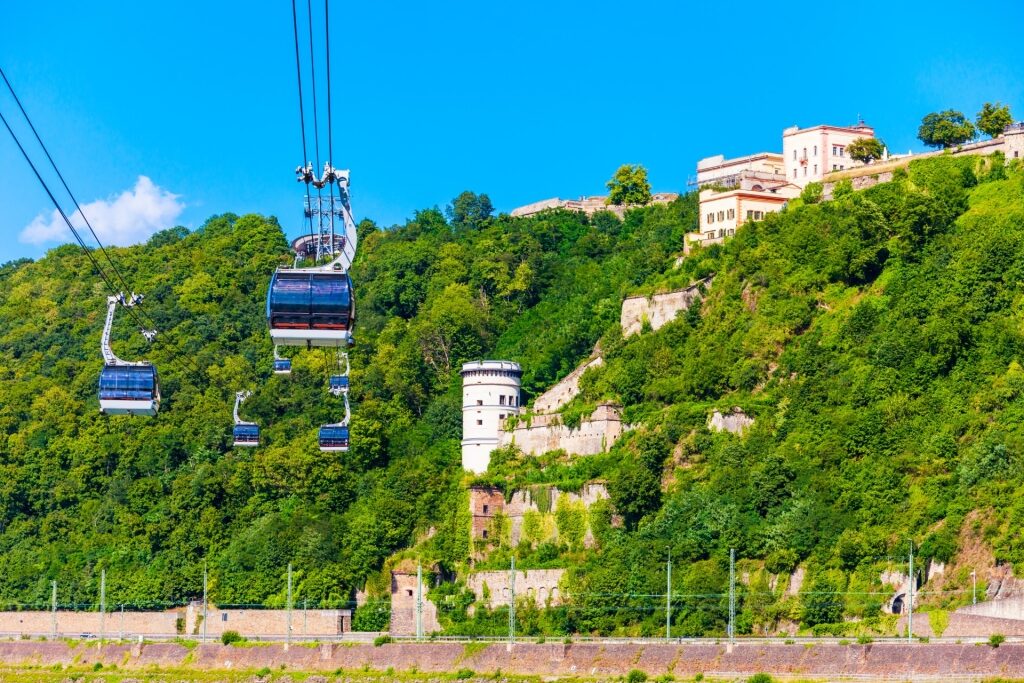
Koblenz Cable Car
Negotiations for the 843 Treaty of Verdun, which saw the partition of the Frankish Empire, took place at the church. Much of the present-day church was built in the 12th century during a period when the Archbishops of Trier fortified Koblenz, with the city becoming a prosperous trading post due to its location on both rivers.
Koblenz was repeatedly occupied during European wars, annexed by France in 1794, and incorporated into the Kingdom of Prussia from 1815, following the French Revolution. It was during this period, in 1828, that the sprawling Ehrenbreitstein Fortress was built, overlooking the Rhine River.
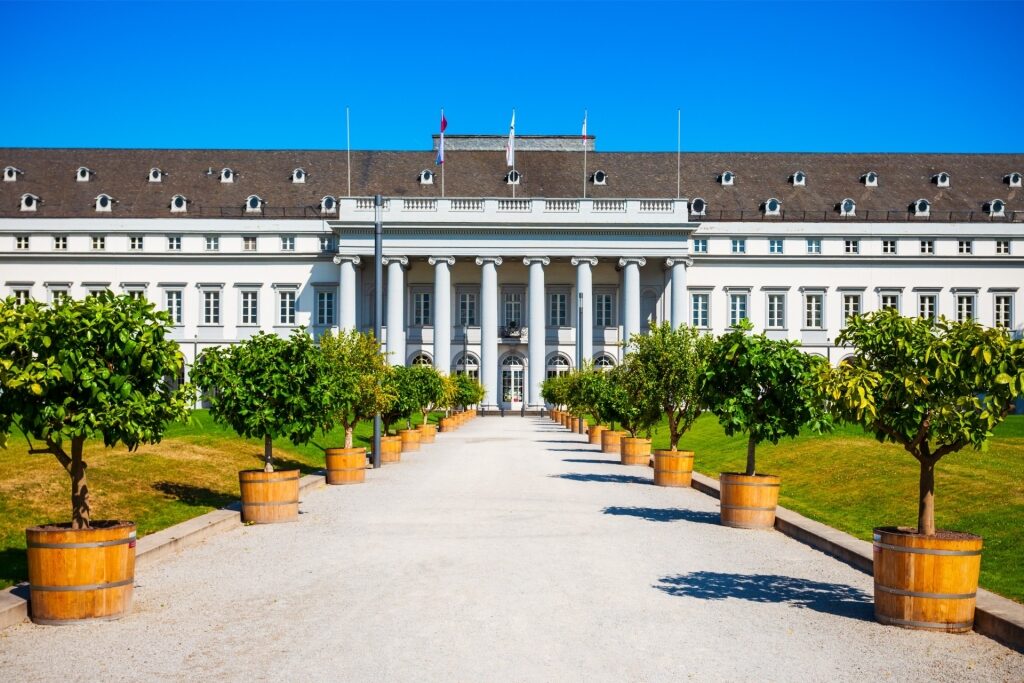
Electoral Palace
Koblenz was heavily damaged during World War II, with historic buildings in the Old Town destroyed and rebuilt following the war. Today, Koblenz is considered the gateway to the UNESCO World Heritage Upper Middle Rhine Valley, a bucolic area of western Germany.
Wildlife & Nature
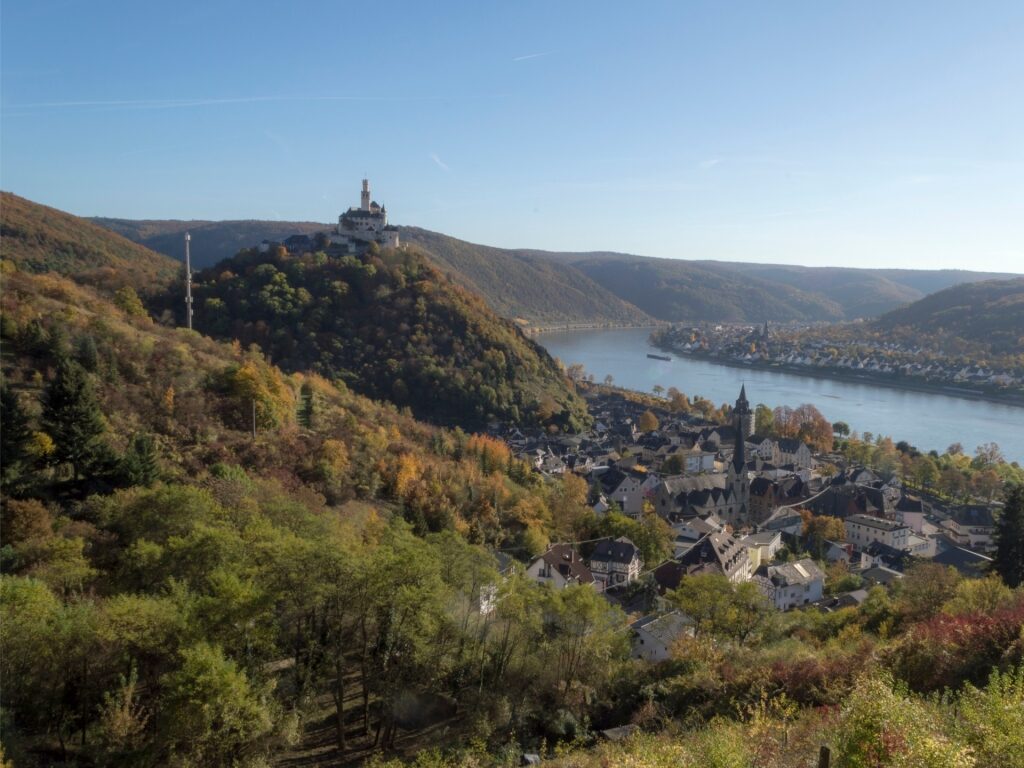
View from Rheinsteig
Given its location beside the Rhine and Moselle rivers and surrounded by leafy vineyards and forests, you don’t have to look far to find wildlife and nature in Koblenz. Just a short walk west from the center of Koblenz, across the Moselle, leads to the local vineyard Schwaab Winery, where vines have been growing at a seemingly impossible gradient since 1890.
Germany’s famous Rheinsteig hiking trail cuts through Koblenz, unfurling almost 200 miles through postcard-perfect forests, meadows, and vineyards. There are 21 stages of the trail, each one clearly marked—just look for the signposts displaying a white R on a blue background. Similarly, the Moselsteig Trail spans the entire German side of the Moselle River, stretching roughly 227 miles, with 24 stages, ending in Koblenz.
Tips for Visiting Koblenz
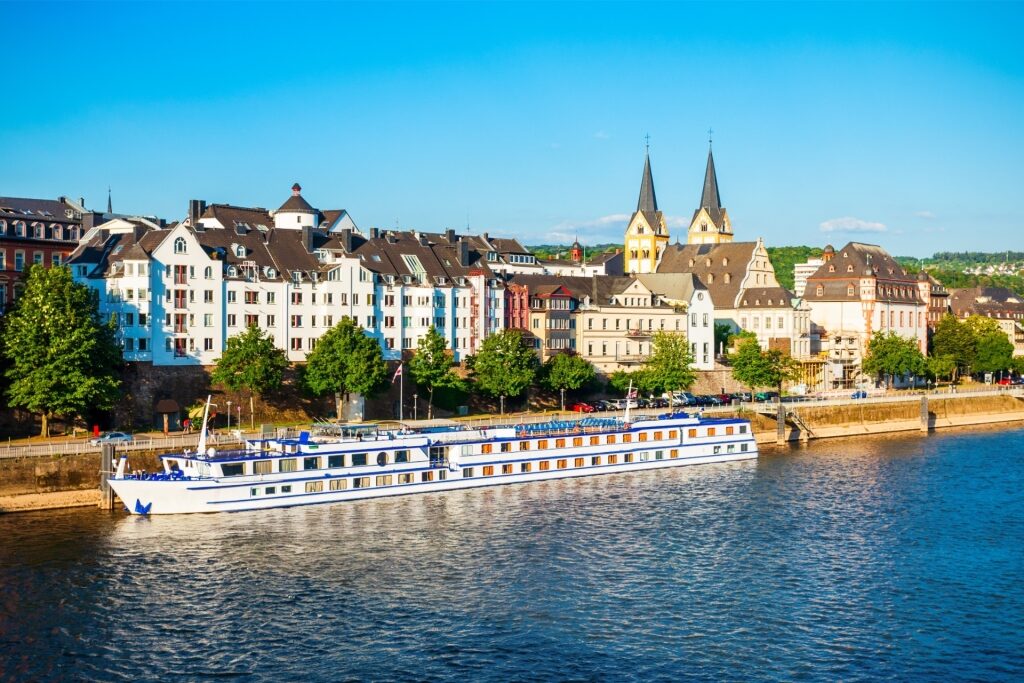
Koblenz
Koblenz is an extremely walkable German city, and comfortable walking shoes are recommended for strolling the cobblestones of the Old Town.
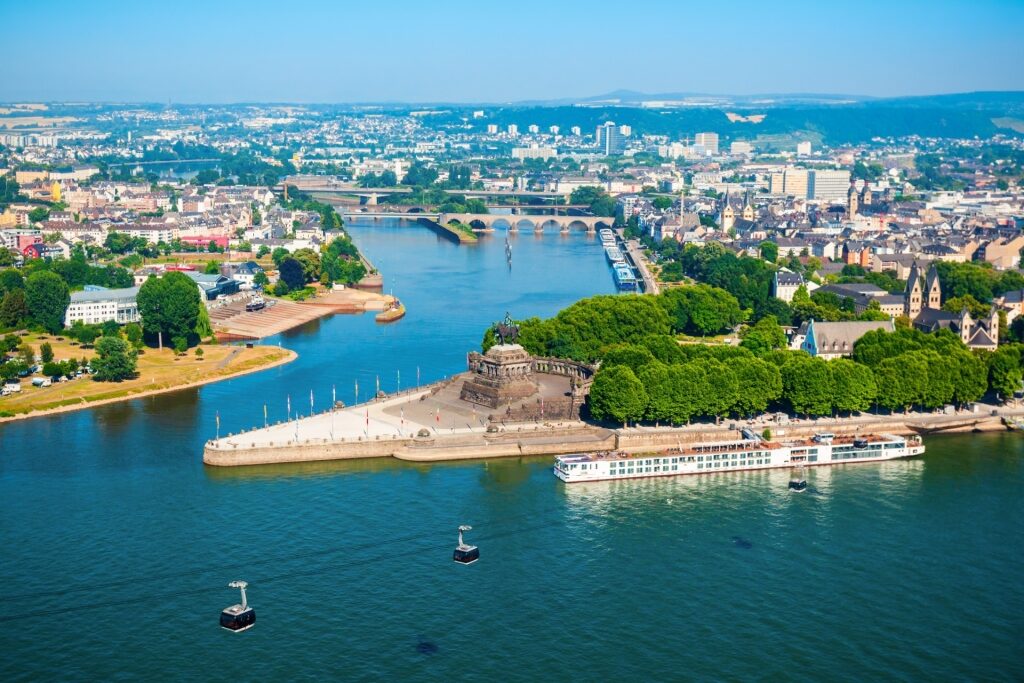
Witness the point where the Moselle and the Rhine meet at Deutsches Eck, or German Corner, by walking the immaculate, two-mile Rhine Promenade. The confluence is marked by the towering monument of Kaiser Wilhelm I, Germany’s first Emperor. The original monument was dismantled by the French military following World War II, leaving only the plinth. In 1993, following Germany’s reunification, a replica of the original statue was erected.
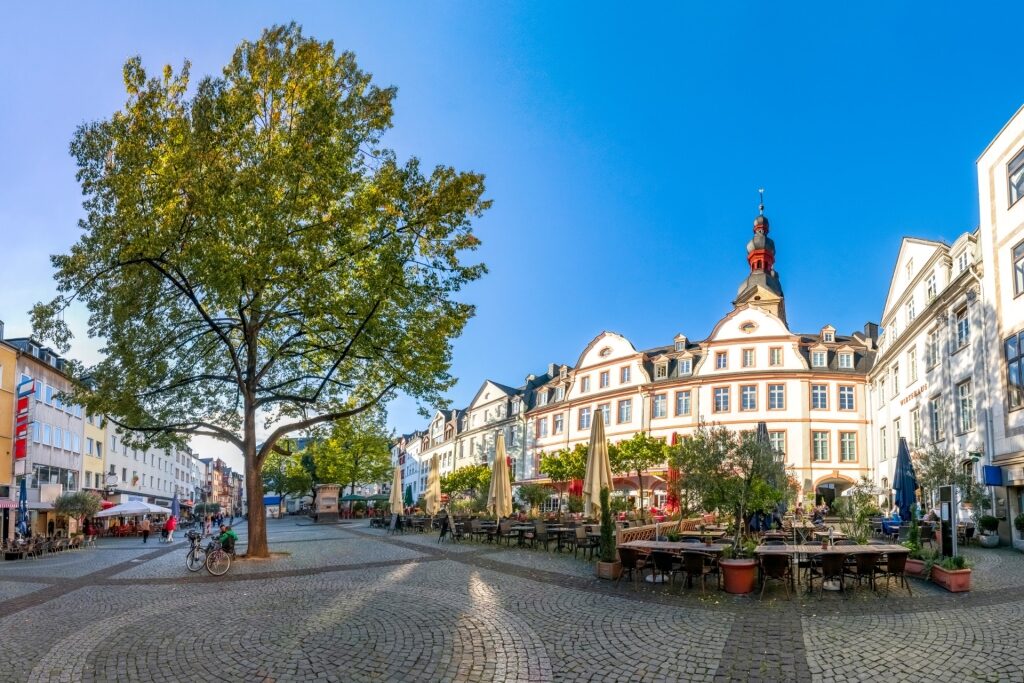
Am Plan
In the Old Town, I recommend walking to the intersection of Am Plan, Löhrstraße, Marktstraße, and Altengraben, where four characterful houses known as the Four Towers are adorned with ornate details.
The buildings were built in the early 17th century and rebuilt later that century following the Palatinate War of Succession. Three of the buildings also required reconstruction following World War II. Fascinatingly, one of the buildings housed a pharmacy from 1730 to the 2000s, while another housed the Koblenz Main Guard until 1848.
Things to Do & Attractions in Koblenz
Ride the Koblenz Cable Car
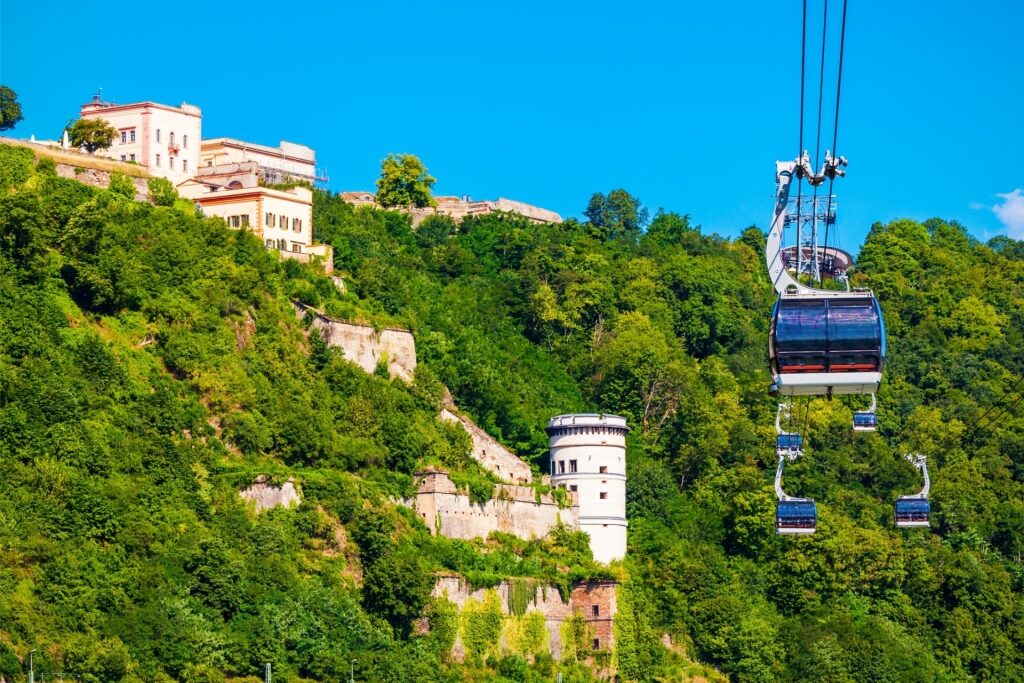
Koblenz Cable Car
You’ll enjoy spectacular views of Koblenz and the winding Moselle and Rhine rivers from the Seilbahn Koblenz, the city’s sky-high cable car.
Seilbahn Koblenz connects the Rhine Promenade near the Basilica of St. Castor with Ehrenbreitstein Fortress on the opposite side, whisking passengers high above the Rhine.
In operation since June 2010, Seilbahn Koblenz was built for the 2011 Federal Garden Show and has remained in operation ever since. It’s the best way to reach Ehrenbreitstein, but also affords spectacular views that stretch across the Rhine Valley.
Visit the Ludwig Museum
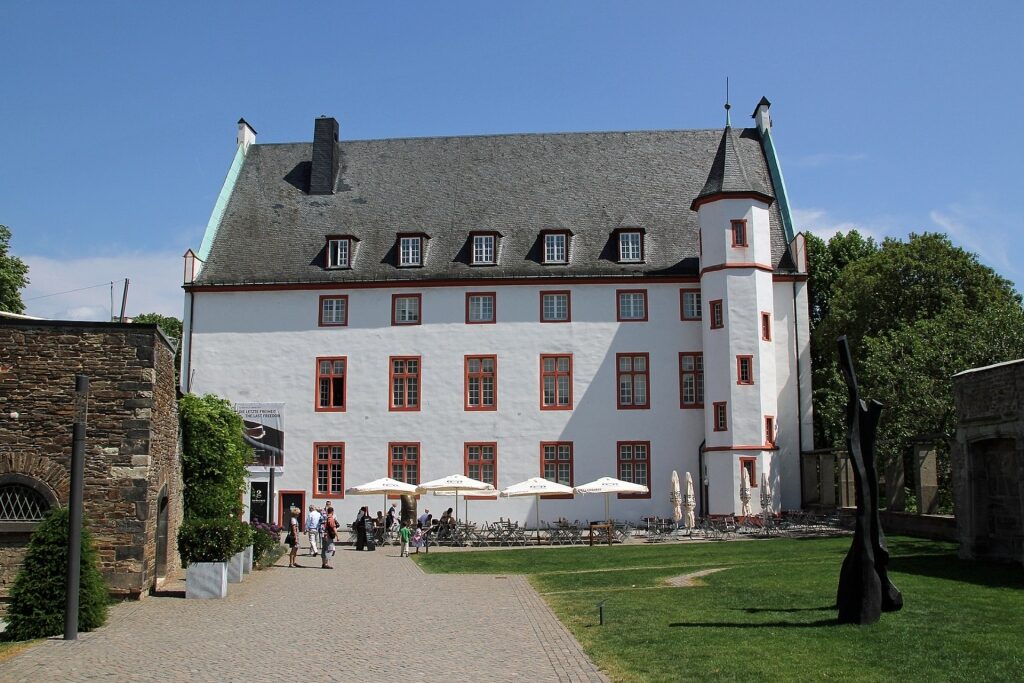
Ludwig Museum Photo by Holger Weinandt on Wikimedia Commons, licensed under CC BY-SA 3.0 DE
Opened in 1992, the Ludwig Museum is Koblenz’s contemporary art museum, home to a 300-strong collection, with a focus on French, American, and German art from 1945.
The four-story collection was amassed by renowned local collectors Peter and Irene Ludwig, including works by Pablo Picasso, Willem de Kooning, Olivier Debré, Hélène Delprat, Andy Warhol, and Karel Appel, among many others.
Outside, the Ludwig Museum features a serene sculpture garden. A star attraction is French sculptor César Baldaccini’s intriguing bronze, Le Pouce, The Thumb, based on a cast of the artist’s own thumb, which makes for a brilliant photo opportunity.
Wander Koblenz Old Town
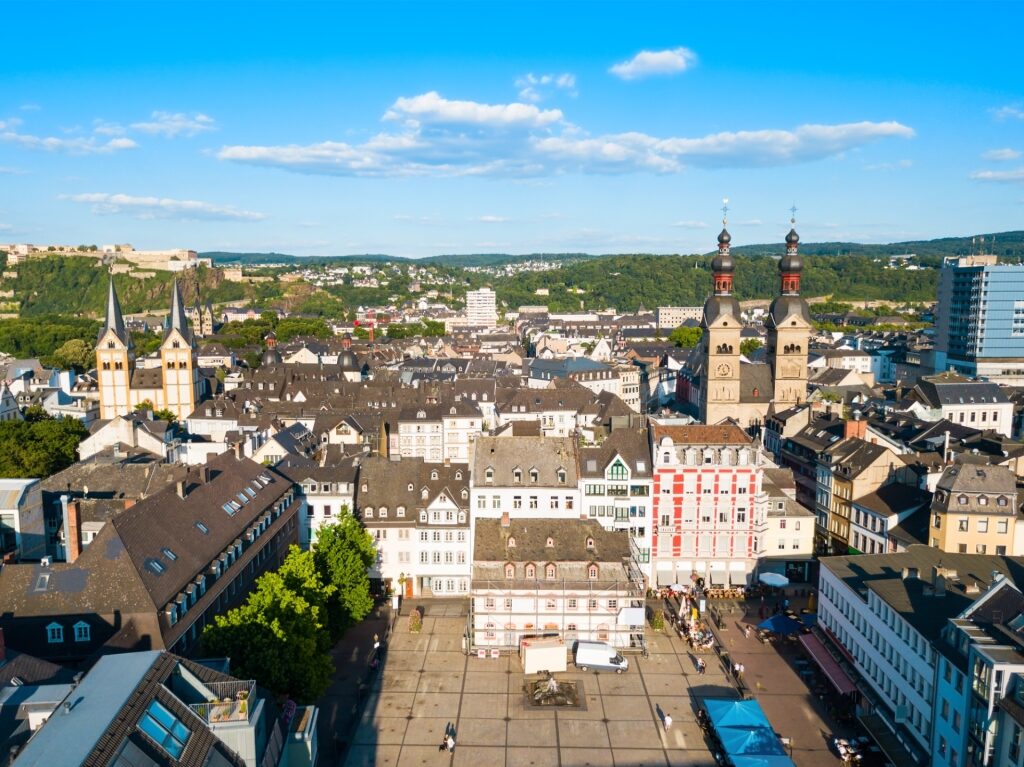
Old Town
Koblenz Old Town contains many of the city’s best parts, including ancient churches, historic statues, and cobblestone squares. First, stop by the imposing Kaiser Wilhelm Monument at the Deutsches Eck and admire the elegant Electoral Palace from the Rhine Promenade, before weaving into the Old Town.
Koblenz Old Town is packed with shops and restaurants, with café-lined squares, including Am Plan, Josef-Görres-Platz, and Jesuitenplatz, offering plenty of opportunities to soak in the local café culture.
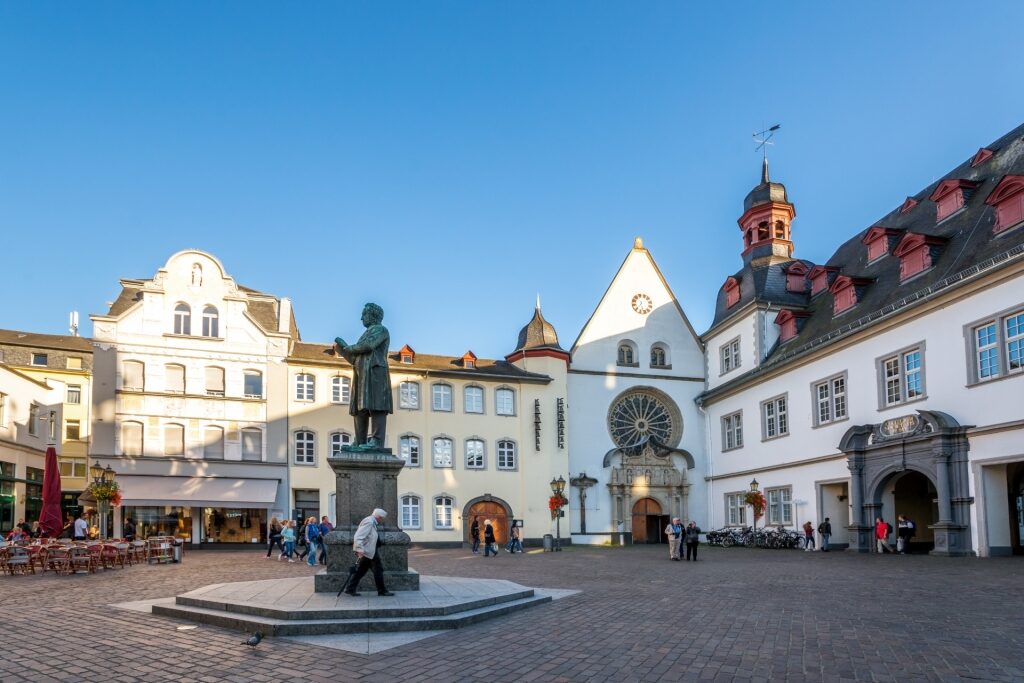
Jesuitenplatz
Look out for the amusing Schängel Fountain as you’re wandering the Old Town. Pointed out to me on my most recent visit, the fountain is located in Willi-Hörter-Platz, by the Town Hall, and depicts a local boy spitting, with the water spouting from his mouth.
My guide explained that the name Schängel refers to the German-French children born during the period of French rule, between 1794 and 1814. A popular name during this time was Jean, though due to the local Koblenz dialect, Jean was often pronounced “Schang,” which over time became “Schängel”—a name still given to native Koblenzers to this day.
Discover Ehrenbreitstein Fortress
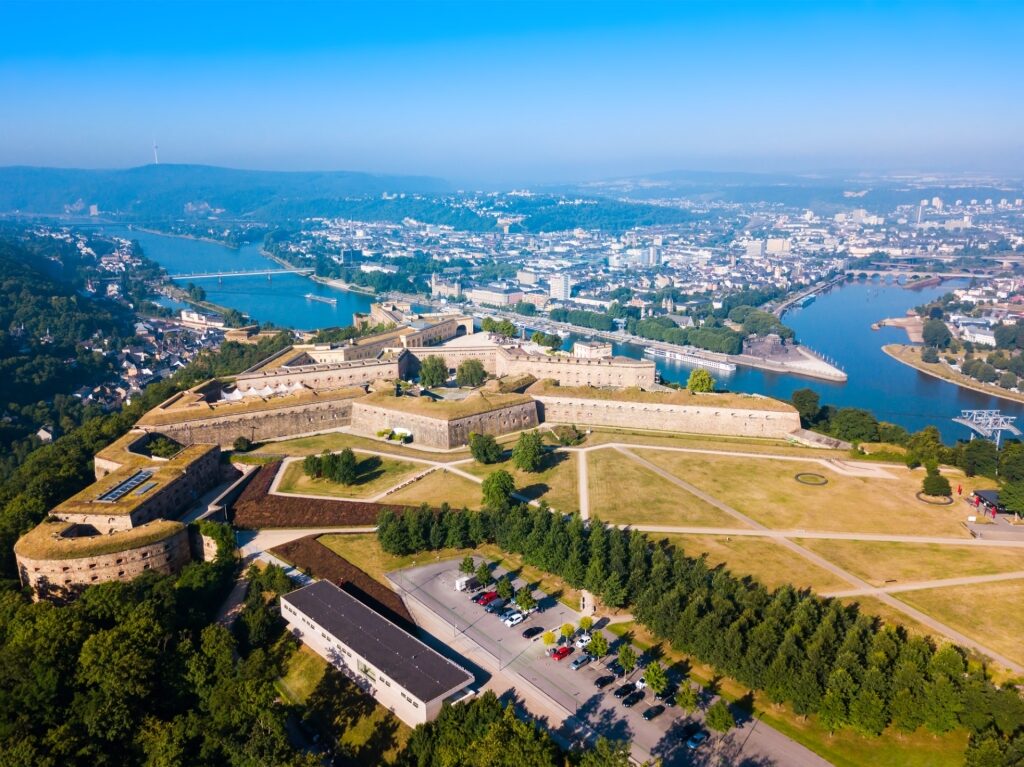
Ehrenbreitstein Fortress
Situated 387 feet above the Rhine, Ehrenbreitstein is among the largest preserved fortresses in Europe and the only surviving 19th-century Prussian fortress. It was built in its current form between 1817 and 1828, but there have been fortresses on this spot since 1000 A.D. Explore the enormous fortress walls, tunnels, and bastions, all designed to withstand military attacks.
Not only does Ehrenbreitstein Fortress offer sublime views, with trails and a viewing platform within the grounds, but it’s one of the best places to learn about Koblenz’s backstory. Join a one-hour guided tour and explore the fortress’s Koblenz State Museum, with its four exhibition rooms covering photography, archaeology, viticulture, and gastronomy.
Explore Historic Churches
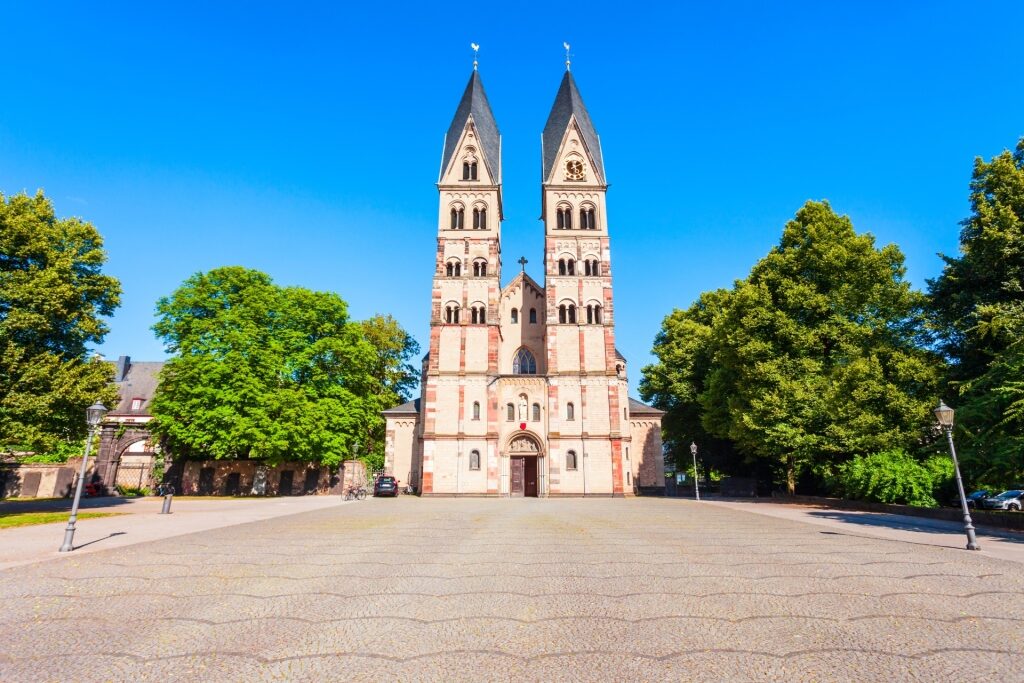
Basilica of St. Castor
Koblenz is home to some wonderful German churches, all located in the city’s Old Town. The oldest preserved and arguably the most famous church is the Basilica of St. Castor, with its Romanesque architecture and beautiful gardens.
Features include a vaulted ceiling, a central nave, two aisles, marble statues, early Baroque oil paintings, and a sandstone pulpit from 1625.
With its onion domes peaking above the city, Liebfrauenkirche, or the Church of Our Lady, is built on the highest point of Koblenz, just steps from the 1100-built Florinskirche, once part of the canons’ monastery of St. Florin. You can tick them all off while exploring Koblenz Old Town on foot.
Food & Drink

Pfälzer saumagen
Koblenz’s food and drink scene is traditional, with plenty of meat-focused regional cuisine and local specialties served at cozy inns and bistros. Look out for the hearty pfälzer saumagen, a sausage-style dish of minced veal, vegetables, and potatoes, fried and sliced, and usually served with sauerkraut and mashed potato. It’s a wonderfully warming German dish to enjoy during fall and winter.
Reibekuchen is another local delicacy, consisting of a crispy potato pancake that’s often served with smoked salmon. Leberknödelsuppe is a liver-dumpling soup, while schnitzels, remoulade, steaks, and a variety of sausages are plentiful, too.

Pork schnitzel
The Einstein Cafe on Firmungstraße serves a sublime pork schnitzel topped with hollandaise sauce. Altes Brauhaus is a lovely brasserie with a dedicated schnitzel menu. Here, this tenderized breaded meat is served with a variety of accompaniments, including a creamy mushroom sauce, with braised onions in beer sauce, and with caramelized onions.
You will find plenty of German wine to sample on a trip to Koblenz. Wine lists will feature Rhine-Moselle varieties, including Riesling and Müller-Thurgau from grapes grown on terraced, riverside vineyards.

Beer
Koblenz and the wider region are also well known for brewing beer, and there’s a lovely beer garden, Königsbacher Biergarten, by the waterfront serving currywurst, bratwurst, pork schnitzels, and local brews, such as the Königsbacher Pils and Benedictine wheat beer.
Best Time to Visit Koblenz
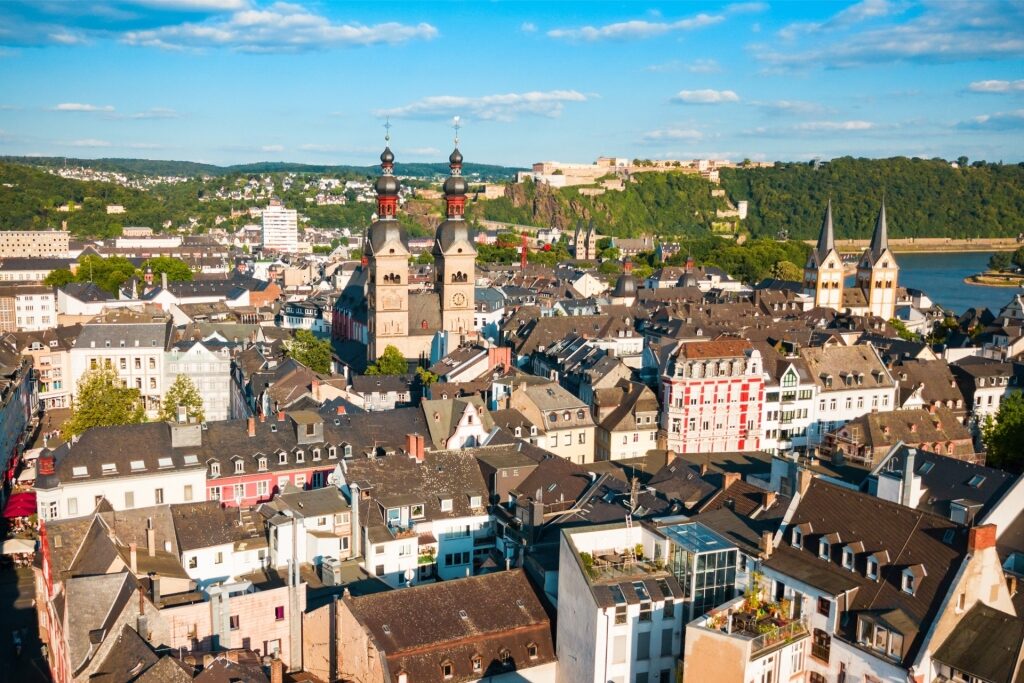
Old Town
Koblenz is a beautiful destination year-round, enjoying mild weather in spring and fall and often, hot summers. One of the best times to visit, though, is during the festive season, thanks to the city’s wonderful Christmas Markets, taking place between late November and early January. During this period, the scent of cinnamon fills the Old Town, which is transformed into a winter wonderland, with mulled wine, bratwurst, twinkly lights, and plenty of sweet treats.
The temperature drops during winter, ranging from 28°F to 40°F in December, so wrap up warm with layers, cozy knits, and a waterproof outer layer. Pack a scarf, a hat, and gloves. It’s also a smart idea to pack sturdy, waterproof walking boots in case of snow or wet weather.
Koblenz
Discover beautiful Koblenz’s culture, history, and shopping on a relaxing river cruise. Browse Celebrity’s river cruises to Koblenz and book your next unforgettable vacation.