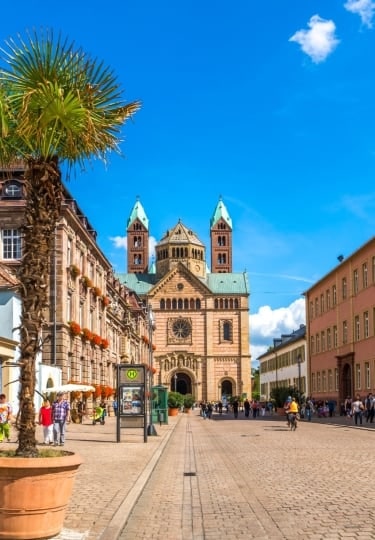
Historic Speyer, Germany, lies on a bend on the west bank of the Rhine in the state of Rhineland-Palatinate, or Rheinland-Pfalz, in southwest Germany. Bucolic scenery stretches as far as the eye can see. This is the heart of Germany’s wine region, and immaculate vineyards cling to steep hills, while leafy parkland follows the curve of the river. Vineyard tours, tastings, and cozy taverns are a highlight of any visit.
What’s startling about Speyer is the punch it packs for a relatively small town. The vast Kaiserdom, the cathedral, more than 1,000 years old, dominates the center. But a few minutes’ walk away, you’ll do a double-take as you spot a Lufthansa Boeing 747 and yes, a Space Shuttle at the fantastic Technik Museum. There are urban beaches, riverside trails, and a vibrant café culture to explore, too.
Why Visit Speyer

Maximilian Street
What’s interesting about Speyer is the fact that it’s so old. A settlement has stood here since Roman times as a trading post on the Rhine. Fortunately, the city survived the WWII bombings remarkably well, so much of what you see here is centuries old.
There are multiple historic buildings to visit in the compact Old Town, from the cathedral to the fascinating Historical Museum of the Palatinate. Speyer also has a rich Jewish history; in the 11th century, this was one of the biggest Jewish communities in what was then the Kingdom of Germany, part of the Holy Roman Empire.
Speyer has a modern vibe, too, with classy shopping along Maximilianstrasse, the main street, and a wide range of restaurants and pubs. In summer, there’s a festival mood here around the second weekend of July, when the whole town turns out for Brezelfest.
This traveling funfair, combined with a food and beer festival, the largest in the Upper Rhine region, celebrates the Brezel, or pretzel. Speyer claims that the salty, twisted bread snack originated here, although other regions of Germany dispute this.
History & Culture

Speyer Cathedral
Speyer is one of Germany’s oldest cities. It may have been founded by the Romans around 10 BC, but archaeologists have found evidence that humans lived here thousands of years before this.
Speyer grew from a Roman military camp to the city of Noviomagus. It fell into disrepair in the 5th century AD, but was rebuilt some 200 years later and named Spira. The city thrived in the Middle Ages as an important center of the Holy Roman Empire, with the magnificent cathedral constructed in 1030 AD. Around this time, Speyer was also one of the most important Jewish communities in the region.
In 1529, the word “Protestant” was coined here as 14 free cities in Germany, as well as six Lutheran princes, rose up against the Edict of Worms—a town in Germany—issued by the Holy Roman Emperor of the time, condemning the theologian Martin Luther as a heretic.
The town was badly damaged by French troops in 1689 and was under French jurisdiction for a while. In 1816, it became the seat of administration for the Bavarian Palatinate until the end of WWII. Speyer celebrated its 2,000th anniversary in 1990.
Wildlife & Nature

Altrhein
Over the millennia, the Rhine has carved its way through the steep hills of Rheinland-Pfalz in large loops, some of which are eventually cut off to become oxbow lakes, here called the Altrhein, or Old Rhine. These former sections of river have formed pristine wetlands very close to Speyer, where bird-lovers will be delighted by the variety of species, from herons and kingfishers to snipe, grebes, and warblers.
In the city itself, Adenauer Park is a leafy oasis of mature trees, ivy, and ferns. A point of interest to some might be the Old Cemetery, a peaceful area of the park where former German Chancellor Dr. Helmut Kohl is buried. It’s an atmospheric place of crooked old gravestones, many of which are overgrown. In contrast, the flowerbeds are immaculately tended, tulips and daffodils providing brilliant color if you visit in spring.
Tips for Visiting Speyer

Speyer Cathedral
Speyer is a small city, and you can walk everywhere. Comfortable shoes are a good idea, as much of the old center has uneven cobblestones.
Although there’s a lot to see, if you manage your time, you can pack in a fair amount and still have time for a glass of wine by the river. Stroll around the Old Town in the morning, for example, and visit the cathedral. Then stop for lunch before making your way to the Technik Museum for a happy afternoon scrambling around old aircraft, vintage cars, and submarines. Finish your day in a riverside wine bar or pub, watching cargo and passenger ships plow up and down the Rhine.

Sonnenbrücke
Germany is very traditional; shops in Speyer close early on Saturdays and are closed all day on Sundays. The town will have a different vibe on weekends; on a Sunday, the pubs and cafés will all be busy, and you can attend a church service if you wish. Locals will be out strolling along the river in fine weather.
If you visit in December, these opening hours don’t apply to the German Christmas markets, which are open every day apart from the 25th and 26th.
Things to Do & Attractions in Speyer
Speyer Cathedral

Speyer Cathedral
The green copper dome, six towers, and red sandstone walls of Speyer’s enormous cathedral, originally built in 1030, dominate the cityscape from miles around. The largest Romanesque cathedral in the world, this German landmark is as extraordinary inside as it is out.
Its full name, translated, is Imperial Cathedral Basilica of the Assumption and St. Stephen, although locals simply call it Kaiserdom. It’s been a UNESCO World Heritage Site since 1981.
If you’re lucky, you may catch an organ recital, but if not, take time to explore. Once you’ve marveled at the sheer dimensions of the interior, head to the altar and down into the crypt. Here, you’ll find the sarcophagi of Roman emperors and kings. Climb the southwest tower, a flight of 304 steps, to reach a dizzying viewing platform with views over the rooftops of the city, the vineyards, and the Rhine.
Technik Museum

Technik Museum Photo by Bahnfrend on Wikimedia Commons, licensed under CC BY-SA 4.0
This spectacular indoor-outdoor museum is a dream for any aviation geek, space enthusiast, or car lover. It’s an enormous collection of air and spacecraft, with a separate section where you can climb inside a 1960s U-boat.
The centerpiece is an old Lufthansa Boeing 747, mounted some 60 feet off the ground. You can go inside and even walk on the wing. Marvel at the giant Antonov An-22, the largest propeller aircraft in the world, and peek inside Buran, a prototype Soviet space shuttle.
There’s also an IMAX cinema here, a collection of military jets, some fine vintage cars, and fire engines.
Historischesmuseum der Pfalz, or Historical Museum of the Palatinate

Historical Museum of the Palatinate
Across from the cathedral, this fascinating museum takes you on a journey through time from prehistory to the Romans and the Protestant Reformation via exhibits and interactive displays.
A section of the museum is dedicated to winegrowing; Germany has the Romans, who brought and planted the first vines, to thank for its thriving viticulture. You’ll see the world’s oldest wine, stored in an amphora more than 1,600 years ago and still in liquid form, as well as a giant wooden wine press from the early 18th century.
Other exhibits include the Goldener Zeremonialhut von Schifferstadt, which is an elaborate piece of headgear from the Bronze Age, an 11th-century bronze crown, and two bronze wheels dating to 800 BC. It’s an eclectic but priceless collection.
Jewish Courtyard, or Judenhof

Jewish Courtyard
Speyer has an important Jewish heritage. In the Medieval era, this was one of Germany’s most important Jewish communities, and evidence of this remains. Visit the fascinating Jewish Courtyard, located near the cathedral. You’ll see the remains of a synagogue dating back to the 1100s, as well as a ritual bath. Take the stairs down to the subterranean baths, a setting that has barely changed over the centuries.
Tragically, Speyer’s Jewish community was eradicated by the Holocaust in 1940, although since the fall of the Berlin Wall, it has begun to make a comeback.
Read: Best Places to Visit in Germany
Stroll & Shop on Maximilian Street

Maximilian Street
Handsome Maximilianstrasse is the city’s main shopping street, lined with pastel-hued gabled houses, restaurants, and some chic boutiques. The German church dominates the end of the street closest to the river.
If you’re visiting on a Tuesday, check out the farmer’s market in front of the Alten Münz, or Old Mint, which goes on until 1 p.m. The market takes place on Saturday mornings in nearby Königsplatz.
During the period from late November to early January, Maximilianstrasse comes alive with the town’s Christmas market, a collection of pretty wooden stalls selling handicrafts, food, and wine with a festive theme. The aroma of glühwein, or mulled wine, and sizzling sausages fills the cold air.
Relax on the Beach at Rheinstrand Speyer
Enchantingly, Speyer has its own river beach. It’s a delightful place to relax in a deck chair or a hammock with a beer or a glass of wine, soak up the sun, and watch the ships go back and forth on the Rhine. Rheinstrand Speyer is a seasonal beach bar where you can enjoy a light lunch of pizza, sandwiches, or flammkuchen, a thin pizza from nearby Alsace topped with crème fraîche and bacon, washed down with a chilled glass of Riesling.
You can’t swim here—the Rhine has strong currents and is a busy shipping thoroughfare—but if it’s really hot, there are scenic swimming lakes close to the city where locals swim and fish. Don’t be put off by the translation of Gänserdrecksee, which means “Goose Dropping Lake.”
Food & Drink in Speyer

Saumagen
The cuisine of the region around Speyer is typically hearty and meaty. One of the classic local dishes is Saumagen, in which seasoned potatoes and pork spiced with marjoram and nutmeg are stuffed into pig’s stomach. This is Germany’s answer to Scottish haggis.
Liver dumplings, black pudding, and bratwurst appear on most menus, with sides of sauerkraut and mashed potatoes. Flääschknepp are meat dumplings, made from pork and beef, served with a sharp horseradish sauce and accompanied by pickles and boiled potatoes.

Pike perch
If this is all too meaty, you’ll find fish on the menu, caught in the Rhine and nearby lakes; pike perch, eel, and bream are all popular. Hungry for a salty snack to accompany your beer? Order a pretzel, or brezel, as they’re called here.
Vegetarians don’t fare as well when it comes to German cuisine, but something unusual to try is Grumbeersuppe mit Quetschekuche, a savory potato soup served with a slice of cinnamon-dusted plum pie. Another dessert to look out for is dampfnudel—a steamed yeast dumpling served with a sweet vanilla sauce.

Red wine
Everything, naturally, is served with the crisp local white wine. Red wine is also made here, as is Eiswein, a sweet dessert wine made from grapes that have frozen on the vine.
Best Time to Visit Speyer

Maximilian Street
Speyer enjoys warm, sometimes humid summers between May and September, and cold, sometimes freezing winters. There’s much to enjoy here whenever you visit. In spring, the vines on the hills are coming into leaf and the countryside is blooming with wildflowers. Summers, which can see highs of around 80°F, are a time for festivals, al-fresco dining, lake swimming, and riverside strolls.
September and October bring the wine harvest, the trees in the forests beginning to assume their dazzling scarlets and yellows of fall.
By December, as the town gears up for the festival season, nights are frosty and snow may fall, which only makes the old center look more beautiful. If you visit around this time, wrap up warm and wear sturdy shoes.

Speyer
Discover the history and culture of beautiful Speyer, Germany, for yourself. Browse Celebrity’s river cruises to Speyer and book your dream vacation.