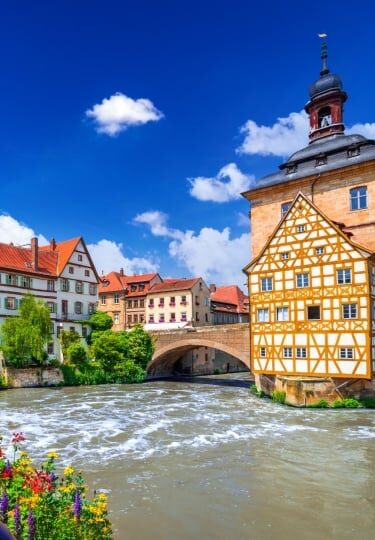
Bamberg, Germany, is the kind of city that makes you feel as though you’ve stepped straight into the pages of a storybook. Set on the banks of the Regnitz River and the Main-Danube Canal, it has one of Europe’s most complete medieval towns. A maze of cobblestone streets winds past half-timbered houses, with church spires rising dramatically above the rooftops.
A visit here is as much about atmosphere as it is about architecture. Whether sipping wine beside the river, raising a glass of smoke-infused local ale in a beer garden, or exploring centuries of history at its hilltop castle, Bamberg never fails to captivate.
Why Visit Bamberg
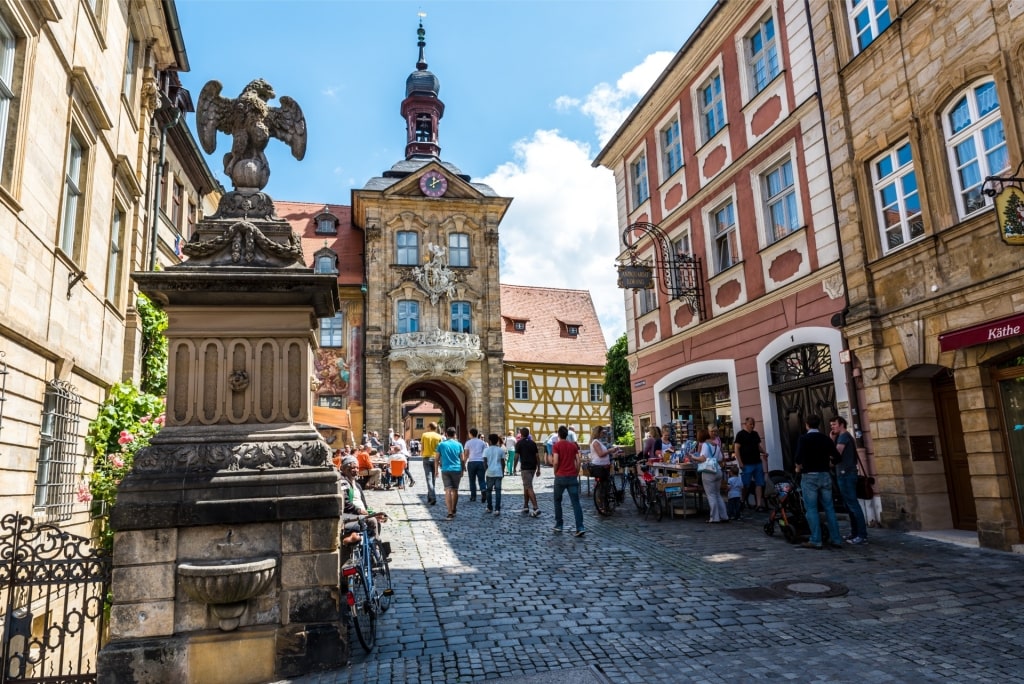
Old Town Hall
When thinking about visiting Germany, Bamberg may not be one of the first destinations that springs to mind, but it should be. Known as one of Germany’s most beautiful cities, it’s small—fewer than 80,000 residents as of 2022—but almost perfectly formed.
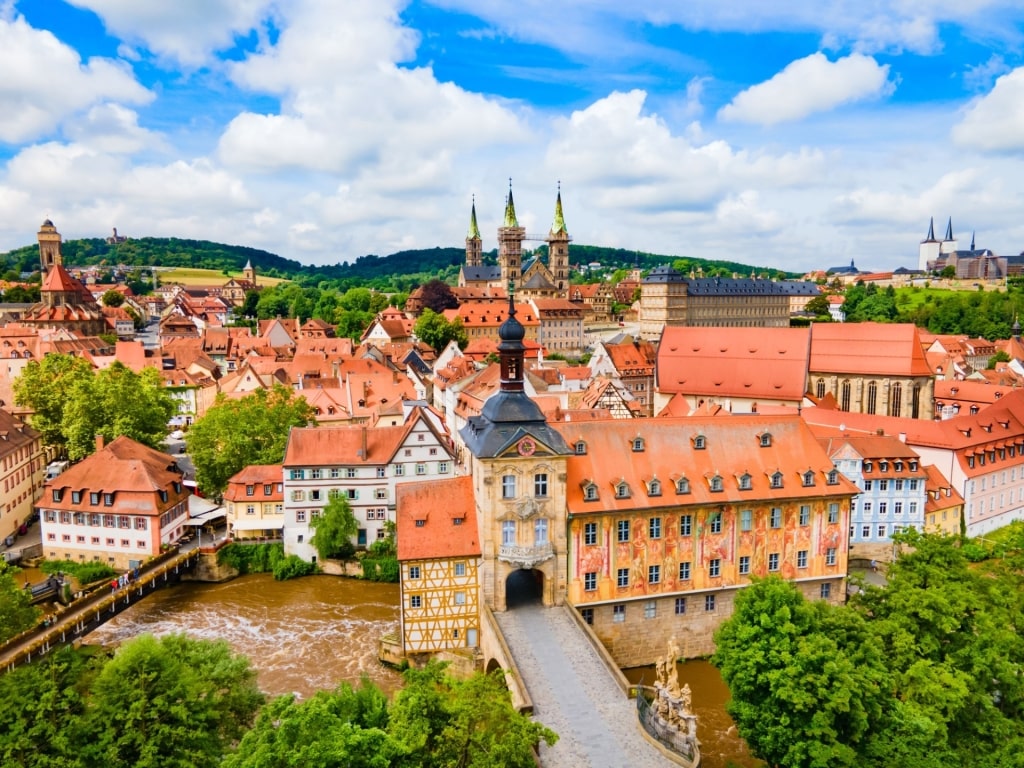
The Old Town is simply gorgeous, a little like a living museum or a movie set. Having escaped major destruction in World War II, its medieval streets are lined with around 2,400 timber-framed houses and a series of elegant landmarks. Among them are the 15th-century Altes Rathaus, or Town Hall, and the 13th-century Bamberg Cathedral, both of which helped earn Bamberg a place on the UNESCO World Heritage List back in 1993.
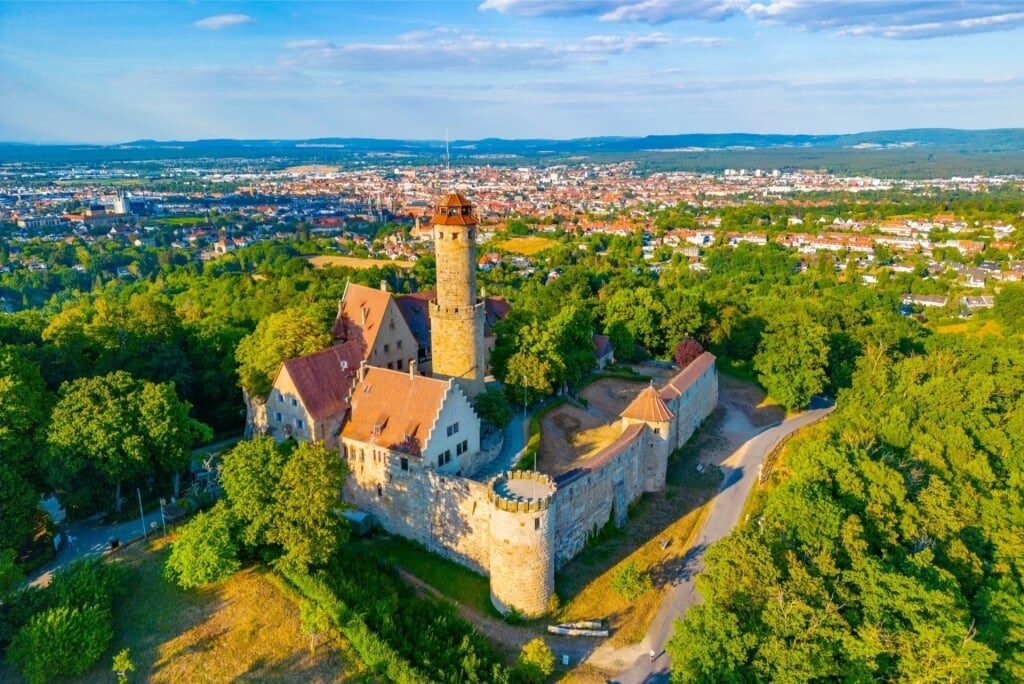
Altenburg Castle
Standing sentinel above it all is Altenburg Castle, perched on one of the seven hills that give Bamberg its distinctive setting. Each hill is topped with a church, earning the city the nickname “Franconian Rome,” though it’s naturally much smaller and more intimate than its Italian counterpart.
Today, there are two sides to a visit. On the one hand there’s the deep history, also evidenced by breweries that have been making distinctive local beers for centuries, and farmers cultivating historic plots around the town. On the other, it’s forward thinking, thanks to the University and associated music scene and festivals.
Beer plays a huge role in modern life here. Not only is Bamberg home to the local brew Rauchbier—made with smoked malt—but the surrounding area is said to be home to the highest concentration of breweries in the world. Food is hearty and distinctly regional, with pork dishes and local carp featuring prominently on menus.
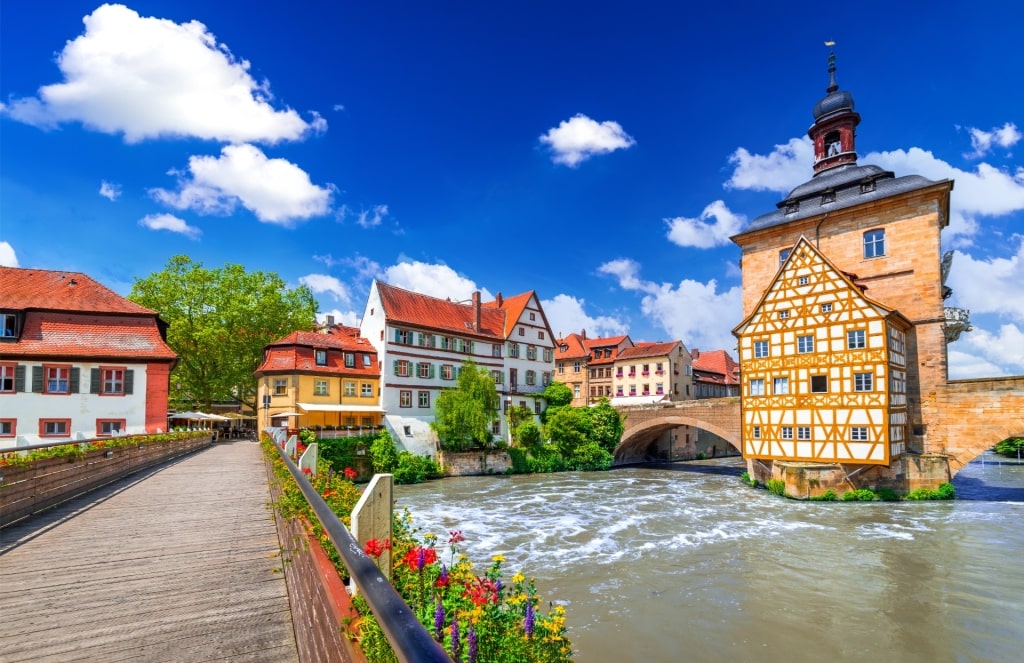
Old Town
The town’s rural setting means that nature and urban life blend seamlessly together, too. The Regnitz River winds its way through the Old Town, creating the picturesque Little Venice quarter of former fishermen’s cottages. The hills around the city are dotted with woodlands, farmers’ fields, and vineyards, making exploring the local countryside another compelling reason to visit.
History & Culture
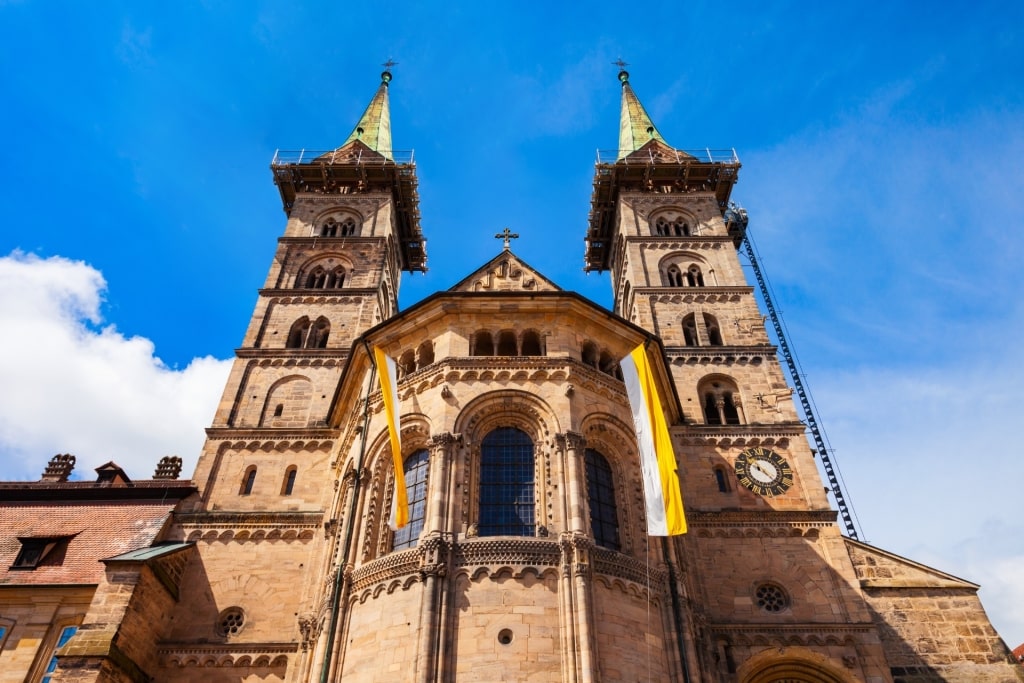
Bamberg Cathedral
People had been settling around the Regnitz and Main rivers for centuries, but the history of Bamberg, Germany, really comes to life in 1007. It was then that the Holy Roman Emperor Henry II decided to establish the bishopric of Bamberg. His aims were twofold: to strengthen Christianity in Germany and create a power base independent of rival local dukes.
Following the Emperor’s stamp of approval, it’s little wonder that the city quickly grew both in size and importance. Its cathedral was first consecrated in 1012 and, while it was later rebuilt after fire, it remains one of the greatest monuments of the Middle Ages. It now houses the tombs of Henry II and his wife, and is also home to the celebrated Bamberg Horseman statue, a symbol of the town.
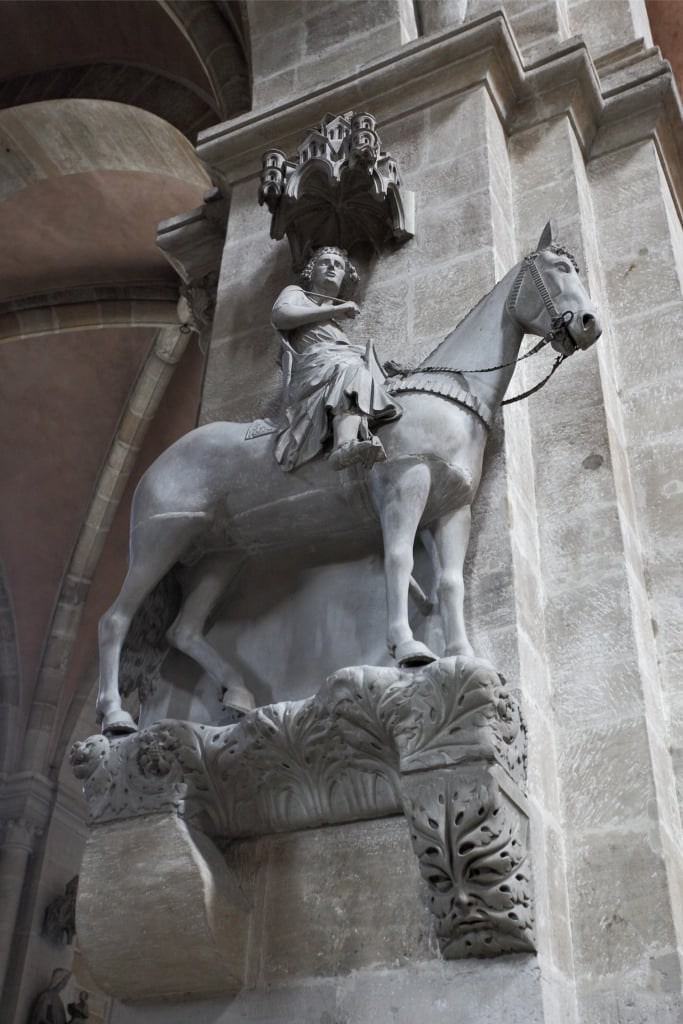
Bamberg Horseman statue
The fact it emerged from World War II relatively unscathed makes Bamberg one of the most complete medieval towns in central Europe, but its fame was not limited to the Middle Ages. In the 17th and 18th centuries, the prince-bishops who oversaw the German town saw fit to remodel it with the help of Italian architects and artists.
Adding a healthy dose of Baroque flair, their legacy includes the 17th-century grand Neue Residenz which served as their residence, as well as the ornate churches that inspire the “Franconian Rome” tag.
Culture today is not limited to the town’s vibrant history. The University was originally founded in the 17th century and was re-established in the 20th to ensure a lively student presence that fuels a vibrant arts and music scene.
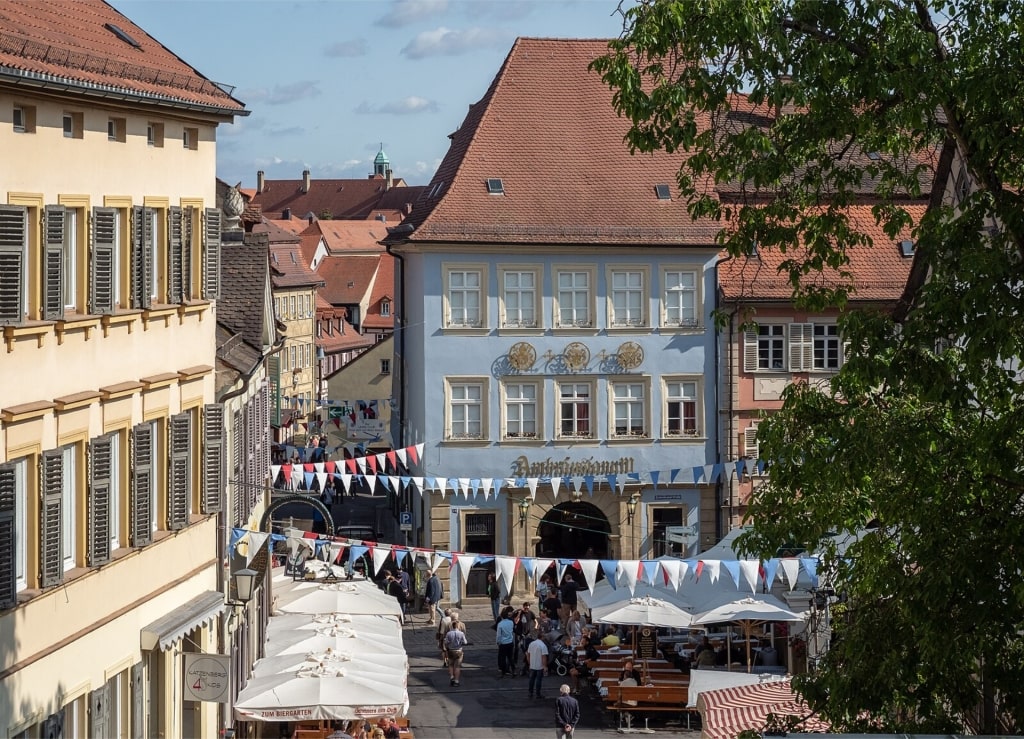
Sandkerwa folk festival Photo by Ermell on Wikimedia Commons, licensed under CC BY-SA 4.0
The annual Sandkerwa folk festival each August attracts some 200,000 visitors to its parades, music, and beer tents. Classical music lovers, meanwhile, may know Bamberg through its world-class Symphony Orchestra. Founded by former members of the Prague German Philharmonic Orchestra after World War II, it tours internationally to great acclaim.
Wildlife & Nature
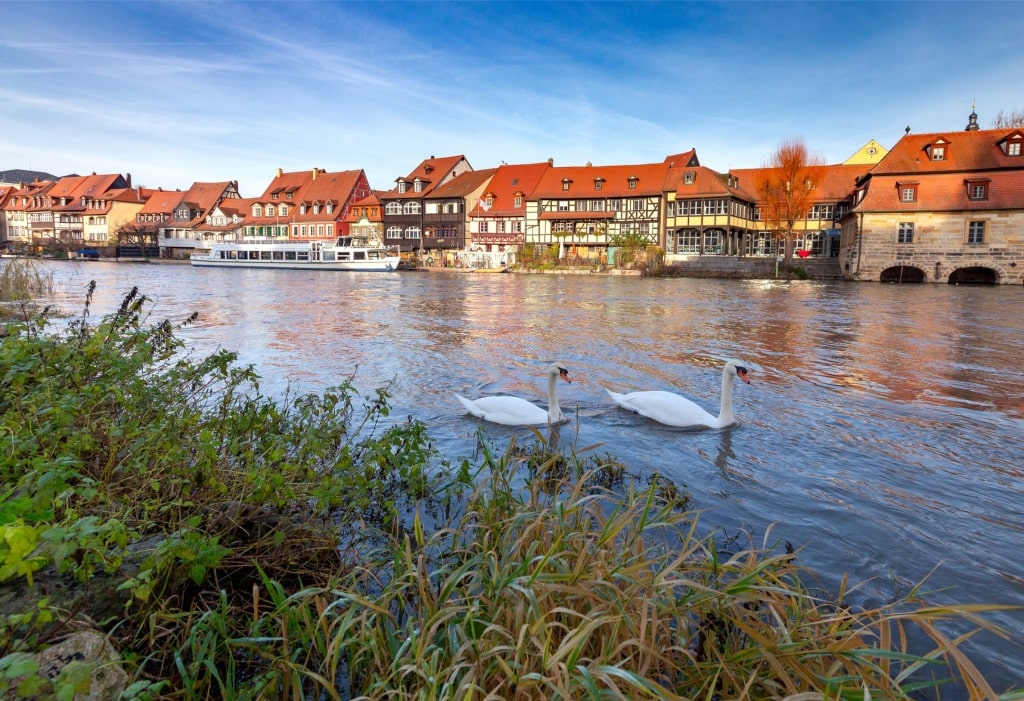
Regnitz River
Bamberg, Germany, may be best known for its medieval streets and Baroque palaces, but the natural world plays an equally important role in shaping the city’s character. Its location on the Regnitz River and the Main-Danube Canal frames the Old Town, while also highlighting its role in connecting two great German waterways.
The banks of both the river and the canal are lined with green meadows, particularly around Hain Park, near the former millers’ quarter. Home to a botanical garden, it’s where locals jog, picnic, and look out for birdlife on the wetlands.
The wider countryside wraps around the town, first with the iconic seven hills, but beyond with a patchwork of vineyards and hop fields. The surrounding woodland is also home to some lovely walking trails, perfect for a challenging hike. Even in the historic center, green spaces are never too far away. The Neue Residenz has a Rose Garden offering more than 4,500 blooming bushes in summer, and great views over the city rooftops at any time of year.
Tips for Visiting Bamberg
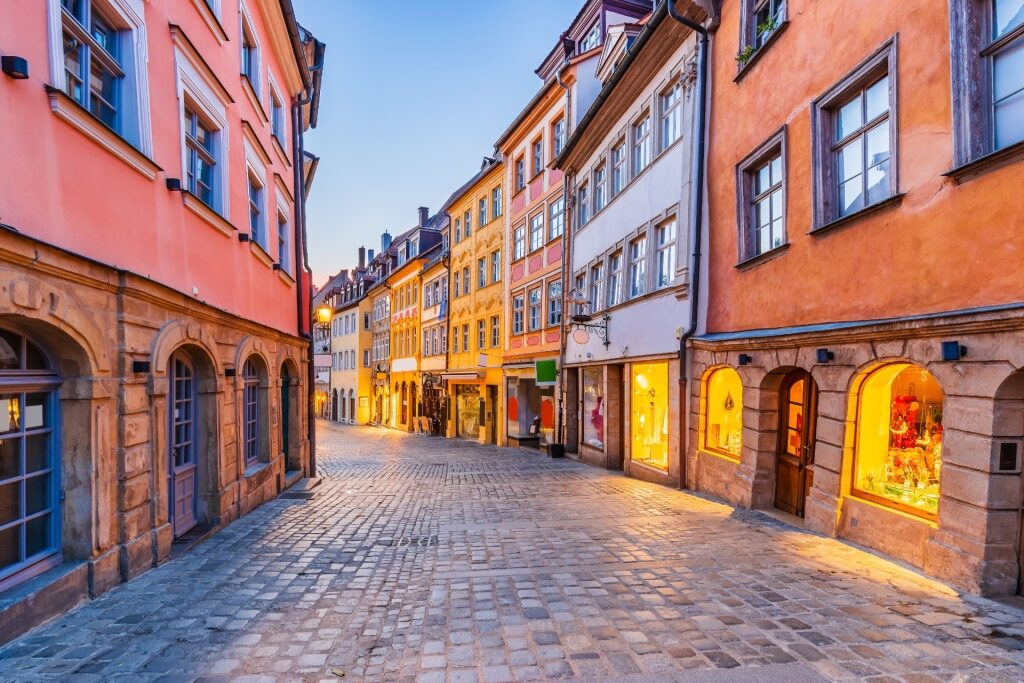
Old Town
The Old Town of Bamberg, Germany, is best explored on foot, but the cobblestone streets can be uneven and some of the slopes are on the steep side, especially those that lead up to the cathedral and castle. As such sturdy, comfortable shoes are a must.
Public transportation includes a reliable bus network around the town and to outer neighborhoods. For those wishing to visit the German castle but who may find the climb daunting, taxis are available. Ride-share apps can also be used where payment is through registered cards.
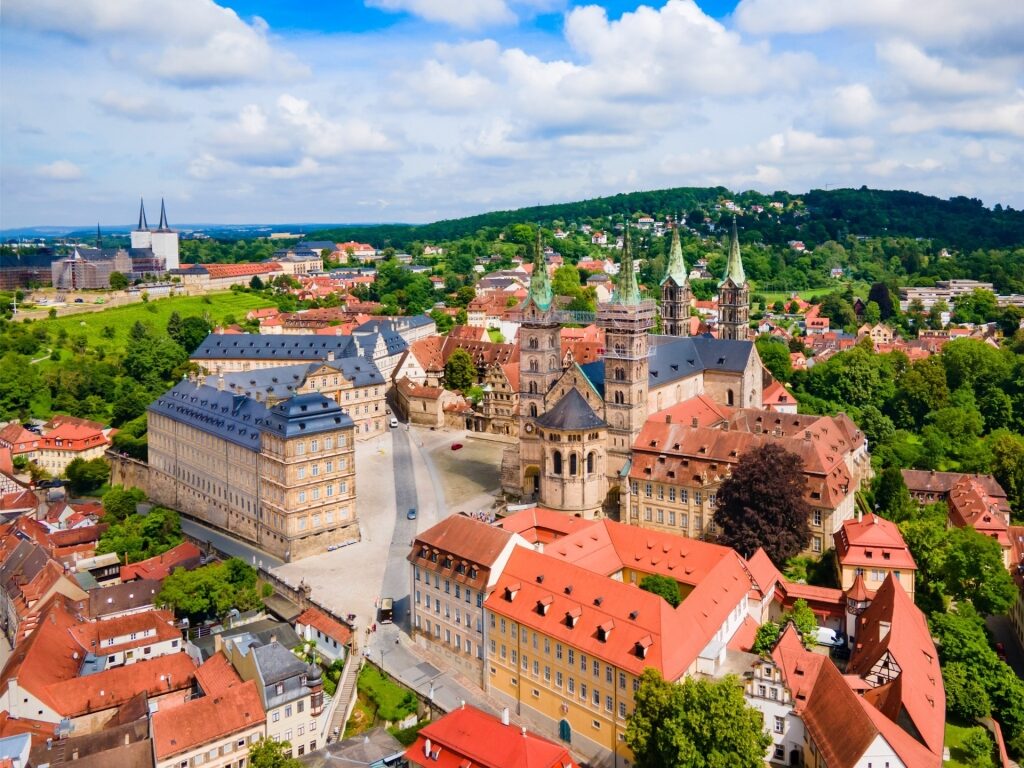
Old Town
Most shops and businesses tend to keep traditional opening hours, with some closing for lunch breaks. Bigger stores such as supermarkets are open later—but by law, most shops are closed on Sundays. Restaurants are mainly open throughout the day, as are beer gardens.
While larger restaurants and shops will accept cards, smaller breweries, bakeries, and cafés may be cash-only, so carry some small change and notes. Tipping in Germany is usually with cash, too.
Things to Do & Attractions
Bamberg Cathedral & Domplatz
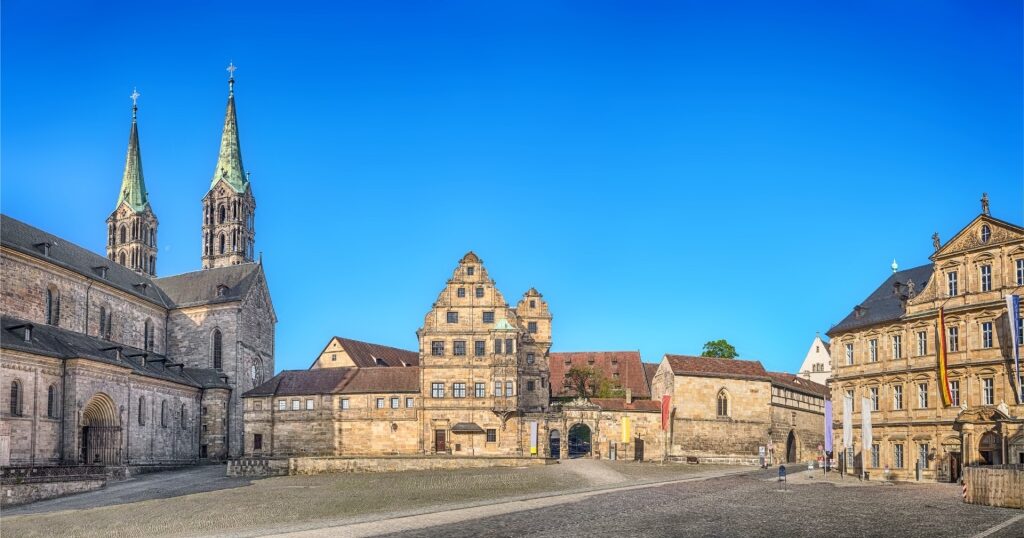
Domplatz
If you only do one thing on a visit to Bamberg, Germany, make it a visit to the Domplatz, the grand square that sits at the very heart of the Old Town.
Rising above it is the imposing Bamberg Cathedral. Dating from the 13th century, it’s widely considered to be one of the great masterpieces of Romanesque and Gothic architecture in Germany.
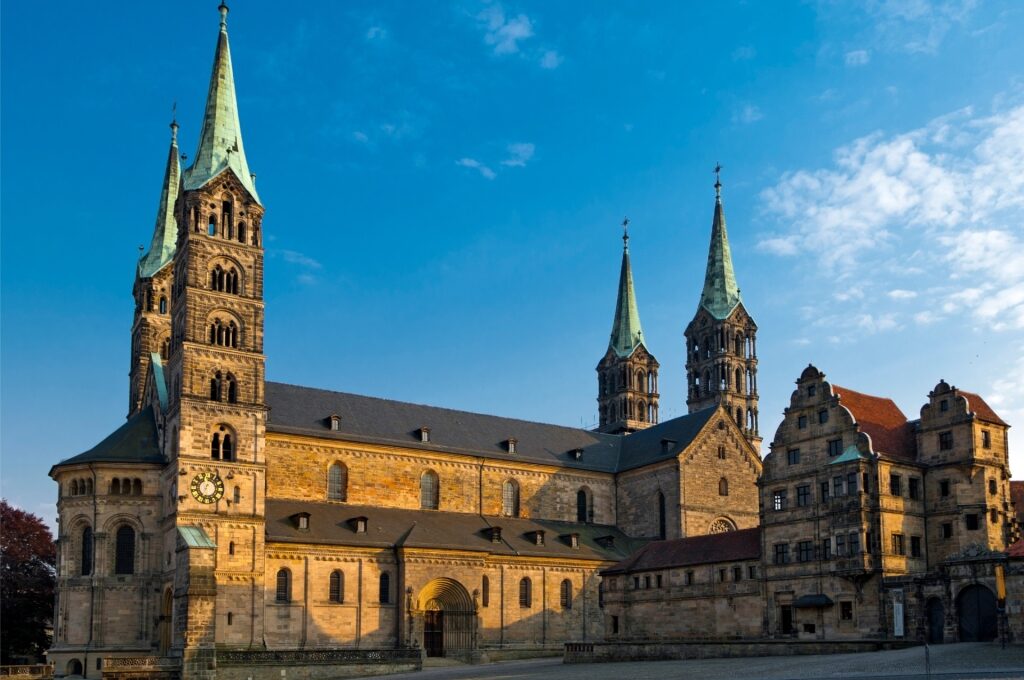
Bamberg Cathedral
Its four imposing towers stand some 250 feet high, dominating the skyline, while inside it’s home to displays of both art and faith. The tombs of Holy Roman Emperor Henry II and his wife Empress Kunigunde, who founded the city and went on to be canonized saints, can be found here in Riemenschneider’s magnificent sarcophagus.
The German church is also home to the Bamberg Horseman, an enigmatic 13th-century stone sculpture, the origins of which have divided scholars for generations. The square itself is ringed with other historic buildings making it a great hub from which to explore the rest of the city.
Altes Rathaus
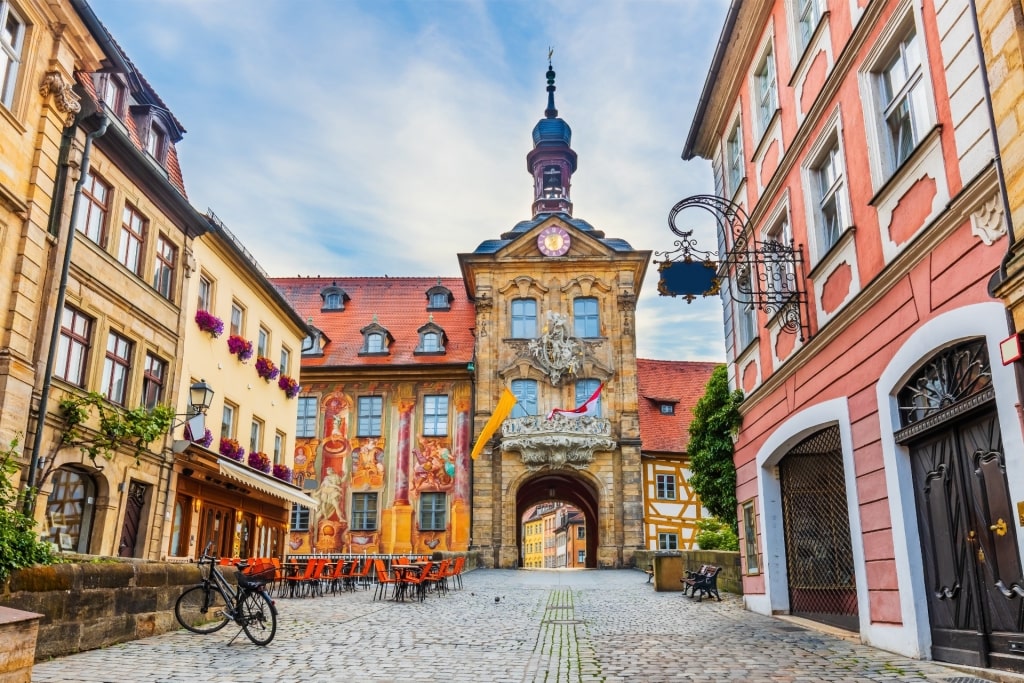
Altes Rathaus
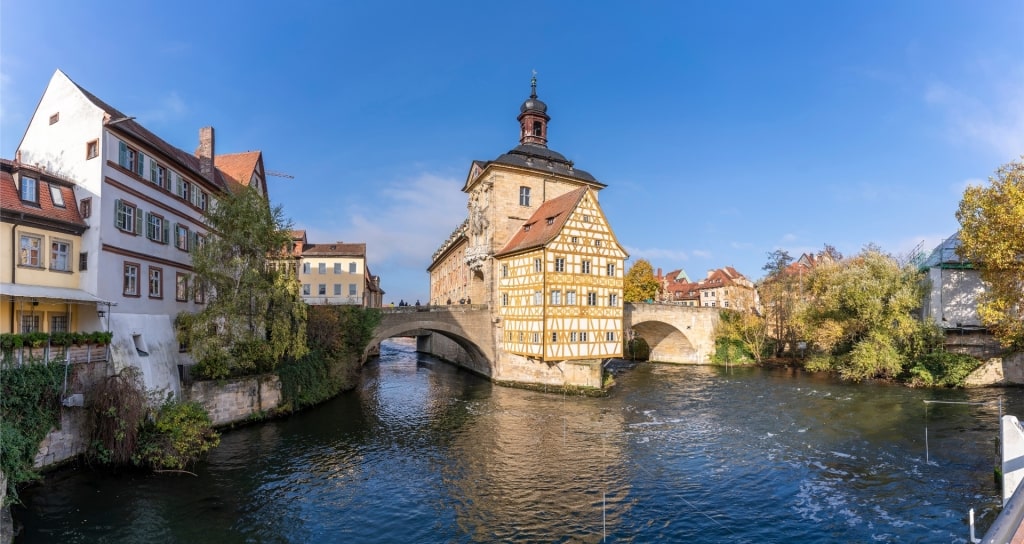
Few buildings capture the spirit of Bamberg like the Altes Rathaus, or Old Town Hall. According to legend, the town’s bishops refused to grant land for a town hall structure and so the residents defiantly built one on an island in the middle of the Regnitz.
Connected by arched bridges, the half-timbered structure seems to float above the water when viewed from some angles. The building is quite stunning in its own right, with colorful trompe-l’oeil murals and painted cherubs adding a three-dimensional feel. Inside it’s no less impressive with Rococo-era interiors and the Ludwig Collection of fine porcelain.
Klein Venedig

Klein Venedig
If you’re looking for images to grace your social media feeds, take a short walk along the Regnitz River to the city’s most photographed spot, Klein Venedig.
Translated as Little Venice, this row of half-timbered fishermen’s cottages line the river with their flower-filled balconies, low roofs, and boats moored on the water. The spot’s picture-book charm is best seen—and photographed—from the water. It’s by no means Venice’s Grand Canal but in the right light, it’s one of the city’s loveliest spots.
Neue Residenz & Rose Garden
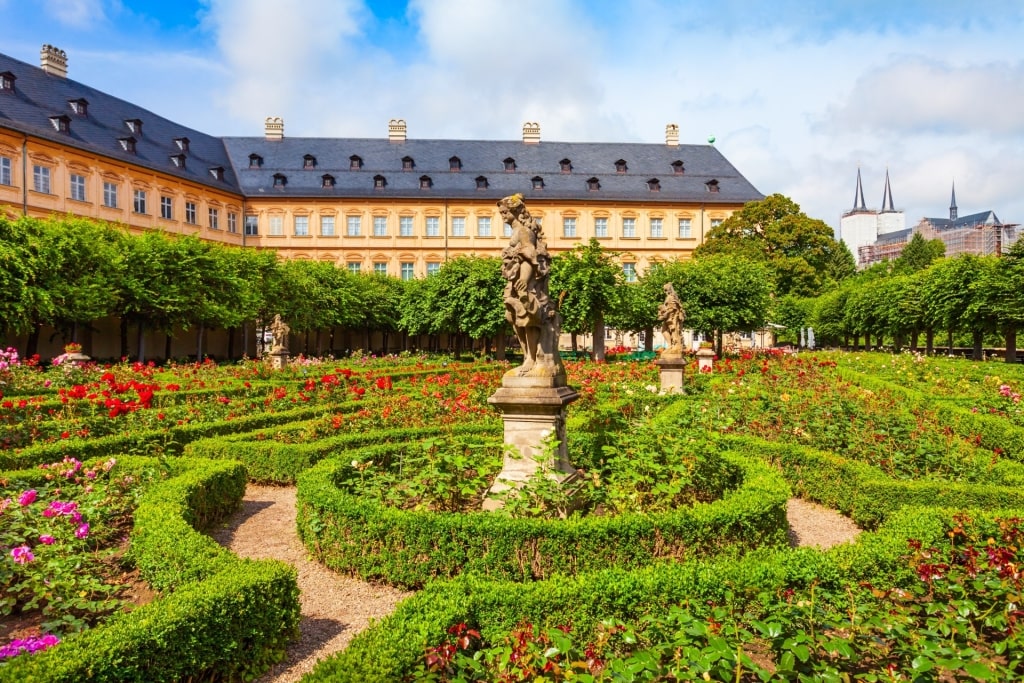
Neue Residenz
On the northern side of Domplatz stands the Neue Residenz, the former palace of Bamberg’s prince-bishops. Originally constructed in the early 17th century, it was expanded in the Baroque style thanks to their grandiose tastes.
Inside, it contains more than 40 rooms filled with frescoes, tapestries, and paintings. The highlight for most though, especially in spring and summer, is the elegant Rose Garden. Home to some 4,500 roses arranged in geometric beds, it offers one of the city’s best panoramas across the tiled rooftops of the Old Town.
Altenburg Castle
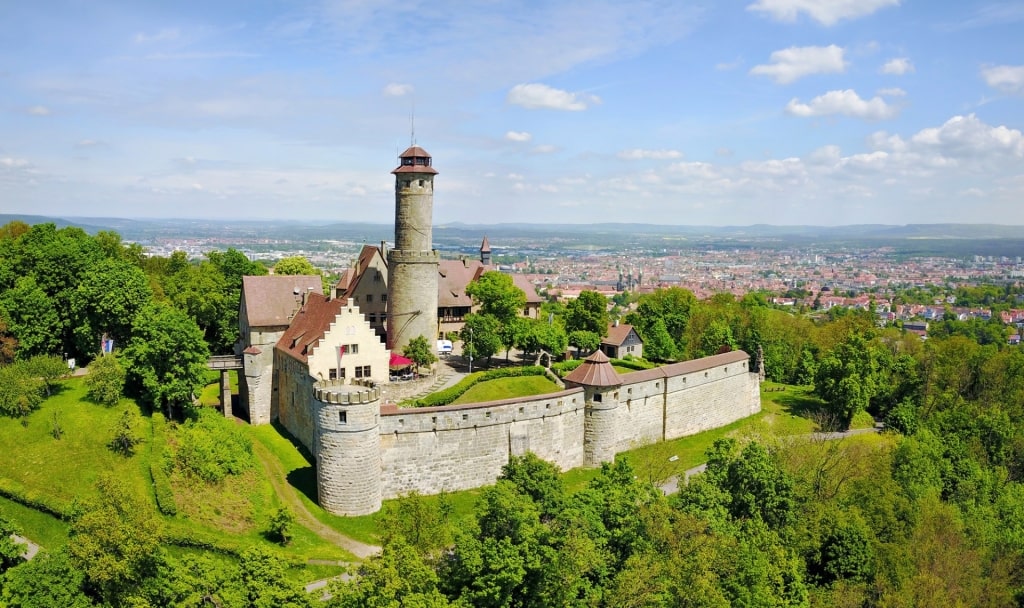
Altenburg Castle
For the very best sweeping views of Bamberg and the surrounding countryside, Altenburg Castle, perched high on one of the city’s seven hills, is the place to go.
Originally a 12th-century fortress, it went on to become another residence for the city’s bishops. It can be reached on foot via a scenic two-mile hike from downtown, or by road via car or taxi.
However you get there, it’s worth your while. The castle’s stout stone towers and walls provide a great backdrop for photos, and the climb rewards you with more panoramic views over the city’s spires, bridges, and surrounding hills. There’s also a small museum that traces the castle’s history, as well as a cozy restaurant for a spot of lunch if you want to make a day of it.
Schlenkerla Brewery & Rauchbier
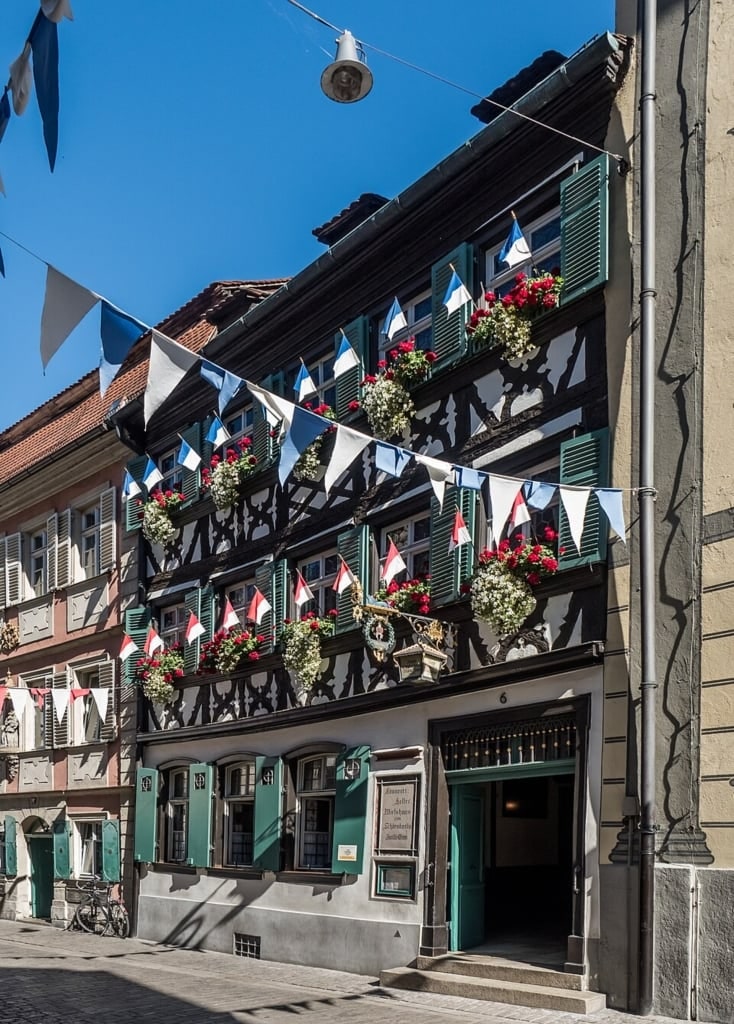
Schlenkerla Brewery Photo by ermell on Wikimedia Commons, licensed under CC BY-SA 4.0
With beer playing such a part in Bamberg’s DNA, if you’re partial to the amber nectar then a visit to Schlenkerla, the city’s most famous brewery, is a must. Housed in another timber-framed building close to the cathedral, it’s the spiritual home of Rauchbier, Bamberg’s iconic smoked beer.
The smokiness comes from when brewers started to dry out malt over beechwood fires and found it added a different taste to the final brew. Described by some as tasting a little like bacon or smoked ham, the locals swear by it and trying at least one glass—drawn from the wooden barrels—is almost a rite of passage. Even if the beer is not to your taste, the historic atmosphere of the tavern, with its vaulted ceilings and dark wood accents, is worth a stop.
Food & Drink

Schäuferla
Bamberg, Germany, sits in the heart of Franconia, a region famed for its breweries and hearty cuisine. Beer dominates the food and drink conversation. There are more than 10 breweries in the city itself with dozens more in the surrounding area. Beyond Rauchbier, breweries produce a wide range of Franconian lagers, pilsners, and seasonal specialties.
Traditional Franconian dishes tend to be both hearty and comforting, while being rooted in local ingredients. Pork features prominently in dishes such as schäuferla, roasted pork shoulder with crisp crackling, usually served with dumplings and sauerkraut. Freshwater fish, especially carp, is another favorite, especially in autumn and winter.

Bamberger hörnla
The city is also known for its breads and pastries. Look out for the Bamberger hörnla, confusingly also the name of a local potato. The croissant-like crescent pastry is a breakfast specialty with butter and jam. Bakeries also sell various pretzels, rye breads, and cakes.
Beer is the star drink but there are also some excellent wines, with the crisp white Silvaner being a popular choice to go with most meals, particularly in summer.
Best Time to Visit Bamberg
Old Town Hall
Bamberg, Germany, is a year-round destination, but your experience will differ by the season. Summer is the liveliest time to visit. It’s when beer gardens hum with activity and festivals spill into the streets.
Spring is a great time thanks to fewer crowds and a riot of color at the Neue Residenz Rose Garden as flowers come into bloom. In fall, the harvest season begins. Crowds thin again, and the surrounding vineyards and forests are bathed in golden light.
In winter, Christmas is a particular highlight with the town’s lively seasonal market opening in early December.
Bamberg
Discover more about the city on one of Celebrity’s river cruises to Bamberg. Browse itineraries and plan your European adventure.