In Strasbourg, you’ll always know exactly where you are. If you’re lost, just look up.
The Strasbourg Notre Dame Cathedral’s single spire towers 466 feet over the city, serving not just as a landmark, but also as a compass. For more than 200 years, it held the title of the tallest building in the world, establishing it as a masterful structure in Gothic architecture. Its sophisticated details, pink-shaded sandstone, and alluring astronomical clock are a rarity worth seeing with the naked eye.
While many see it shoreside, only a few get to experience it from the Rhine. It’s in the historic plaza of Grande Île, a 10-minute drive from the Rhine River cruise port—and for a Celebrity River Cruises℠ guest, the anticipation builds at the sight of the single spire from miles away.
Strasbourg Notre Dame Cathedral at a Glance
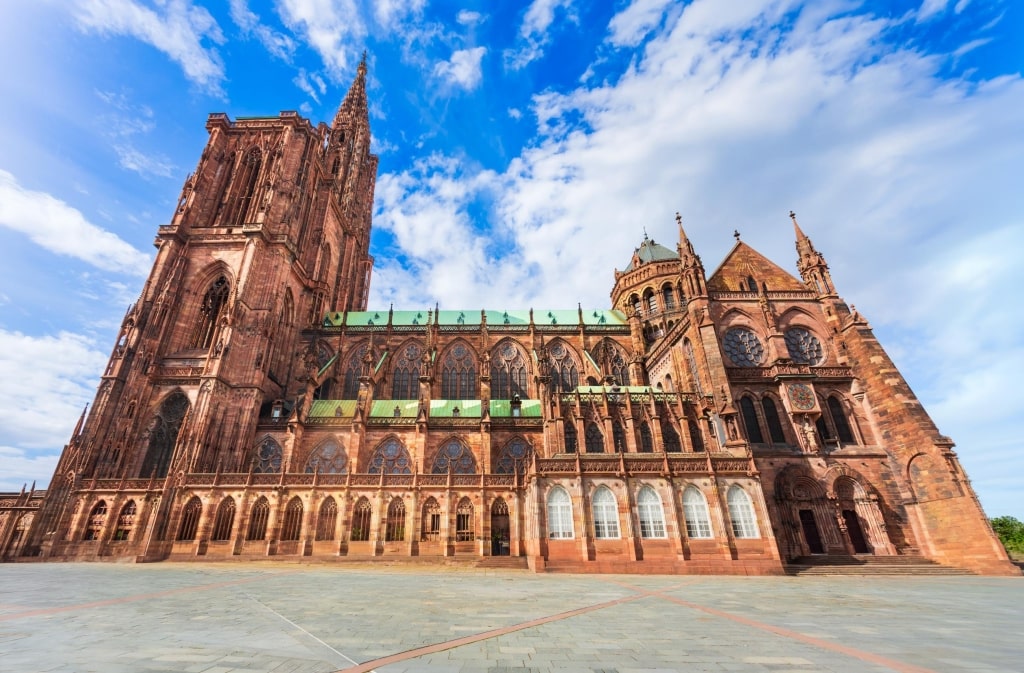
The majestic Gothic architecture and facade of Strasbourg Cathedral of Notre Dame in Strasbourg, France.
Strasbourg Notre Dame Cathedral was completed in the 15th century and served as a major landmark for the French city for hundreds of years. Its history, preserved architecture, and refined interior have guests counting down the minutes to see it.
Here are some quick facts at a glance:
- What: Strasbourg Notre Dame Cathedral
- Where: Place de la Cathédrale, in the Grande Île historic district of Strasbourg, France
- Construction dates: 1176–1439 (built on the site of an earlier Romanesque cathedral dating to 1015)
- Architecture: Gothic
- Height: 466 feet (142 meters)—the world’s tallest building from 1647 to 1874
- How to enter: The nave is free; separate paid tickets are required for the platform climb and the astronomical clock exhibition
- Platform climb: 330–332 steps to the platform
Why Is the Strasbourg Notre Dame Cathedral Famous?
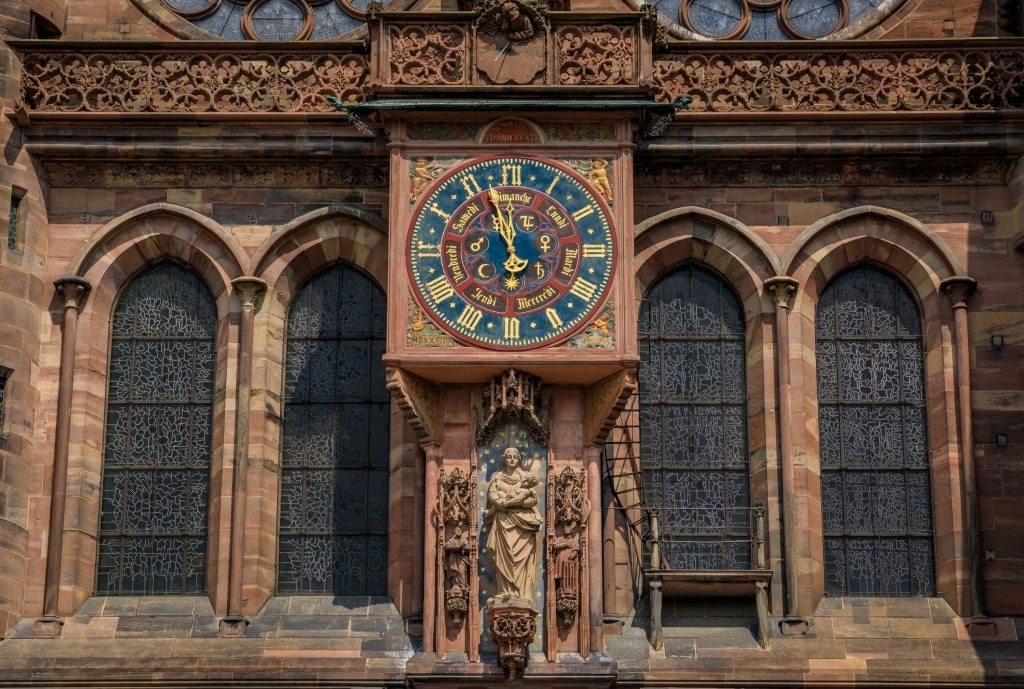
Ancient astronomical clock with Roman numerals and planet symbols displaying days of the week on the facade of Strasbourg Cathedral.
Up until the 19th century, the Strasbourg Notre Dame Cathedral was the tallest building in the world. Now, people admire it for the astronomical clock’s daily performance, the sandstone’s ever-changing pink exterior, the sparkling stained glass, and, of course, its height. Many people see it as a Gothic-style masterpiece rather than a cathedral on its own—a defining symbol of the city.
Architecture: Where Pink Sandstone Meets Gothic Detail
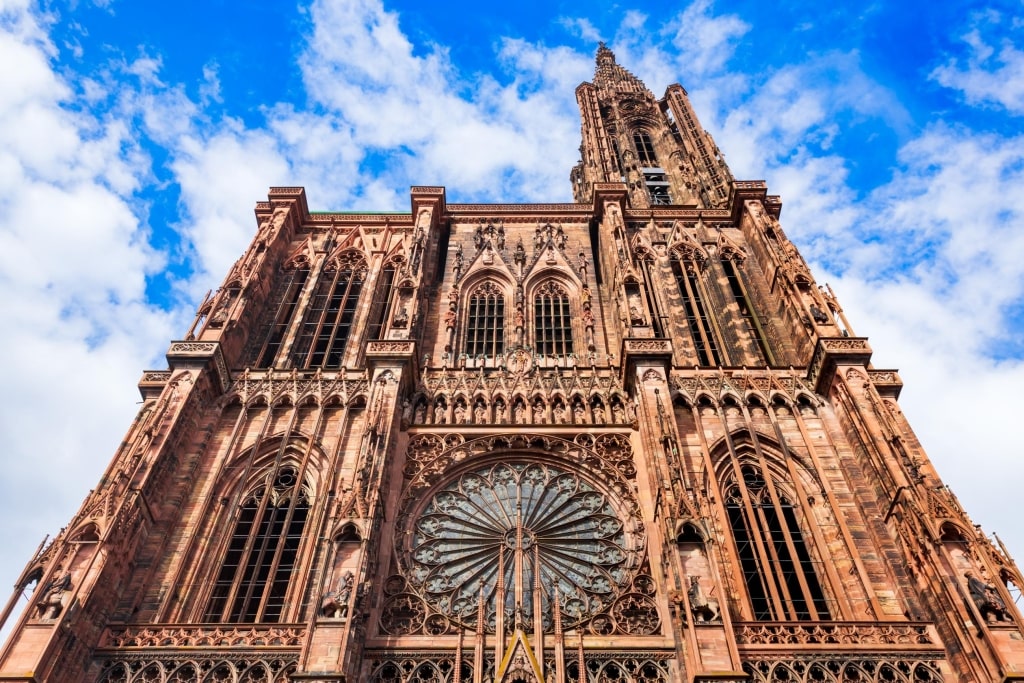
The intricate, pink sandstone west facade and soaring single spire of Strasbourg Cathedral (Cathédrale Notre-Dame) against a bright blue sky.
The tall spire is the first thing people see, but the artistry thrives up close. It was built with pink Vosges sandstone, quarried from the nearby Vosges Mountains in the Alsace region where Strasbourg sits. From sunrise to sunset, the sandstone shifts from pale pink to earthy crimson red, giving each guest a different experience depending on when they visit.
Ornately carved detail lines the cathedral’s crevices, including the pointed archways that frame the doors. Statues stand in tall domes at each corner, reaching up to the tip of the spire, with similar sculptures decorating the pillars inside.
Dozens of stained-glass windows light up the interior, leading to the famous astronomical clock. The gated marvel features statues, paintings, and animated mechanics that tick at a certain time of day. Centuries of construction, delays, and rebuilding make the cathedral a story worth its own look.
History: Rising From the Ashes
The cathedral rose on the site of an earlier Romanesque church built in 1015. When a fire destroyed the original structure, construction on the current cathedral officially began in 1176, wrapping up in 1439.
The building held onto its Romanesque roots at first, until a new team of architects took over construction in the 13th century. Pointed arches, ribbed vaults, and soaring spires started to take shape under the emerging Gothic style. While two towers were originally planned, the southern tower was never completed. Still, the resulting single spire—paired with the cathedral’s overall grandeur—quickly became what Strasbourg is known for today.
Astronomical Clock: A Universal Compass
Inside the Strasbourg Notre Dame Cathedral, you’ll find one of the oldest working astronomical clocks in the world, and the third to occupy this spot since the 1350s. It was designed and built by Jean-Baptiste Schwilgué, a Strasbourg-born engineer and mathematician, along with a team of artists and technicians. Its features date from 1842 and track time, planetary orbits, moon phases, and the Christian calendar.
Today, the clock puts on a daily animated show at 12:30 p.m. that reveals different stages of life parading past death. Above it, apostles parade before Christ while the clock sounds off. Guests can view the clock’s exhibition from behind a gate, adding a sense of occasion to seeing the mechanism up close. The performance is one of the main reasons the cathedral is listed as one of the top things to do on a Rhine River cruise.
There’s a small fee to enter, and a separately paid ticket that takes you up the platform.
What You Can Expect at the Strasbourg Notre Dame Cathedral
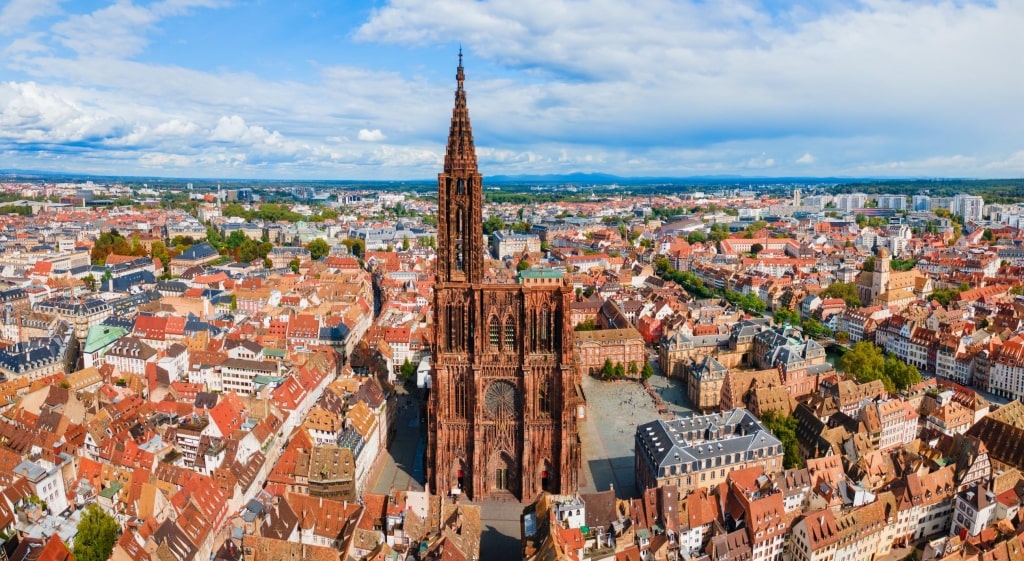
Strasbourg Cathedral towers high above the historic old town’s red rooftops.
Strasbourg Notre Dame Cathedral is the focal point of the city. Its upper platform, just beneath the spire, offers panoramic views over Strasbourg and the surrounding northeastern French countryside.
Those on a Rhine River cruise can see it from all three perspectives: the river, the shore, and from above.
Visiting the Strasbourg Cathedral
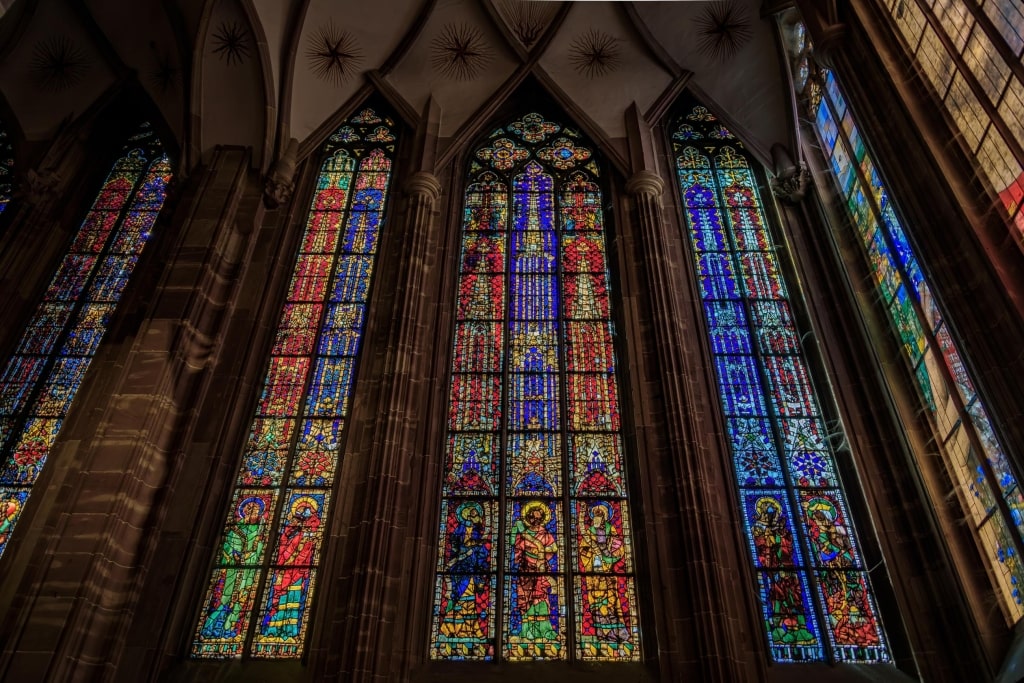
Ornate colorful stained glass windows in the beautiful Gothic cathedral of Notre Dame in the historic center of Strasbourg.
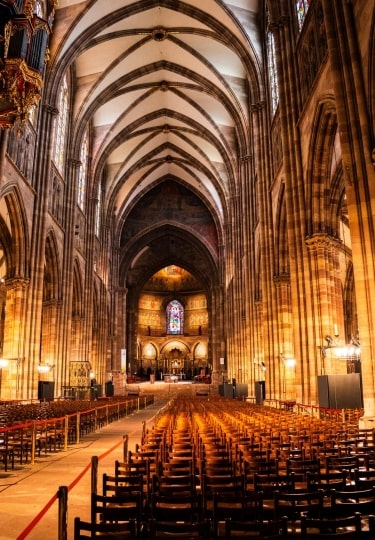
Seeing the cathedral up close sets a new benchmark. The nave’s curved high ceilings stretch toward a pulpit with delicate stonework. Stained-glass windows dating from the 12th to 14th centuries cast colored light across the floor. The circular rose window with meticulous designs draws the eye as the sun hits the jewel-toned glass above the south transept.
For those looking to go further, a 330-step climb leads to a viewing platform beneath the spire, with panoramic views stretching across the Alsace plain and, on clear days, to the Black Forest. It’s a moderate climb—not for those short on time or those with accessibility concerns—but for guests with an afternoon in port, it’s one of the most rewarding views in Strasbourg.
Seasonal Arrivals
Planning a seasonal arrival is a bonus for those who love the winter holidays—Strasbourg calls itself the Capital of Christmas.
During the season, a market unfolds right in front of the cathedral as part of the city’s larger Christmas Market, known as Christkindelsmärik, which dates back to 1570 and ranks among the oldest in Europe. Think wooden chalets, brightly lit Christmas trees, and Alsatian crafts. Sweet and savory treats and mulled wine satisfy guests as they stroll past souvenir stands and light displays.
A late November or December Rhine River cruise will take you to the heart of the action.
Strategic Strasbourg Sightseeing: Tickets, Hours, and What to Wear
Strasbourg is cozy with a lot to see, but it’s not overwhelming for a port day. It earns its place as one of the best cities on the Rhine River—and planning is just as effortless.
A few things to keep in mind: the nave is free to enter, but the astronomical clock exhibition and the platform will have two separate ticket costs. The cathedral is generally open daily, though access can be restricted during religious services—it’s worth checking hours ahead of time, especially since they can shift seasonally.
As an active place of worship, modest dress is appreciated: covered shoulders and knees are a safe bet for anyone planning to step inside. Comfortable shoes are worth packing, too, specifically for those tackling the platform climb.
Frequently Asked Questions
Why is the Strasbourg Cathedral famous?
The Strasbourg Cathedral was the tallest building in the world from 1647 to 1874, thanks to its 466-foot spire. Additionally, it’s known for its pink sandstone facade, astronomical clock, and panoramic platform views.
How does Strasbourg Notre Dame Cathedral compare to other famous cathedrals in France?
Its single, asymmetrical spire sets it apart—most Gothic cathedrals were designed with two towers, but Strasbourg’s second was never completed, giving it a distinctive, uneven silhouette.
What is the astronomical clock inside Strasbourg Cathedral?
The astronomical clock inside the Strasbourg Cathedral is one of the oldest in the world, tracking planetary orbits, moon phases, and the Christian calendar. Its animated figures perform daily at 12:30 p.m.
Can you visit Strasbourg Notre Dame Cathedral during a Rhine River cruise stop?
Yes, you can visit the Strasbourg Notre Dame Cathedral on a variety of Celebrity’s Rhine River cruises.
Can you climb Strasbourg Notre Dame Cathedral, and is the view worth it?
You can climb 330 steps to the viewing platform of Strasbourg’s Notre Dame Cathedral. It’s beneath the spire and offers scenery across the Alsace plain and, on clear days, the Black Forest.
Are there Christmas markets near Strasbourg Notre Dame Cathedral?
Christkindelsmärik is one of the oldest Christmas markets in Europe. To get into the holiday spirit, book a Strasbourg river cruise for a late November or December sailing.
Sail to Strasbourg
Strasbourg is a place worth slowing down for. It sits along the Rhine River, where guests can witness a different side of France and its many landmarks.
On a regular port day, budget at least an hour at the cathedral alone. If you’re climbing the platform, add about an extra hour to climb up and soak in the skyline. Don’t forget to snap a photo before heading back down to the plaza’s cobblestone streets.
From there, Old Town and the canals of La Petite France unfold like something out of a storybook, blending French and German architectural styles. A Strasbourg port day offers a rare chance to pair centuries of masterful Gothic craftsmanship with an easy, walkable afternoon of sightseeing.
Explore Rhine River cruises with Celebrity River Cruises℠ to start planning your own stop in Strasbourg.