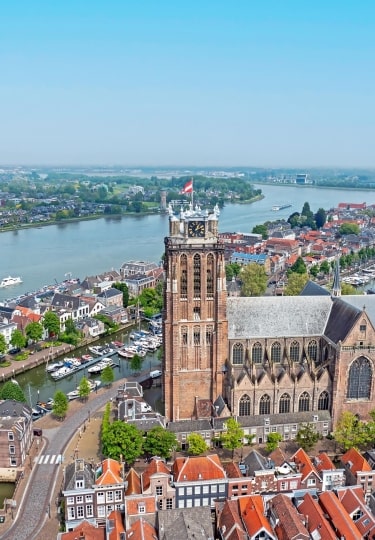
Many Dutch cities have a Grote Kerk, or “great church,” and Dordrecht’s in South Holland is a Gothic landmark that defines the town. Also known as the Church of Our Lady or Onze-Lieve-Vrouwekerk, it stands in the center, overlooking the marina and river. Its Brabantine Gothic architecture and unfinished, leaning tower make it one of Dordrecht’s most recognizable sights. Visitors can climb the tower for panoramic views, making it a highlight of a Celebrity River Cruises℠ itinerary.
The church’s exterior features pointed-arch windows and intricate detailing, while its interior has soaring ceilings, elaborate chandeliers, and historic craftsmanship. Guests get more than a photo opportunity here; they also gain an introduction to Dordrecht’s character. The structure is also within walking distance of the river cruise dock, so it’s an easy addition to a port-day stroll.
Unfamiliar? Here are a few quick facts:
- Also known as: Church of Our Lady (Onze-Lieve-Vrouwekerk)
- Style: Brabantine Gothic
- Tower climb: 275 steps
- Time to allow: One to two hours
A Church That Survived Fire and Reformation
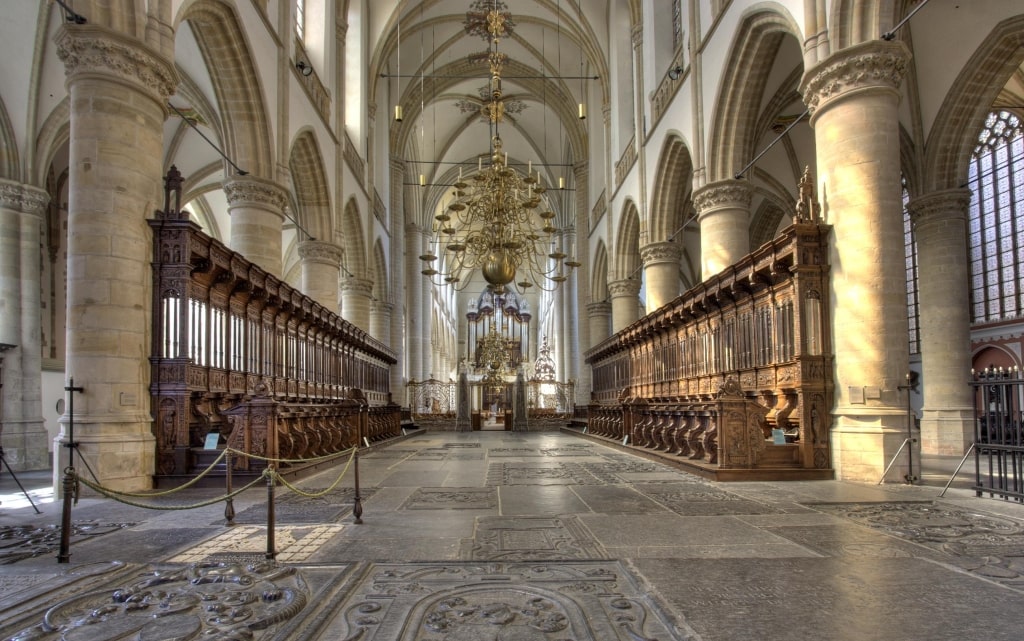
Intricately carved wooden choir stalls line the luminous interior of Grote Kerk Dordrecht.
Beyond its aesthetics, Grote Kerk Dordrecht carries a long history that reveals the city’s resilience. A charter from 1122 mentions a chapel that may have been the Grote Kerk, meaning the church could be more than 900 years old. In that time, it survived a major fire in 1457 and the shift from Catholicism to Protestantism in 1572.
During this time, the Sea Beggars—Dutch rebels fighting Spanish rule—removed altars and saint statues, as well as whitewashed murals; however, the carved choir stalls survived. The pulpit replaced the altar as the centerpiece, shifting the focus to the sermon. A major restoration supported by fundraising in the 1980s returned the church to its former design, and visitors can see the result today. This history of rebuilding and adapting offers a glimpse into what the Netherlands is known for.
If you’re a fan of history, here’s the timeline of Grote Kerk Dordrecht at a glance:
- 1200s: Excavations in 1986 uncovered an earlier Romanesque church beneath the choir, including a rounded apse about 30 feet wide.
- 1284–85: A new Chapel of Our Lady, also called the Mary Chapel, was added on the north side.
- 1339: Construction of the present tower likely began.
- 1367: The church became a collegiate church, and the high choir was likely rebuilt with a walkway around it (the ambulatory).
- 1457: A major fire hit the city and the church, but the church continued to be rebuilt.
- 1460: The tower bells rang for the first time.
- 1470: The church looked a lot like how guests see it today.
- 1540: The carved wooden choir stalls were made. Visitors were admiring them by 1609.
- 1572: The Sea Beggars entered the city, ending four centuries of Catholic worship. Altars and saint statues were removed, murals were whitewashed, but the choir stalls survived.
- 1597 and 1756: Following the Reformation, the pulpit replaced the altar as the centerpiece. A new pulpit was installed in 1597, followed by today’s marble pulpit in 1756.
- 1982–87: A major restoration returned the church to its former glory.
Gothic Architecture and the Church’s Interior
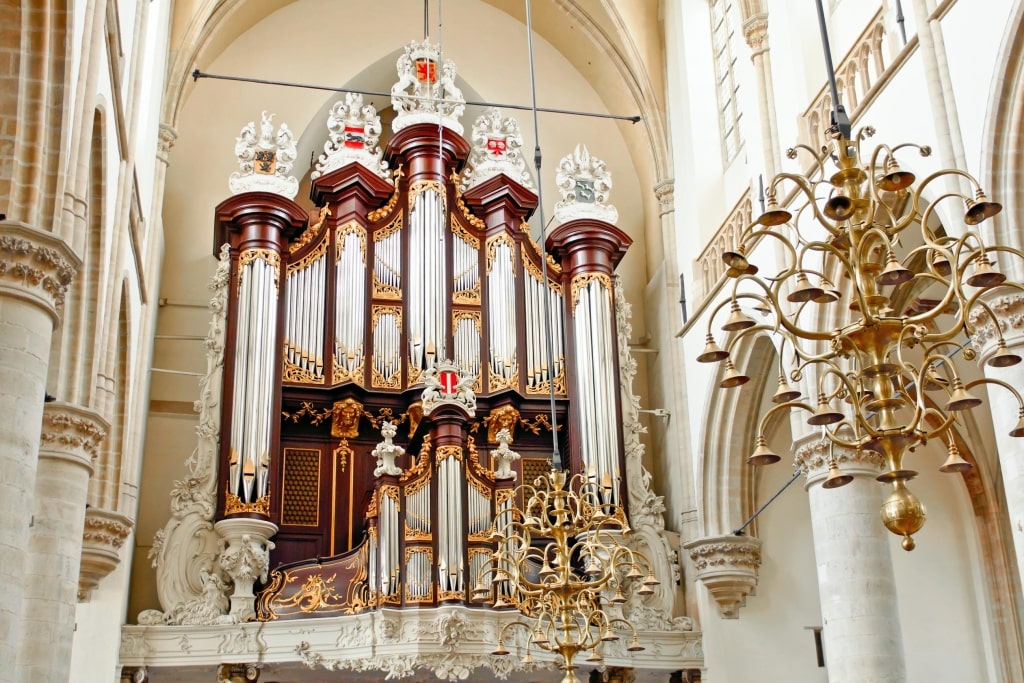
An ornate golden chandelier hangs near the monumental organ within Grote Kerk Dordrecht.
The Grote Kerk’s detailed Gothic architecture and leaning tower rise above Dordrecht’s skyline. The tower stands more than 210 feet tall and can be seen as you arrive on a river cruise to Dordrecht. Four enormous clock faces give the tower its distinctive silhouette, making it visible from across the city.
Pointed arches and narrow windows give the building its Brabantine Gothic style, which continues inside. The bright white interior is lined with columns that echo the pointed window arches and allow natural light to filter through the aisles. An ornate golden gate marks the entrance to the carved wooden choir stalls, which survived the Reformation. The stalls face a large white organ with gold detailing. Dramatic chandeliers hang beneath the vaulted ceiling, adding to the interior’s sense of grandeur.
Grote Kerk Dordrecht also stands apart for its construction. Its stone vaulting is an unusual feature in Holland, where soft ground made this type of construction more challenging. This approach required more weight-bearing support and craftsmanship than traditional timber ceilings, making it a notable example of medieval construction. The combination of the church’s Gothic exterior and stone-vaulted interior gives it a distinctive character, both up close and from the river.
The Leaning Tower
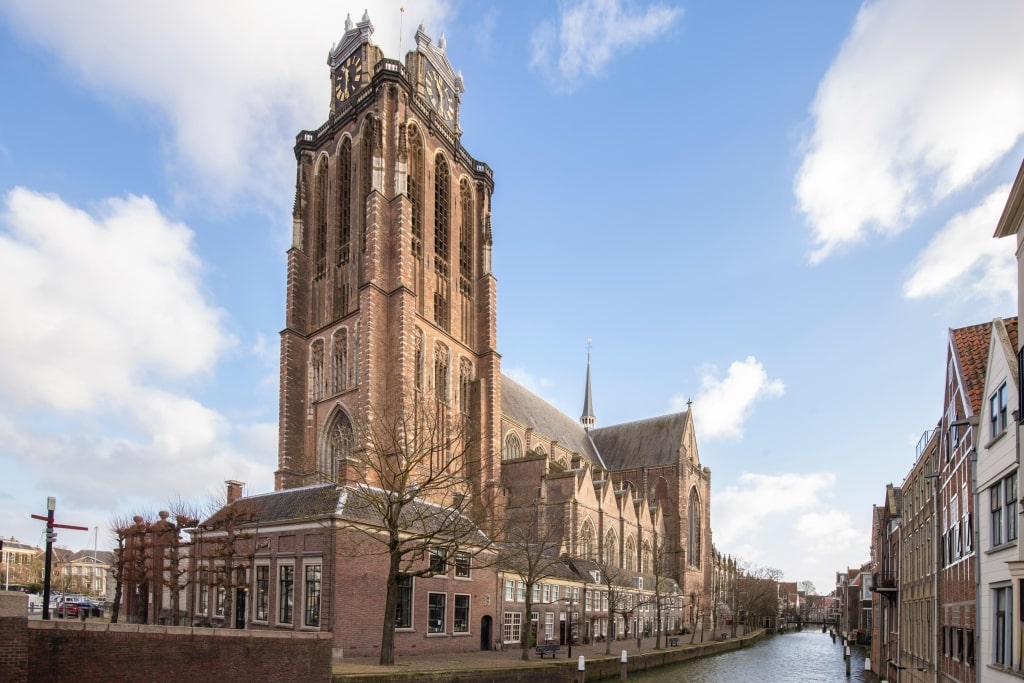
The iconic, uncompleted tower of Grote Kerk rises dramatically over Dordrecht’s serene waterways.
Pisa isn’t the only place with a leaning tower; Dordrecht has one, too. Construction of the Grote Kerk tower began in the 14th century, and the original plan called for a tower with a stone crown and spire reaching about 354 feet (108 meters). Those plans were abandoned because it began to lean as work progressed. Since construction halted, the tower now stands at about 213 feet (65 meters). The city is between rivers, so its grounds might have made it difficult to support the tower’s weight, causing it to lean.
Not only can visitors see it from the shore, but they can also climb 275 steps to the top. Sweeping views of the rivers, old town, and the surrounding skyline are the grand finale. The scenery gives you a better sense of Dordrecht’s location, which is at the meeting point of several waterways.
The payoff after 275 steps is partly why it earns its spot among the best places to visit in the Netherlands, and if you time it right, you may hear the bells, which first rang in 1460.
A Day in Dordrecht
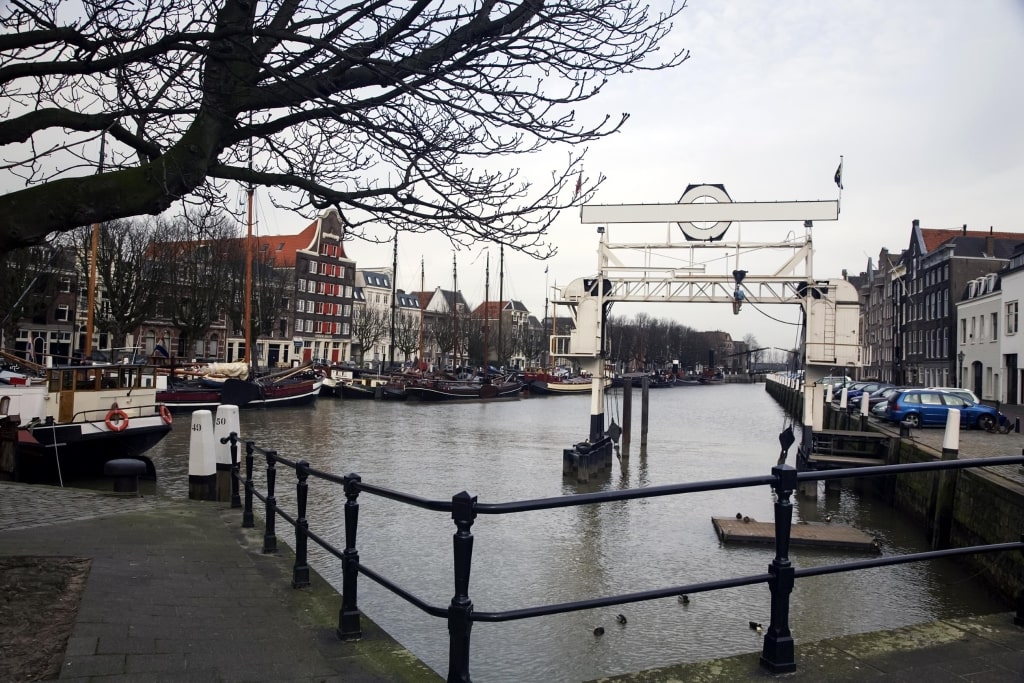
Classic Dutch vessels dock peacefully alongside the iconic white drawbridge framing Dordrecht’s historic Wolwevershaven harbor.
Dordrecht Rhine River itineraries are some of the most ideal river cruises for first-timers because they pack history, medieval architecture, and marina views into one walkable stop. The Grote Kerk is the city’s focal point, and its tower is visible from across town, so it’s easy to find and a natural place to start. The cruise dock sits near the town, making the walkable city easily accessible.
You can spend a half or full day in Dordrecht. For a half day, climb the tower, then stroll the historic harbors at the river junction and stop at a café. With a full day, add a canal walk, a look at 19th-century mansions, and a stop at a public art museum. The compact historic center makes it easy to take in several sights without spending much time traveling between them.
Travel Tips
July through September are among the warmer months to visit Dordrecht. For a different seasonal atmosphere, consider Christmas in the Netherlands, when light displays, holiday markets, and Dutch traditions bring a festive ambiance.
Average high temperatures in the warmer months are in the low 70s, so light layers are a good choice. Bring a heavier coat for fall and winter, along with rain gear during wetter months such as December. Comfortable walking shoes are essential for exploring the historic center and climbing the Grote Kerk tower. Hours vary by season, so check the church’s website for current opening times before your visit, as well as the local forecast to pack appropriately.
Frequently Asked Questions
What is Grote Kerk Dordrecht?
Grote Kerk Dordrecht, meaning “Great Church of Dordrecht,” also known as the Church of Our Lady or Onze-Lieve-Vrouwekerk, is a Brabantine Gothic church with an unfinished leaning tower. It sits in the center of Dordrecht, South Holland, and is one of the city’s defining landmarks. Medieval in origin, it combines Gothic architecture, a climbable tower, and views over the old town and rivers.
Why is Grote Kerk Dordrecht historically significant?
Dordrecht’s Grote Kerk stands on the site of an earlier chapel, possibly mentioned in an 1122 charter, though the current church is much younger. Its leaning tower also makes it a landmark in Dordrecht.
The church also survived a major fire in 1457. In 1572, when the Sea Beggars took the city, Catholic worship ended, and the church became Protestant. The altars and saint statues were removed, but the carved choir stalls survived.
Can you climb the tower at Grote Kerk Dordrecht?
Yes, you can climb 275 steps to the top of the Grote Kerk Dordrecht tower. The climb offers views over the old town, the harbors at the river junction, and the surrounding skyline. Wear comfortable shoes, and check the church’s website for current climbing availability before you go.
The tower was meant to be taller, but it was never finished because it began to lean during construction. To keep it from getting worse, builders stopped at 213 feet (65 meters) instead of the planned 354 feet (108 meters).
What makes Grote Kerk Dordrecht different from other historic churches in the Netherlands?
Grote Kerk Dordrecht is notable for its stone-vaulted interior, an unusual feature among churches in Holland. That gives the interior a sense of height and scale, while the unfinished leaning tower makes its silhouette instantly recognizable. Add the Brabantine Gothic design and carved choir stalls, and you get a church that feels distinctive compared with other Grote Kerks across the country.
Is Grote Kerk Dordrecht a good stop on a Dordrecht visit?
Grote Kerk Dordrecht provides history, architecture, and panoramic views, making it a highlight on your European river cruise itinerary.
Glide the River to Grote Kerk Dordrecht
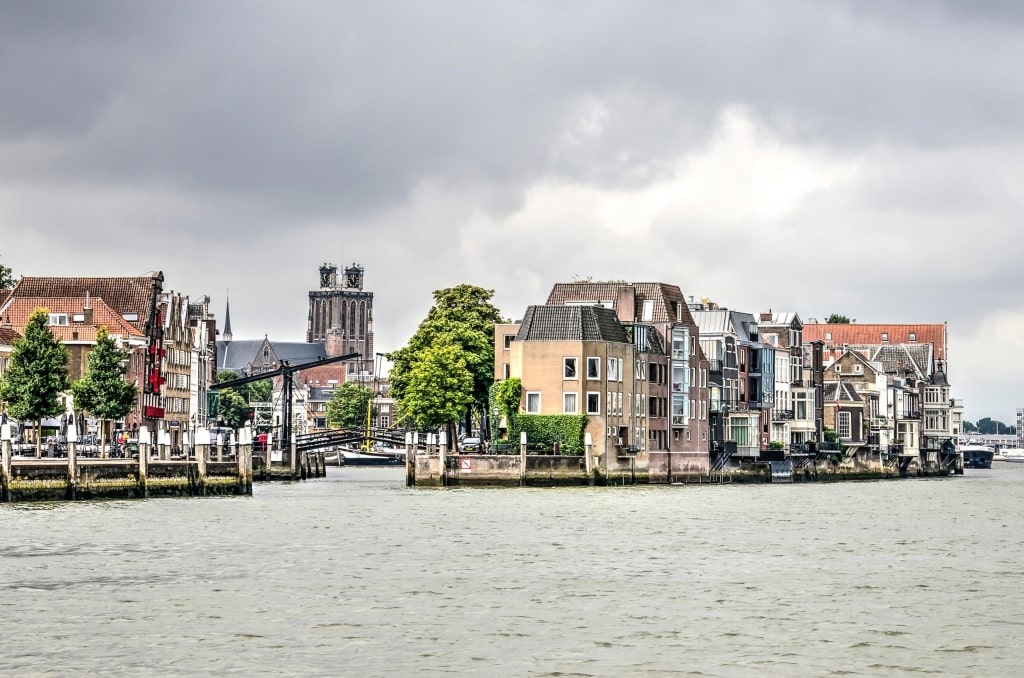
Historic waterfront buildings line the Merwede River in Dordrecht, the Netherlands, with the towering Grote Kerk rising above the city’s picturesque skyline.
The South Holland town of Dordrecht’s past comes alive inside the Grote Kerk, a church that has changed with the city over the centuries. Its intricate design, unfinished tower, and skyline views make the city a standout river cruise destination for a half day or full day of discovery.
For more time in the Netherlands, you can extend your vacation with Before and After Stays by Celebrity River Cruises. The package places you in the heart of Amsterdam on either side of the sailing, allowing you time to explore the city beyond the guidebooks. You’ll enjoy breakfast at your hotel and a daily excursion led by a Local Storyteller℠ or Destination Insider℠, who will immerse you in the city like only a local can.
Start your Dutch journey by exploring Netherlands river cruise itineraries today.