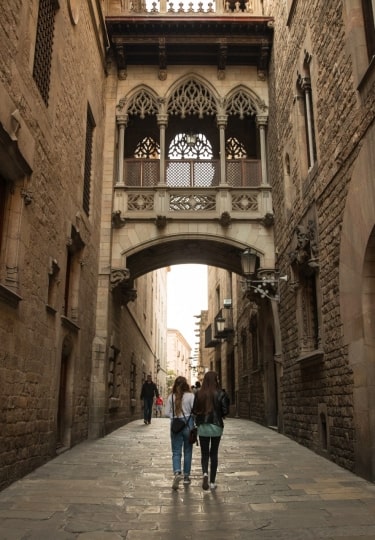
If you’re an avid lover of history and culture and are planning to take a cruise, Barcelona’s Gothic Quarter is worth visiting for its centuries-old architecture, lively plazas, hidden alleyways, and easy access from the Port of Barcelona’s numerous terminals.
Known locally as Barri Gòtic, Barcelona’s Gothic Quarter is the oldest part of the city, exuding charisma and crammed with two millennia of history, including remnants of the city’s Roman past. Bordered by La Rambla, Plaça de Catalunya, the waterfront promenade at Port Vell, and Via Laietana, this buzzing central district is one of the best places to explore, especially for cruise guests looking to experience the heart of Barcelona.
Located just 1.5 miles from the cruise port, guests can spend a few hours to a full day ashore exploring the Gothic Quarter, which is about a 10- to 15-minute drive from numerous popular attractions in the vicinity. Crisscrossing cobblestone lanes, sun-dappled squares, and splendid churches fill this distinct neighborhood. It’s also bursting with tapas bars, coffee shops, and xocolaterias, which specialize in dense hot chocolate and fluffy churros.
Whether your passion is gastronomy or history, or you simply prefer to soak it all up in a vibrant square, here’s everything you need to know about exploring Quarter on a cruise or shore excursion.
Key Takeaways:
- The Gothic Quarter is one of the best places to experience Barcelona’s history, culture, and local atmosphere in a single visit, especially for cruise guests.
- The area is known for its medieval architecture, historic landmarks, and vibrant plazas.
- Major attractions, shopping streets, and dining options are all within easy walking distance inside the quarter.
- This vibrant district is approximately 1.5 miles from Barcelona’s cruise port.
- Most cruise guests can reach the neighborhood in 10 to 15 minutes by taxi, bus, or shuttle.
What Makes Barcelona’s Gothic Quarter Special?
Barcelona’s Gothic Quarter boasts more than 2,000 years of history with the energy of a modern European city.
At the heart of this dynamic neighborhood is the impressive Barcelona Cathedral, surrounded by a labyrinth of narrow lanes, hidden courtyards, and buildings first erected centuries ago. Look closely, and you’ll find remnants of ancient Roman walls woven into the district’s architectural fabric, offering a treasured glimpse into Barcelona’s earliest days.
The Gothic Quarter is also known for its lively plazas, including Plaça Reial and Plaça Sant Jaume, where locals and visitors often congregate to enjoy cafés, street performers, and cultural events. This mix of history and everyday living gives the neighborhood an atmosphere that feels both timeless and distinctly Catalan.
Another reason the area is worth visiting is its location. The Gothic Quarter sits between Port Vell’s waterfront and many of Barcelona’s most popular attractions, making it easy to explore on foot.
For cruise guests, the Gothic Quarter offers an authentic introduction to Barcelona, where medieval streets, local culture, delectable food, and a rich history come together in just a few walkable blocks of memorable exploration.
Where Is Barcelona’s Cruise Port?
If you’re arriving in Barcelona on a cruise, you’ll likely end up at one of two docking locations at the Port of Barcelona, situated near Las Ramblas:
- Moll D’Adossat (Adossat Quay) at terminals A, B, C, D, or E.
- The north and south docks at the World Trade Centre (WTC).
Depending on which terminal you dock at, the Port of Barcelona is roughly 1 mile away from Old Town, 1.5 miles from the Gothic Quarter, and 3 miles from the city center. Cruise guests can take a shuttle, bus, or taxi to visit popular tourist attractions along Las Ramblas and Port Vell, such as the Columbus Monument, the Gothic Quarter, Plaça Reial, Plaça del Pi, or the Barcelona History Museum.
The main transportation hub is located at the WTC, which is the closest of the two cruise hubs to the city center. From there, visitors to Barcelona can take buses, shuttles, or taxis to get to various parts of the city, costing them somewhere between €3 and €20.
How To Get From the Port of Barcelona to the Gothic Quarter
The Port of Barcelona is docked, making arrival, departure, and general travel straightforward for most cruise guests.
The distance between the Port of Barcelona and the Gothic Quarter is around 1.5 miles, with travel times ranging from 10 to 15 minutes by car, bus, shuttle, or taxi. Depending on the exact terminal, adventurous travelers who don’t have a lot of luggage and don’t mind working up a sweat can spend around 30 to 40 minutes walking from the cruise port to the quarter.
The most convenient option to get from the cruise port to the city center is a taxi. A ride to the Gothic Quarter costs roughly €10 to €30, depending on traffic and your exact destination. Taxis in Barcelona are generally wheelchair accessible upon request, although availability may vary.
Many cruise guests use the Portbus shuttle, which connects the Moll D’Adossat terminals with the WTC terminals near the Columbus Monument located at the foot of La Rambla. The shuttle ride takes about five minutes and usually costs a few euros each way. When you reach the drop-off point, it’s generally a 10 to 15-minute walk into the heart of the Gothic Quarter.
Public transportation is another easy choice. From the shuttle stop or nearby areas, you can connect to Barcelona’s metro or city buses. Combined transport costs are usually between €3 and €5, getting you to most parts of the Gothic Quarter quickly.
Rental cars are available at the port and throughout Barcelona, although they’re rarely necessary for exploring the city center. Narrow streets, limited parking, and excellent public transportation make walking, shuttles, taxis, and transit the most practical options for exploring Barcelona’s vibrant Gothic Quarter.
10 Best Things To Do in Barcelona’s Gothic Quarter From the Cruise Port
Barcelona’s Gothic Quarter is packed with historic landmarks, from royal palaces and medieval churches to Roman ruins and hidden squares. Here are 10 unique attractions that reveal the neighborhood’s rich layers of Catalan, Roman, Jewish, and regal history.
1. Stroll through the iconic Barcelona Cathedral

View of Barcelona Cathedral overlooking the historic city center in Barcelona, Spain.
- Name: Barcelona Cathedral.
- Location: Pla de la Seu.
- Opening Hours: 9:30 am to 6:30 pm on weekdays, 9:30 am to 5:15 pm on Saturdays, and 2 pm to 5 pm on Sundays.
- Entry Fee: €16 for individuals and €8 per person for groups.
Barcelona Cathedral is Barri Gòtic’s star attraction. Built between the 13th and 15th centuries on the site of a Roman temple and paleo-Christian church, the Cathedral of the Holy Cross and Saint Eulalia, to give it its full name, is known for its extraordinary Gothic facade.
Fanciful features include a tall, elaborate spire, two smaller spires, and two bell towers. The sensational facade was added much later, in the 19th and early 20th centuries.
Inside, there’s a vaulted ceiling, five aisles, two chapels, and a raised high altar with a view into the crypt, a sacred spot where the body of St. Eulalia is interred.

Visitors outside Barcelona Cathedral in the Gothic Quarter of Barcelona, Spain.
The cathedral’s beautiful cloister, accessed via a Romanesque white marble door, is a tranquil space with palm trees, magnolias, an orange tree, and a fountain. There’s a pond here, too, home to the cathedral’s 13 white geese in honor of St. Eulalia, a martyr who was killed during the persecution of Christians when she was just 13 years old.
Once you’ve explored every inch of the interior, take the elevator to the cathedral’s rooftop for some of the best views in Barcelona. Here, you’ll be greeted by dazzling views of the cloister and the Gothic Quarter’s toothpick-thin alleyways from above.
2. Visit the Palau de la Generalitat de Catalunya

The Palau de la Generalitat de Catalunya, one of Barcelona’s most significant civic landmarks.
- Name: Palau de la Generalitat de Catalunya.
- Location: Plaça de Sant Jaume.
- Opening Hours: Open on the second and fourth weekend every month (except August) for 50-minute guided tours. Also available for tours on special occasions such as Sant Jordi, the National Day of Catalonia (La Diada), and Christmas.
- Entry Fee: Free entry, but visitors need to make a reservation for guided tours in advance.
Barcelona’s Gothic Quarter’s Palau de la Generalitat de Catalunya is no ordinary government building. It’s one of the longest-serving government buildings in Europe, having been the seat of the Government of Catalonia since the 1400s.
The stone facade on Plaça de Sant Jaume features a pleasing symmetrical design, with an elegant central balcony, shuttered windows, and a series of gargoyles set around the top of two pillars.
Inside, the late Gothic main courtyard features a galleried upper floor crowned with 26 striking gargoyles. There’s also the Courtyard of the Orange Trees on the second floor, filled with fragrant citrus trees.
The first floor of St. George Hall, designed as the building’s new chapel in the early 1600s, is a triumph, with three naves, a marble floor, and pillars supporting vaulted frescoed ceilings.

Visitors walk beneath the Pont del Bisbe on Carrer del Bisbe in Barcelona’s Gothic Quarter, Spain.
Admire this glorious building from the plaza outside, or any other surrounding streets, including Carrer de la Ciutat and Carrer del Bisbe. Carrer del Bisbe is the location of a small but extraordinary marble bridge that is synonymous with the Gothic Quarter. El Pont del Bisbe joins Palau de la Generalitat de Catalunya with the Casa dels Canonges and is celebrated as a fantastic piece of Gothic architecture and a real treasure of Barcelona’s old quarter.
3. Walk Through the Roman Necropolis in Plaça de la Vila de Madrid

Ancient Roman tombs at the Roman Necropolis in Plaça de la Vila de Madrid, Barcelona, Spain.
- Name: Roman Necropolis.
- Location: Plaça de la Vila de Madrid.
- Opening Hours: 11 am to 2 pm on Tuesdays; 11 am to 3 pm and 4 pm to 7 pm on Sundays.
- Entry Fee: €2.10 for standard tickets.
The Roman Necropolis is one of Barcelona’s most revered archaeological sites, containing the remains of 95 tombs dating back 2,000 years to the period of the Roman colonia (colony).
The open site is outside the Roman wall in the center of Plaça de la Vila de Madrid, since burials were prohibited inside the Spanish city during the Roman period.
The site was conserved for centuries, with a convent built here in 1588, although this was heavily damaged during the Spanish Civil War (1936-1939). This led to the formation of the square and the discovery of the necropolis in the 1950s, with the site further excavated between 2000 and 2003.
Stroll around the tombs, which are part of a secondary burial site that was reserved for the lower and middle classes. Visit the Interpretation Center to view objects found at the site and to learn more about Barcelona — or Bàrcino as it was then known — during the Roman period, including a fascinating window into the rituals and funeral beliefs of the period.
4. Explore Plaça del Rei

View of Plaça del Rei in Barcelona’s Gothic Quarter, with historic medieval buildings and visitors in the square.
- Name: Plaça del Rei.
- Location: c/ del Veguer, Ciutat Vella.
- Opening Hours: Open to the public year-round.
- Entry Fee: Free.
Plaça del Rei, or the King’s Square, is undoubtedly one of the Gothic Quarter’s most atmospheric spaces, offering a fascinating glimpse into Barcelona’s regal past. This elegant 14th-century plaza is surrounded by the Palau Reial Major, once the residence of the counts of Barcelona and kings of Aragon.
The square’s grand stone buildings create a striking medieval setting, while the Royal Palace complex reveals layers of the city’s history. Admire the vast arches of the Salón de Tinell, explore the Gothic and Renaissance details of the Lloctinent Palace, and step inside Santa Ágata Chapel to see Jaume Huguet’s remarkable 15th-century altarpiece.
History enthusiasts should also explore the celebrated Museu d’Història de Barcelona (MUHBA), or Barcelona History Museum, while walking through the famed square.
With its rich heritage, impressive architecture, and central location, Plaça del Rei is one of the best places in the Gothic Quarter to experience medieval Barcelona, providing an extraordinary glimpse into the city’s historical foundations.
5. Wander Through the Reial Major

View of the Reial Major Palace in Plaça del Rei, Barcelona, Spain, with its Gothic architecture and stone courtyard.
- Name: Palau Reial Major.
- Location: Plaça del Rei, c/ del Veguer, Ciutat Vella.
- Opening Hours: 10 am to 6/7 pm seasonally from Monday to Saturday, and 10 am to 4 pm on Sundays.
- Entry Fee: €26.
The Palau Reial Major is a palace and former royal residence of the counts of Barcelona and kings of Aragon.
The Royal Palace comprises three buildings: the Salón de Tinell, a former throne room, with its rounded grand arches; Santa Ágata chapel; and the Lloctinent Palace, added in the 16th century for the king of Spain.
Stop by the lesser-known Museu Frederic Marès inside the Royal Palace to see its impressive collection of sculptures, including statues from the pre-Roman period. Roam more of Reial Major Palace’s grounds to see fragments of the former Roman wall and marvel at the late Gothic and early Renaissance architecture of Lloctinent Palace.
Inside Santa Ágata Chapel, check out the spectacular 15th-century altarpiece by Jaume Huguet and reach the soaring octagonal tower via the staircase found inside a small room next to the chapel’s altar.
6. Explore the Museu d’Història De Barcelona (MUHBA)
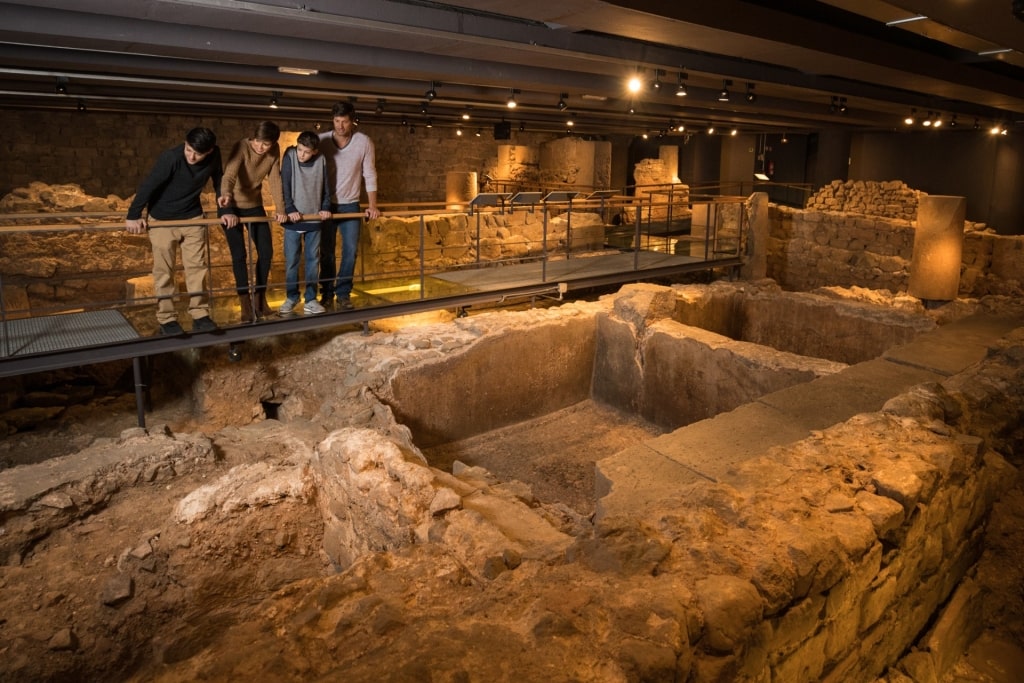
Visitors explore the archaeological ruins at the Barcelona History Museum (MUHBA) in Barcelona, Spain.
- Name: Museu d’Història De Barcelona (MUHBA).
- Location: Plaça del Rei, c/ del Veguer, Ciutat Vella.
- Opening Hours: 10 am to 7 pm from Tuesday to Saturday, and 10 am to 8 pm on Sundays.
- Entry Fee: €5.20 to €7.30.
Beneath the medieval buildings of Plaça del Rei lies one of Barcelona’s most fascinating archaeological attractions. The MUHBA allows visitors to descend below modern street level and explore the remains of ancient Bàrcino, the Roman city that eventually became Barcelona.
Walk through excavated streets, workshops, homes, and public spaces dating back nearly 2,000 years. In the Barcelona History Museum, you’ll see evidence of daily Roman life, including areas used for wine production, fish processing, and textile dyeing.
This museum visit pairs perfectly with the Roman Necropolis in Plaça de la Vila de Madrid, offering a deeper understanding of the city’s Roman heritage. For cruise guests who are history enthusiasts, the MUHBA is one of the Gothic Quarter’s most rewarding experiences.
7. Relax in Plaça Reial

Palm trees and historic buildings surround Plaça Reial in Barcelona, Spain.
- Name: Plaça Reial.
- Location: Ciutat Vella (near La Rambla).
- Opening Hours: Open to the public year-round.
- Entry Fee: Free.
Just off La Rambla, Plaça Reial, also known as the Royal Square, is one of Spain’s great historical treasures. A wide-open space dotted with tall palm trees, Plaça Reial is lined with restaurants and nightclubs with tables flowing onto the stone square, including La Gallega Tobogán and Expat Cafè.
If you have at least three days in Barcelona, take time to relax in Plaça Reial. Indulge yourself with delicious tapas and enjoy a glass of effervescent Cava or a chilled cerveza as you people-watch in this royal plaça.
Check out the ornate lamp posts on Plaça Reial, which were designed by Catalan architect Antoni Gaudí, famed for designing the city’s La Sagrada Familia.
8. Immerse Yourself in the Great Synagogue of Barcelona

The Great Synagogue of Barcelona. Photo by Malik Shabazz on Wikimedia Commons, licensed under CC BY-SA 3.0
- Name: Great Synagogue of Barcelona.
- Location: Carrer de Marlet, 5, Ciutat Vella.
- Opening Hours: 10 am to 2 pm and 2:30 pm to 5:30 pm from Monday to Friday; 10 am to 2 pm on Sundays (summer only).
- Entry Fee: €5 for general admission.
Moments from St. James’s Square, in the El Call district (the Catalan name for the Jewish Quarter), Sinagoga Major de Barcelona, or the Great Synagogue of Barcelona, is one of the oldest in Europe, constructed in the third and fourth centuries.
The remains of the synagogue are nestled in some of the Gothic Quarter’s narrowest streets that were once the center of Barcelona’s Jewish community.
Rediscovered in the late 20th century, the Great Synagogue of Barcelona is now an archaeological site consisting of a two-room museum that also holds private ceremonies such as bar mitzvahs and bat mitzvahs.
Join a guided tour of the synagogue and excavation site to learn more about the building and the rich Jewish heritage of Barcelona’s Gothic Quarter.
9. Drop by the Plaça de Sant Felip Neri

The fountain and historic buildings of Plaça de Sant Felip Neri in Barcelona’s Gothic Quarter, Spain.
- Name: Plaça de Sant Felip Neri.
- Location: Ciutat Vella.
- Opening Hours: Open to the public year-round.
- Entry Fee: None.
This tucked-away plaza is named after the historic Church of Saint Philip Neri that looms over the square.
Plaça de Sant Felip Neri boasts an octagonal fountain in the center of the square, while tall trees and buildings offer plenty of shade. There’s also a lovely restaurant and a single shop selling fragrant handmade soaps on one corner.
Built in the 1700s, the square’s baroque church bears the scars of the Spanish Civil War following an aerial bombing that took place on January 30, 1938. This Spanish church was commandeered for military use during the war and was subsequently bombarded by Franco’s military from the air. The impact of an explosion is visible across the entire lower front facade of the church.
Visit today, and you’ll find Plaça de Sant Felip Neri, one of the most peaceful spots in Barcelona’s Gothic Quarter. Step inside the church, then enjoy a quiet drink or bite to eat at the restaurant as you soak in this beautiful setting.
10. Go to the Basílica de Santa Maria del Pi

The Gothic façade and rose window of the Basílica de Santa Maria del Pi in Barcelona, Spain.
- Name: Basílica de Santa María del Pi.
- Location: Plaza del Pi, the Gothic Quarter.
- Opening Hours: 10 am to 8 pm from Monday to Saturday, and 1 pm to 8 pm on Sundays and holidays.
- Entry Fee: €8 for general admission.
Not to be outdone by Barcelona Cathedral, the 14th-century Basílica de Santa Maria del Pi is another masterpiece of religious architecture.
Basílica de Santa Maria del Pi features wonderful stained-glass windows and an elegant rose window, creating shafts of exquisite light that bathe the church’s single nave.
Opt for a guided tour to explore the bell tower, garden, and crypt, followed by a visit to the basilica’s museum, with its collection of Catalan gold and silver.
Memorable Barcelona Gothic Quarter Shore Excursions
Beyond its major landmarks, the Gothic Quarter rewards curious visitors with excellent shopping and fascinating traces of ancient Roman Barcelona.
Most cruise ships dock in Barcelona for a full day, typically arriving between 5 am and 9 am, and departing between 5 pm and 7 pm. This gives guests plenty of time to explore the Gothic Quarter’s historic landmarks, browse local shops, and experience the city’s rich culture before returning to the ship.
From artisan boutiques and gourmet food shops to centuries-old ruins hidden among medieval streets, there is plenty more to discover between sightseeing stops.
Take a Guided Tour
If you’d prefer to explore with expert local insight, guided walking tours are among the most popular shore excursions in Barcelona. These tours typically combine the Gothic Quarter’s major landmarks with fascinating stories about the city’s Roman, medieval, and Catalan heritage.
Food-focused excursions are another excellent option, offering opportunities to sample tapas, local wines, cured meats, and traditional Catalan specialties. Guests looking to venture farther afield can also choose panoramic city tours that showcase Barcelona’s iconic architecture and waterfront districts.
Read: Things To Do in Barcelona With Kids
Shop for Souvenirs

Pedestrians fill a busy street in Barcelona’s Gothic Quarter, lined with historic buildings and shops in Barcelona, Spain.
If your favorite vacation pastime is shopping for souvenirs, you’ll adore Barcelona’s labyrinthine Gothic Quarter. This is one of the best places to go shopping in Barcelona, as there are boutiques, galleries, gourmet shops, and specialist stores selling everything from books and antiques to mouthwatering Iberico ham.
Make a pilgrimage to La Manual Alpargatera, considered one of the best shopping streets in the Gothic Quarter. It’s the place to buy gorgeous handmade espadrilles on vibrant Carrer Avinyó. Sombrerería Obach is a hat atelier specializing in an array of made-to-measure and off-the-shelf creations, from straw hats to berets.

Vintage glass seltzer bottles displayed among antiques at a market stall, Barcelona.
The narrow Baixada de Santa Eulàlia is a wonderful strip for one-of-a-kind Spanish souvenirs, with a perfumery, antique stores, jewelry, and vintage boutiques.
Browse the boutiques of Carrer del Pi and pick up gourmet goods from the time capsule Xarcuteria La Pineda for all of your cheese and charcuterie needs. Just next door, Xocolates Fargas is the place to grab some sublime confectionery. Just across the street is La Nostra Ciutat, a delightful spot for colorful illustrations of Barcelona and other artisan pieces — homeware, jewelry, and postcards — crafted by local artists.
Read: Souvenirs From Barcelona
Trace Roman Relics

Ancient Roman columns of the Temple of Augustus in Barcelona, Spain, preserved within a historic courtyard.
As well as the Roman necropolis, a smattering of other Roman remnants can be found in Barcelona’s Gothic Quarter, the center of ancient Barcino.
The best place to start is at the Barcelona History Museum. Situated under Plaça del Rei, the museum lies in an extraordinary medieval building on the site of a former Roman factory and workshop. Inside, there’s a vast collection of artifacts to browse.
A few paces away from Palau de la Generalitat de Catalunya and Barcelona Cathedral, on Carrer del Paradís, are the remains of the Temple of Augustus, including four 30-foot Corinthian columns inside the Centre Excursionista de Catalunya. Once part of Barcelona’s Temple of Augustus, dedicated to Emperor Augustus, the columns date back to the first century B.C.
There’s more, including the arches of Roman aqueducts, towers, and walls on Plaça Nova, Carrer de la Palla, Plaça de Ramon Berenguer, and Carrer del Correu Vell for avid history lovers to explore further.
What To Eat in Barcelona’s Gothic Quarter: Local Food and Dining Guide
Barcelona’s Gothic Quarter is one of the city’s most rewarding places to eat, where centuries-old restaurants, bustling tapas bars, and sun-filled plazas showcase the flavors of Catalonia. From fresh seafood and Iberian ham to cava and traditional tapas, there’s something to suit every cruise guest’s taste.
What Food Is Barcelona’s Gothic Quarter Known For?
Barcelona’s Gothic Quarter is one of the city’s best places to sample classic Catalan cuisine, from crispy croquettes and garlic shrimp to tomato-rubbed bread served with acorn-fed Iberian ham. Tapas bars spill into lively plazas, cava flows freely, and seafood features prominently on many a menu in the neighborhood.
Vegetarians and vegans will find plenty of options, too, including:
- Dishes with grilled seasonal vegetables.
- Hearty bean stews.
- Catalan flatbreads topped with fresh local ingredients.
- Vegan empanadas, gazpacho, and churros.
Best Restaurants in the Gothic Quarter
From historic dining rooms that once welcomed artists and intellectuals to lively terrace cafés serving sangria and tapas, the Gothic Quarter is packed with memorable places to eat. Cruise guests can look forward to delectable Catalan specialties, fresh seafood, local wines, and atmospheric plazas — all within easy reach of Barcelona’s many cruise port terminals.
Els Quatre Gats

Els Quatre Gats. Photo by Jaume Meneses on Wikimedia Commons, licensed under CC BY-SA 2.0
Opened in 1897, Els Quatre Gats, or the Four Cats, is a Gothic Quarter institution, based on Paris’ famed Le Chat Noir cabaret venue.
The Four Cats has appeared in a Hollywood movie and was the location of Pablo Picasso’s first exhibition in 1899, and remains one of Barcelona’s most storied restaurants.
Dine on a selection of marinated anchovies with sherry and apple cider vinegar, acorn-fed Iberian ham, fried baby squid, and cod croquettes in either the more casual gastro-bar or restaurant.
Les Quinze Nits

A traditional Spanish dish of chipirones (baby squid) served over crispy fries at Les Quinze Nits in Barcelona, Spain.
On a convivial corner of Plaça Reial, with tables lining the outdoor terrace, Les Quinze Nits is one of the best people-watching restaurants in Barcelona.
This fantastic spot for food in Barcelona is perfect for ordering a selection of dishes for the table, along with carafes of sangria. Savor dishes such as baby octopus, crispy eggplant, and tomato-rubbed coca bread (a style of Catalan flatbread).
There’s a plant-heavy appetizer section, a paella menu with vegan, seafood, and meat choices, and mouthwatering main courses, such as the white-bean hummus and monkfish stew with clams and potatoes.
El Salón
This Barcelona bistro is a romantic spot for a relaxed lunch. Enjoy a glass of crisp rose cava on the restaurant’s Plaça dels Traginers terrace. Face the Roman city walls as you browse a diverse menu of salads, appetizers, fish, and meat.
The fish selection is a highlight, including swordfish carpaccio and grilled squid with white beans. Don’t skip the arugula, pear, Iberico ham, and buffalo mozzarella salad, plus the sublime pumpkin and sweet potato soup with mascarpone and crispy ham.
There aren’t many vegetarian choices, though. With that said, the eggplant terrine with a goat’s cheese gratin is a tasty option.
Bodega Biarritz 1881 Tapas Bar

Traditional Spanish tapas with crispy pork bites, olives, and vermouth served at a restaurant in Barcelona, Spain.
For an outstanding menu of tapas in a charming setting, the intimate Bodega Biarritz 1881 on Carrer Nou de Sant Francesc is a standout Gothic Quarter restaurant.
Sit at the bar or choose a table to savor dishes of roast tomato tarte tatin, garlic shrimp, Iberian ham in puff pastry, and smoked chorizo with steamed apples.
Typically open from 1 pm until late, Bodega Biarritz 1881 is a no-reservation restaurant with a warm, rustic vibe.
Practical Tips for Visiting Barcelona’s Gothic Quarter on a Cruise
A little preparation can help you make the most of your time in Barcelona’s Gothic Quarter. From packing tips and seasonal weather to local customs, transportation, and travel documents, here’s what guests need to know before exploring this historic neighborhood from the cruise port.
What To Pack
Pack comfortable walking shoes year-round, as Barcelona’s Gothic Quarter is best explored on foot. In summer, bring lightweight clothing, sunglasses, a water bottle, a hat, and sunscreen. For spring and fall, add light layers and a jacket for cooler evenings. Winter calls for warmer layers, a coat, and an umbrella for occasional rain. Make sure you also pack a European travel adapter to charge your devices with.
Best Time to Travel

Visitors stroll through Plaça Reial, a palm-lined square surrounded by historic arcades in Barcelona, Spain.
Expect pleasant temperatures in Barcelona’s Gothic Quarter during spring and fall in Spain, with lows of around 60°F and highs of 73°F. If you’re visiting during summertime, the city’s peak season, expect highs of around 85°F. Though there is plenty of shade in the Gothic Quarter, wear SPF and carry water to remain hydrated.
The Gothic Quarter is one of Barcelona’s most popular neighborhoods and can therefore get busy during peak season. I recommend opting for an early visit to beat the crowds.
Travel Documents You’ll Need
Most travelers visiting Barcelona on a cruise will need a valid passport with at least six months’ validity after their cruise ends. Visa requirements depend on your nationality and itinerary, so check the latest entry requirements for Spain and any other countries included in your cruise before departure. Generally speaking, most visitors are allowed to be in Spain, including Barcelona, for up to 90 days within a 180-day period without needing a visa.
What To Expect When You Arrive
Spanish and Catalan are Barcelona’s primary languages, though English is widely spoken in hotels, restaurants, and major tourist attractions. Expect to do plenty of walking over cobblestone streets in historic areas such as the Gothic Quarter and beyond. Free Wi-Fi is common in cafés and public spaces in the quarter, while local SIM cards offer convenient data access.
How To Get Around
This compact quarter of Barcelona is easy to cover on foot. It’s possible to visit all of the major attractions here and still have time to shop and relax over a meal or drink in a sun-drenched square. The Gothic Quarter is generally safe and well-patrolled. With that said, you’d be wise to keep an eye on your belongings in busy squares and along popular streets. You should also watch out for opportunistic theft in the form of pickpockets and bag-snatchers in crowded areas.
Currency and Tipping
The currency of Spain is the euro. Cards are accepted all over Barcelona, but if you want to pay with cash, there are plenty of ATMs around the Gothic Quarter. Tipping is optional in Barcelona, but you can leave around 10 percent for good service. Check first to see if service is included (“servicio incluido”) on your bill.
Read: What Is Barcelona Known For?

Visitors walk past restaurants and historic buildings in Barcelona’s Gothic Quarter, Barcelona, Spain.
Sail to Barcelona With Celebrity Cruises
Barcelona is one of the Mediterranean’s premier cruise ports and a gateway to some of Europe’s most captivating destinations. With Celebrity Cruises®, you can also explore Mediterranean cruise itineraries and discover voyages that include Barcelona and Valencia alongside iconic ports across Southern Europe, such as France, Italy, and the Greek Isles.
Once ashore at the Port of Barcelona, guests can choose from a variety of experiences, from guided walks through the Gothic Quarter and visits to architectural landmarks to culinary tours showcasing Catalan cuisine at its finest. Back on board, continue your Mediterranean journey with destination-inspired dining, enriching entertainment, and the elevated experiences that define Celebrity.
Browse cruises to Barcelona to experience the wonderful atmosphere of the Gothic Quarter on an unforgettable Mediterranean getaway.
Frequently Asked Questions About Barcelona’s Gothic Quarter
What is the Gothic Quarter known for?
The Gothic Quarter is known for its medieval streets, centuries-old architecture, hidden plazas, and Roman ruins. As Barcelona’s historic heart, it’s home to landmarks such as the Barcelona Cathedral and the Plaça del Rei, along with vibrant tapas bars, shops, and numerous cultural attractions for every kind of traveler.
Where is the Gothic Quarter in Barcelona?
The Gothic Quarter, or Barri Gòtic, is located in the heart of Barcelona’s Old Town, between La Rambla and Via Laietana. It’s a short distance from the city’s cruise port and many of Barcelona’s most famous attractions.
Is Las Ramblas the same as the Gothic Quarter?
No, they aren’t. Las Ramblas only forms part of the Gothic Quarter’s western border, but it’s actually a long stretch of road connecting the Port of Barcelona’s cruise ports to the heart of the city center and many other tourist attractions.
Where do cruise ships dock in Barcelona?
There are two main cruise docks in the Port of Barcelona, which is located on Las Ramblas: the Moll D’Adossat (Adossat Quay) and the World Trade Centre (WTC). Moll D’Adossat has five terminals (A, B, C, D, and E) while the WTC has two terminals on the northern and southern sides.
How do you get from the Barcelona cruise port to the Gothic Quarter?
You can take a cruise shuttle, use public transportation, or walk to get from the Port of Barcelona to the Gothic Quarter. Be sure to check your cruise itinerary for more details to choose the best mode of travel for your preferences.
Can you walk from the cruise port to the Gothic Quarter?
You can walk from the various terminals at the Port of Barcelona, but it will take you roughly 30-40 minutes, which is cumbersome in hot weather while carrying lots of luggage. Instead, cruise guests should take a shuttle or taxi from the cruise terminals to their accommodation or into the heart of the city, which takes 10 to 15 minutes in comparison.
What time do cruise ships arrive and leave in Barcelona?
Cruise ship arrival and departure times in Barcelona vary by itinerary. Most ships arrive early in the morning, usually between 5 am and 9 am, then typically depart in the late afternoon or evening between 5 pm and 7 pm. Always confirm times with your cruise line to avoid any hiccups during your cruise and land excursions.
How long should you spend in the Gothic Quarter?
Most visitors spend two to four hours in the Gothic Quarter, which is enough time to see major landmarks, browse local shops, and enjoy a meal. If you’re a history or photography lover, you can easily spend half or even a full day exploring and capturing this unique district’s many streets and plazas.
What is there to do in the Gothic Quarter?
There’s so much to do in Barcelona’s Gothic Quarter, with its medieval streets, historic churches, lively plazas, boutique shopping, museums, and excellent restaurants. Visitors can explore the Great Synagogue of Barcelona or the royal palace at Plaça del Rei, discover Roman ruins, relax in charming squares, and enjoy tapas, seafood, and other Catalan specialties.
Is the Gothic Quarter safe at night?
Yes, the Gothic Quarter is generally safe at night and remains busy with residents, diners, and visitors. Like any major city, visitors should be aware of their surroundings, keep valuables secure, and take extra care in crowded areas where pickpocketing and bag-snatching may happen.
What is the best time of year to visit Barcelona?
With optimal temperatures ranging from 60°F to 85°F, 300 days of sunshine a year, and lots of things to do, you can visit Barcelona at almost any time of the year.
Summer (June to September) is one of the best times to visit Barcelona, with hot weather during the day and cool weather at night. Visitors can enjoy epic water sports, idyllic beach trips, music festivals like Sónar, or admire the superb architecture of the Sagrada Família and Park Güell.
If you don’t like big crowds or hot weather, you can also travel to Barcelona in late fall and early winter, between October and December. During this time, you can attend the Barcelona Jazz Festival or sample delicious food with a traditional calçotada, a wintertime barbecue, as snow dusts the northern part of the city.
What language do they speak in Barcelona?
Catalan and Spanish are the main languages in Barcelona, though you’ll likely hear many more languages spoken on any given day in the city. English is also spoken widely in popular tourist areas like Las Ramblas, La Sagrada Família, and Park Güell.
What currency is used in Barcelona?
The euro (€) is used throughout Spain, including Barcelona. You can exchange any foreign money, including US dollars ($) or UK pounds (£), before your cruise or after you arrive in Barcelona. There are several licensed bureaus de change and ATMs in tourist locations like Las Ramblas and Avinguda Paral-lel. You can also make card payments at most local establishments, so you don’t need to carry too much cash with you.
How much should I tip in Barcelona?
It’s totally up to you. Tipping isn’t mandatory in Barcelona, but it’s appreciated by local businesses. A good rule of thumb is to check if a “servicio incluido” (service fee) has been added to your bill or not. Generally, it’s ok to tip about 10% if you’re feeling generous, which translates to roughly 1 to 2 euros. Make sure you tip in cash or coins and not via electronic payments, though; that way, you can rest assured your tip ends up in the right hands.
Do you need a passport to visit Barcelona?
Most visitors to Barcelona, particularly cruise guests, need a valid passport with validity for six months after their travel dates. Visa requirements depend on your nationality and travel plans, but travelers can generally stay in Spain for up to 90 days during any 180-day period. Before your cruise, check the latest entry requirements for Spain and any other countries included in your itinerary.