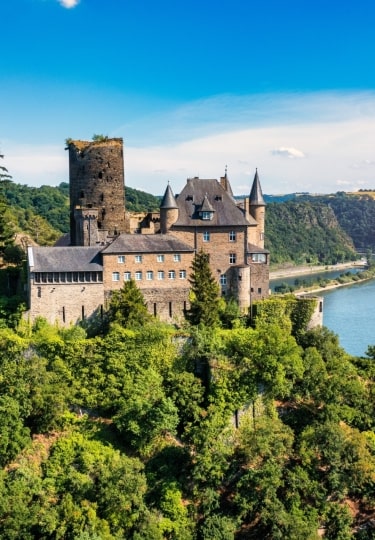
From Bonn and Cologne in the north to Heidelberg Castle in the south, you will find all the most beautiful castles on the Rhine river. Some 40 survive between Koblenz and Rüdesheim alone, guarding almost every bend and looking down from cliff tops on the dramatic valley of the Middle Rhine.
In earlier times, when the Rhine was even more of a major thoroughfare, these castles served as strongholds, toll stations, and the homes of robber barons. Many were renovated in the Romantic period of the 18th and 19th centuries, when ornate turrets, follies, and crenelated walls added even more beauty to their picturesque settings.
Here are 15 of the most beautiful Rhine river castles.
Schloss Drachenburg, Cologne
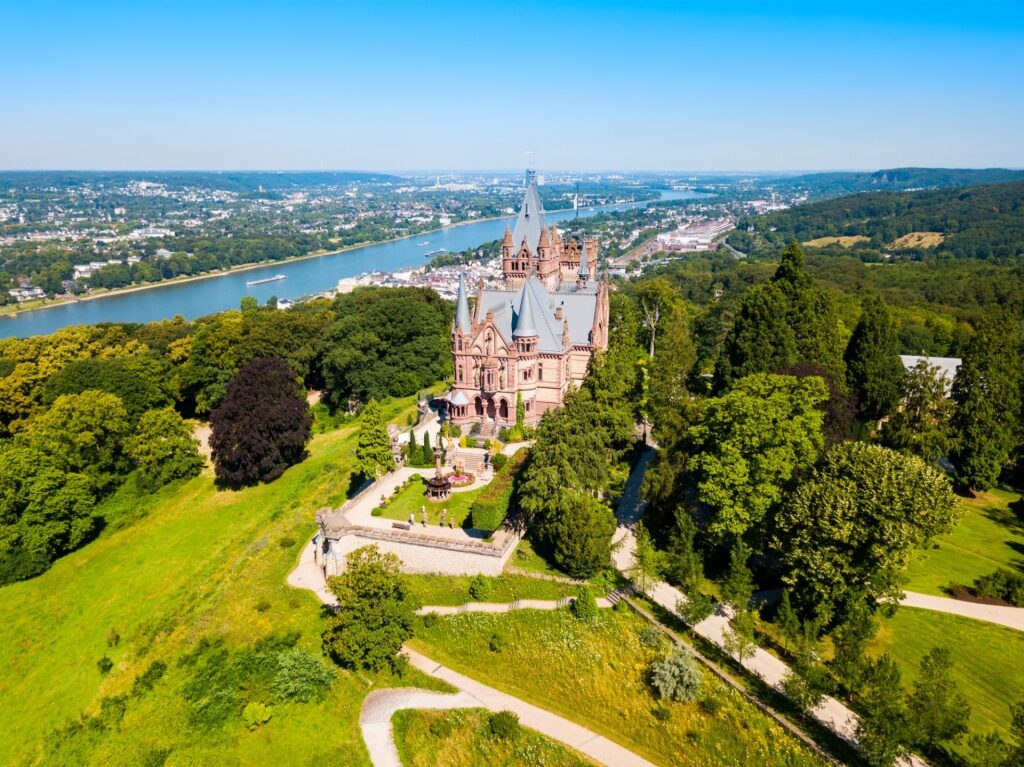
Schloss Drachenburg, Cologne
This flamboyant 19th-century castle in Germany may look medieval but was actually built in 1884 as a private villa. In the decades since, it has served as a Nazi school and a railway training facility.
Restored in recent years, its views over the Rhine Valley from Drachenfels hill are as spectacular as ever. Inside, the opulent rooms are furnished in original style and lit by stained glass windows.
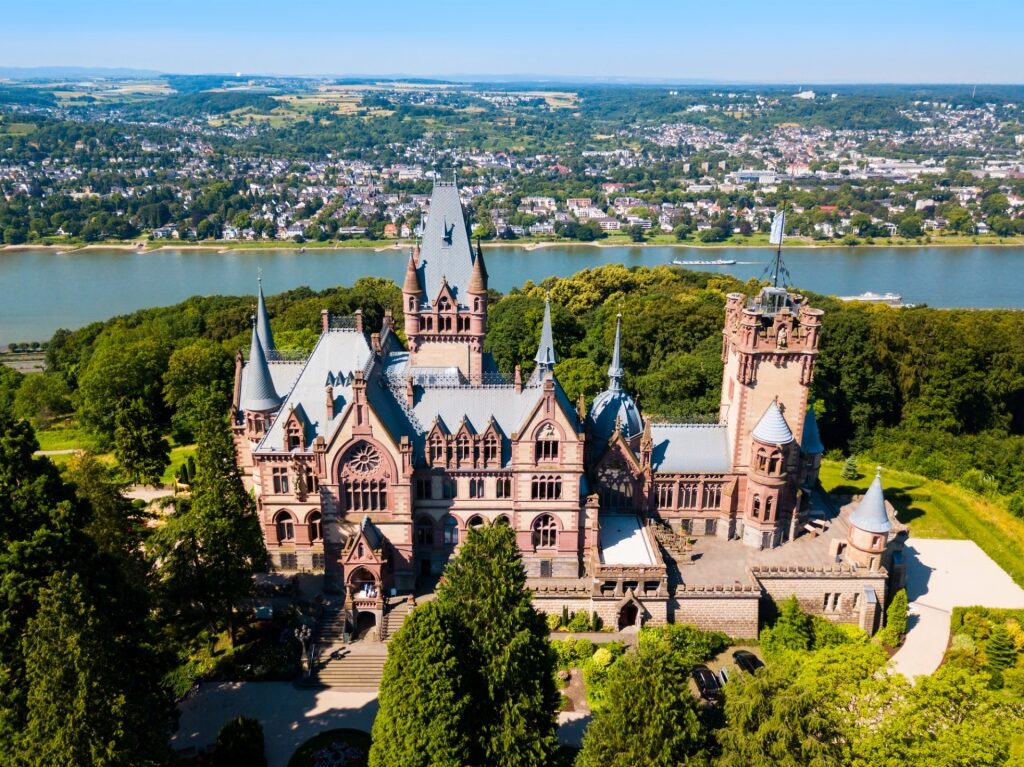
Schloss Drachenburg, Cologne
The climb up to the castle is long and steep but it’s also served by the Drachenfelsbahn, Germany’s oldest cog railway. The railway carries on up to the ruins of Drachenfels castle, where Siegfried slayed the dragon in the Nibelungenlied epic.
Festung Ehrenbreitstein, Koblenz
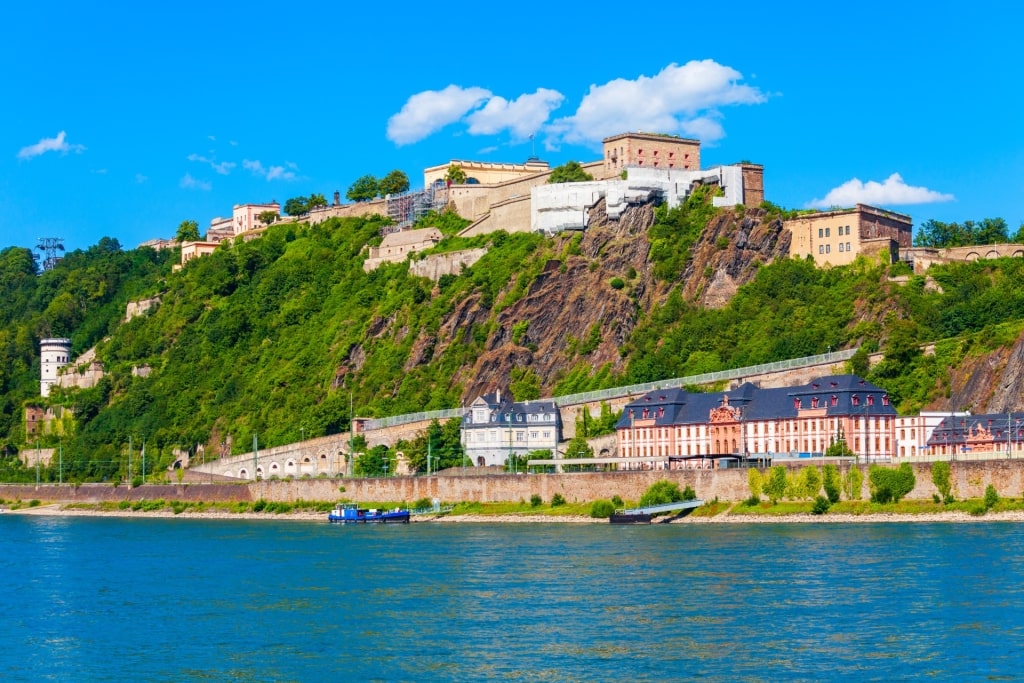
Festung Ehrenbreitstein, Koblenz
No one would call Ehrenbreitstein beautiful in the classical sense but it is certainly handsome—and impressive—as one of Europe’s largest fortresses. The Prussians built it between 1817 and 1828 as a symbol of their power, using the latest in military technology.
Considered impregnable, Festung—meaning Fortress—Ehrenbreitstein never faced a serious siege and was even spared WWII bombing because of its significant art collection. It now houses several museums, including ones on regional history and photography.
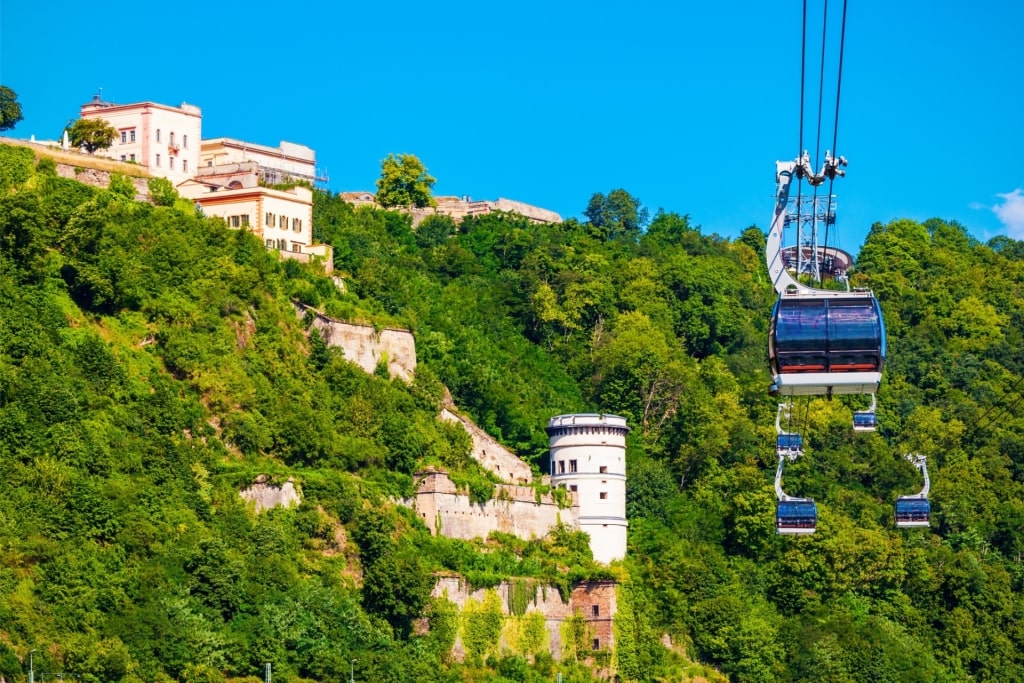
Koblenz Cable Car
Take the cable car ride up for great views over Koblenz and the Rhine-Moselle confluence. You might be lucky enough to come across a concert or festival, while the beer garden is a perfect spot for taking in the panorama below.
Burg Stolzenfels, Koblenz
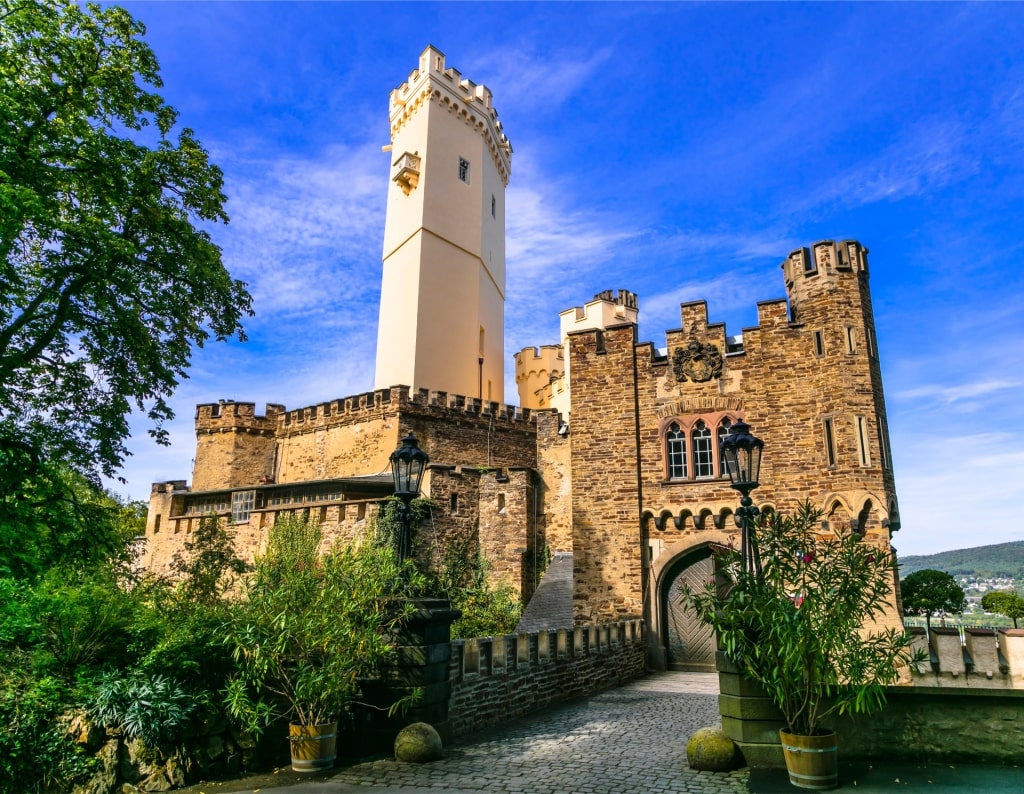
Burg Stolzenfels, Koblenz
Frederick William IV of Prussia is responsible for the fairy-tale look of Stolzenfels, having rebuilt it in medieval style in 1823. The original 14th-century castle had been destroyed by the French in 1689.
That cream-coloured exterior hides a splendid Gothic Revival interior, with all the 19th-century comforts of a king. The Knights’ Hall has some interesting frescoes and the wood carving throughout is exquisite.
The castle is approached by a walk up a tree-filled gorge with a waterfall. You’ll then come through English and Italian-style terraced gardens, which are especially lovely in spring and summer.
Marksburg, Koblenz
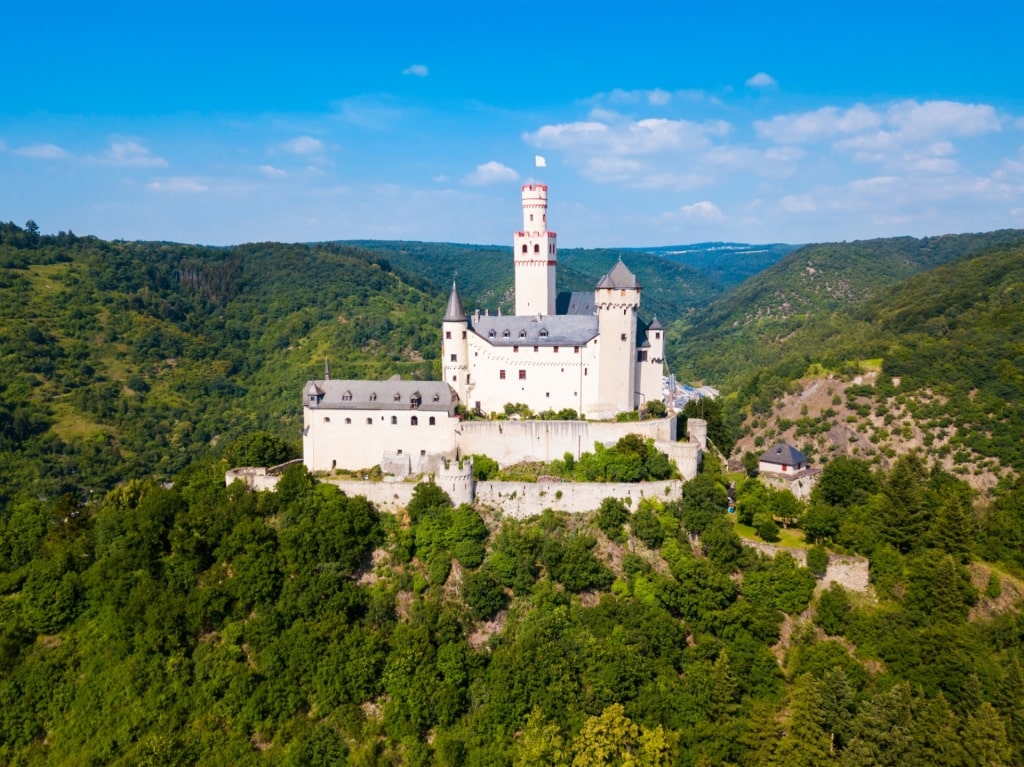
Marksburg, Koblenz
Of the 40 hill castles between Bingen am Rhein and Koblenz, Marksburg is one of only two which have never been destroyed. That’s mostly due to its excellent defensive position and partly good luck.
Sitting 500 feet above the Rhine near Braubach, it has been continuously inhabited for more than 700 years. That has helped preserve its original medieval living quarters and kitchen, complete with a massive fireplace. Outside, there’s a wonderful herb garden, where only herbs that were available during medieval times are grown.
The armory has a collection of weapons and armor spanning several centuries and a spine-chilling torture chamber. The castle was a prisoner-of-war camp for Allied officers during WWII, one part of its history best heard on a guided tour.
Burg Katz, Koblenz
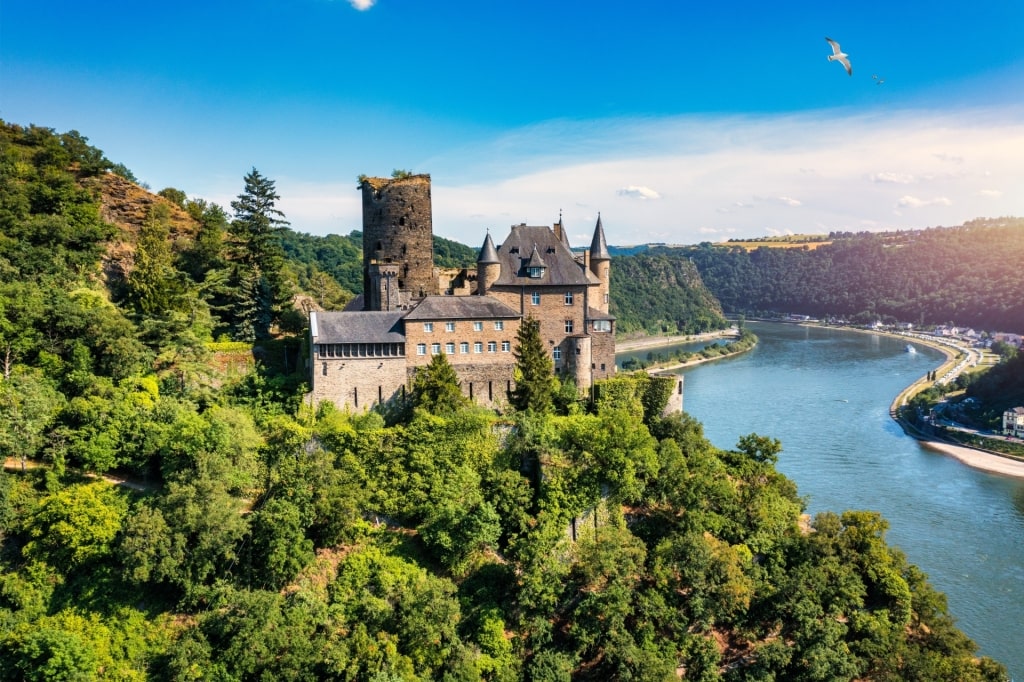
Burg Katz, Koblenz
“Cat Castle” is paired with nearby Burg Maus—“Mouse Castle”—with both not far from the legendary Lorelei Rock. A beautiful maiden was said to sit on the rock, luring sailors to their death with her haunting songs.
Built in the 14th century, both Burg Katz and Burg Maus merely separated sailors from their cash in the form of tolls. Burg Katz stands out for its massive circular residential tower, Bergfried, high defensive walls, and towers.
Burg Maus has the distinction of being the only Rhine castle other than Marksburg to survive intact. Built as a lookout point rather than a fortification, its slim tower is still an evocative sight guarding the river.
Burg Rheinfels, Koblenz
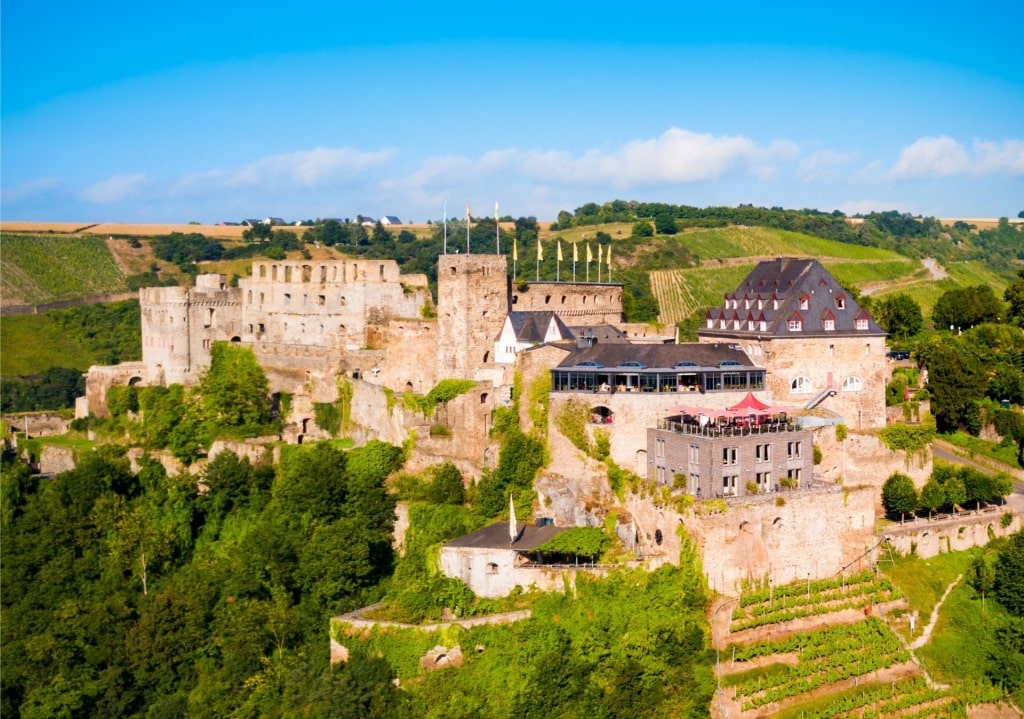
Burg Rheinfels, Koblenz
Once the largest castle on the Rhine, Rheinfels is now a magnificent ruin standing above St. Goar. Built in 1245, it successfully withstood one of the most famous sieges in German history in 1692.
Key to that survival was a set of tunnels which you can still visit today by lantern light. This thrilling experience is complemented by an interesting small museum detailing the castle’s history.
Sadly, Rheinfels’ fortifications were destroyed in 1797 by the French Revolutionary Army. From its ruined battlements, you can still appreciate the strategic setting overlooking the Rhine and Lorelei Rock.
Pfalzgrafenstein, Koblenz/Mainz
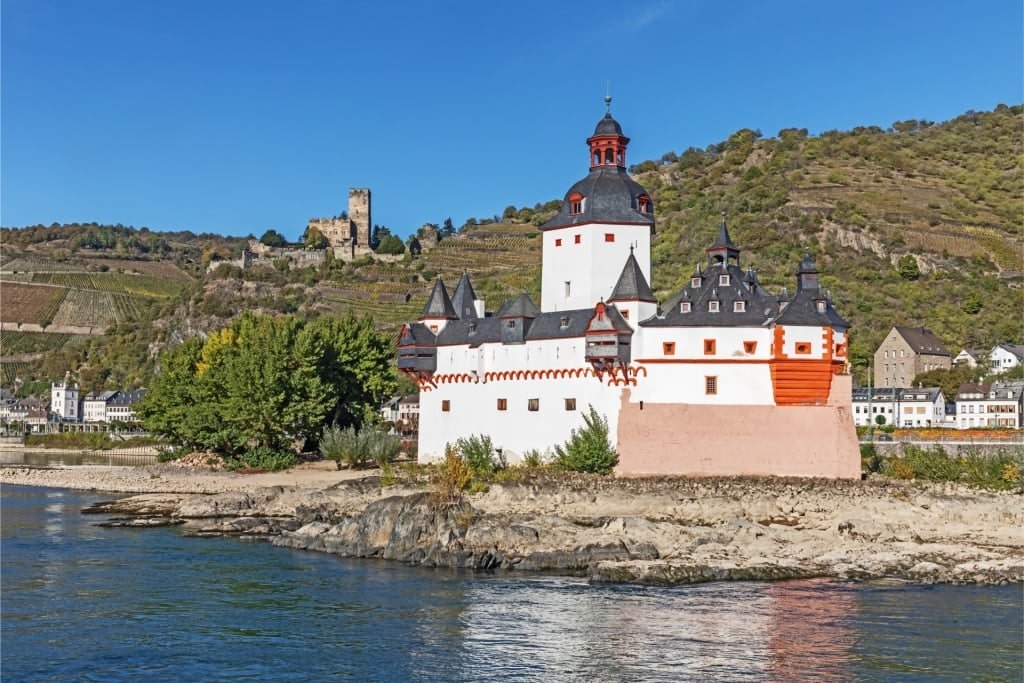
Pfalzgrafenstein, Koblenz/Mainz
The Rhine’s most unusual castle stands like a boat-shaped island in the middle of the river near Kaub. It was built in 1327 as a toll station, guarding a chain across the river, and generated enormous wealth for its owners.
The pentagonal design and whitewashed walls with red and pink detailing give Pfalzgrafenstein a unique look. Inside, the cramped interior has rooms built into its walls and a tiny chapel in the tower.
The castle, now a museum only open Thursday through Sunday, is reached by ferry from Kaub. Don’t miss the dungeons, which were flooded twice daily by the Rhine—quite an incentive for toll debtors to pay up.
Burg Schönburg, Koblenz/Mainz
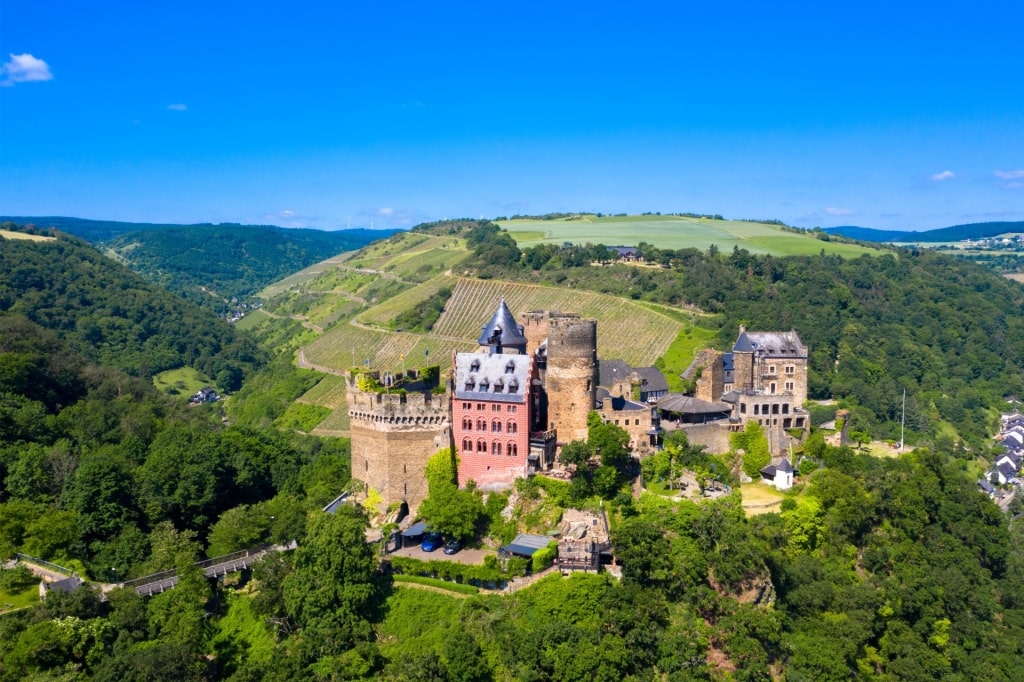
Burg Schönburg, Koblenz/Mainz
The multiple towers and turrets of Schönburg Castle create a distinctive silhouette, especially when lit by the afternoon sun. The Rhine is calm at this point so it’s not unusual to also see its reflection in the river.
Seeing this Rhine castle rising above the red rooftops of Oberwesel is one of the most picturesque sights on the river. It’s now a luxury hotel but a museum in one tower details its 700 years of history, with some medieval siege weapons.
The tall curtain wall is literally a stand-out feature, still intact at 60 feet in height. Its width conceals hidden passages designed for defenders to surprise attackers.
Burg Stahleck, Koblenz/Mainz
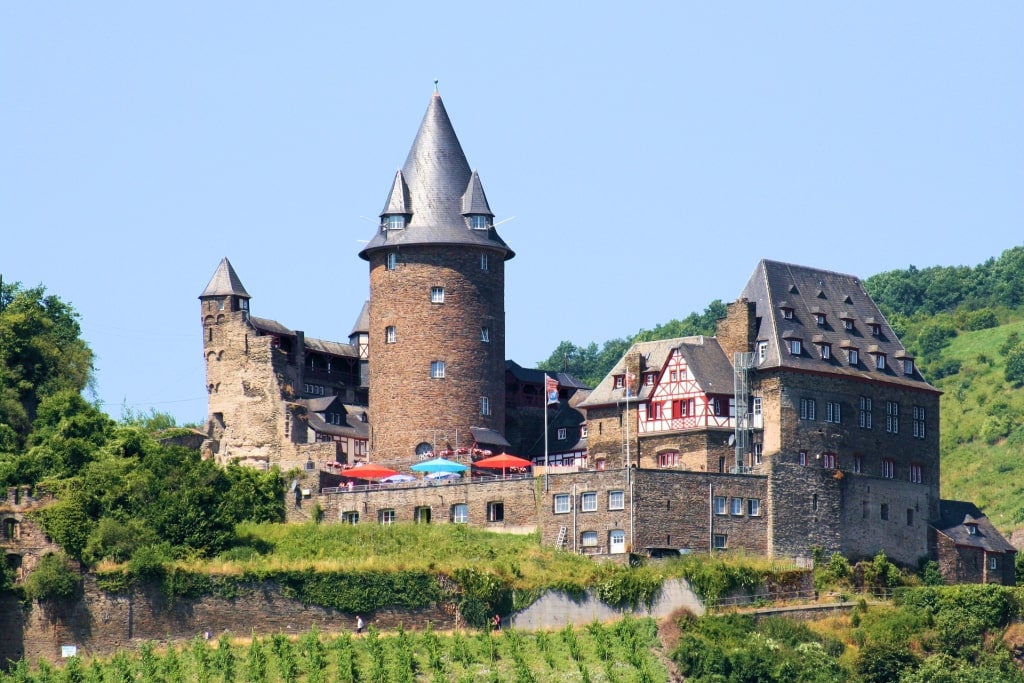
Burg Stahleck, Koblenz/Mainz
Stahleck, high above the wine town of Bacharach, is one of the few Rhine river castles you can actually sleep in. Built in the 11th century, and destroyed by the French in 1689, it was reconstructed as a youth hostel in the 1960s.
The restoration kept the castle’s medieval character while adding modern amenities. Its massive keep and imposing curtain wall, rising almost seamlessly out of solid rock, must have been an intimidating sight to attackers.
You don’t have to sleep in the hostel to enjoy the castle’s Rhine panorama. Visitors can access the main courtyard where the low parapet allows unrestricted views over the Lorelei Valley.
Burg Sooneck, Mainz
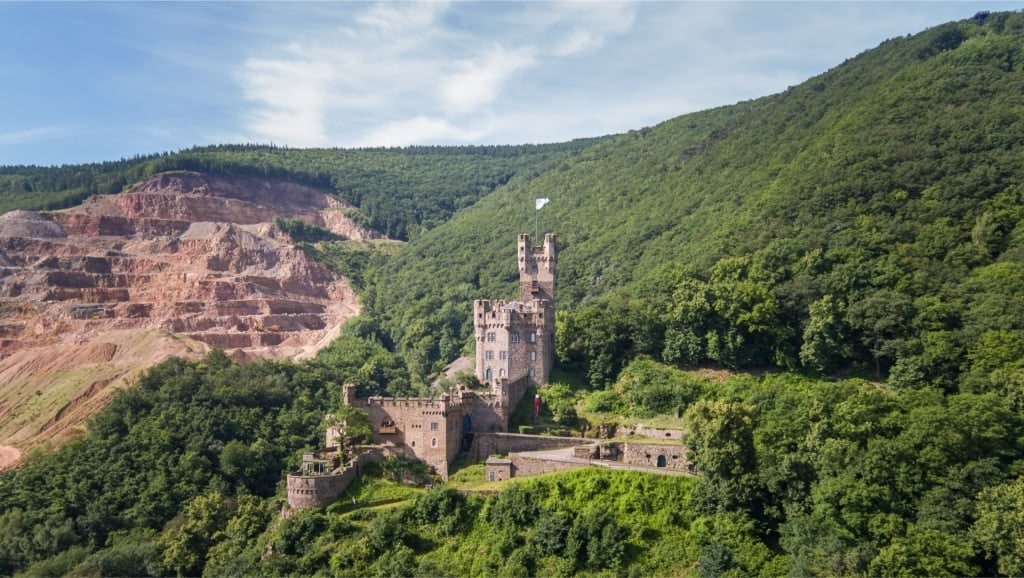
Burg Sooneck, Mainz
Towering over dense forest above the Rhine, Sooneck Castle has a dark reputation to match its gloomy setting. It’s a former robber baron stronghold, built in the 11th century, that became notorious for attacks on shipping below.
In 1282, King Rudolf of Habsburg solved the problem by destroying both Sooneck and its equally nefarious neighbor Reichenstein. The castle was eventually restored in the 19th century as a picturesque ruin-turned-residence.
This reconstruction mixes medieval elements with 19th-century romanticism, with rooms decorated in period furniture and fierce weaponry. Guided tours describe its past role in controlling—and disrupting—river traffic.
Burg Reichenstein, Mainz
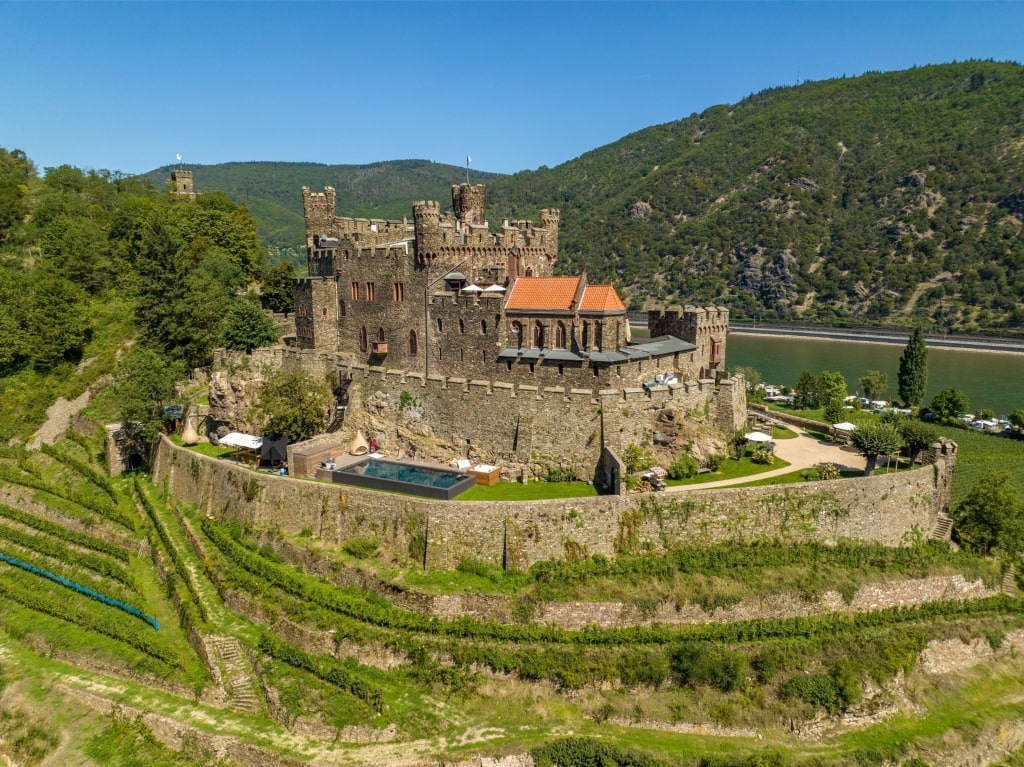
Burg Reichenstein, Mainz
Another former robber baron castle, Reichenstein rises straight from a cliff above Trechtingshausen. Built in the 11th century, it was destroyed in 1282 because of its owners’ Rhine piracy.
A neo-Gothic reconstruction in 1899 saw it transformed into a medieval showpiece. It’s filled with period artifacts, including armor, weapons, and medieval art.
There’s even a torture chamber, dungeon and, in contrast, a chapel with original frescoes. The gardens are another peaceful spot to take in the Rhine view.
Burg Rheinstein, Mainz
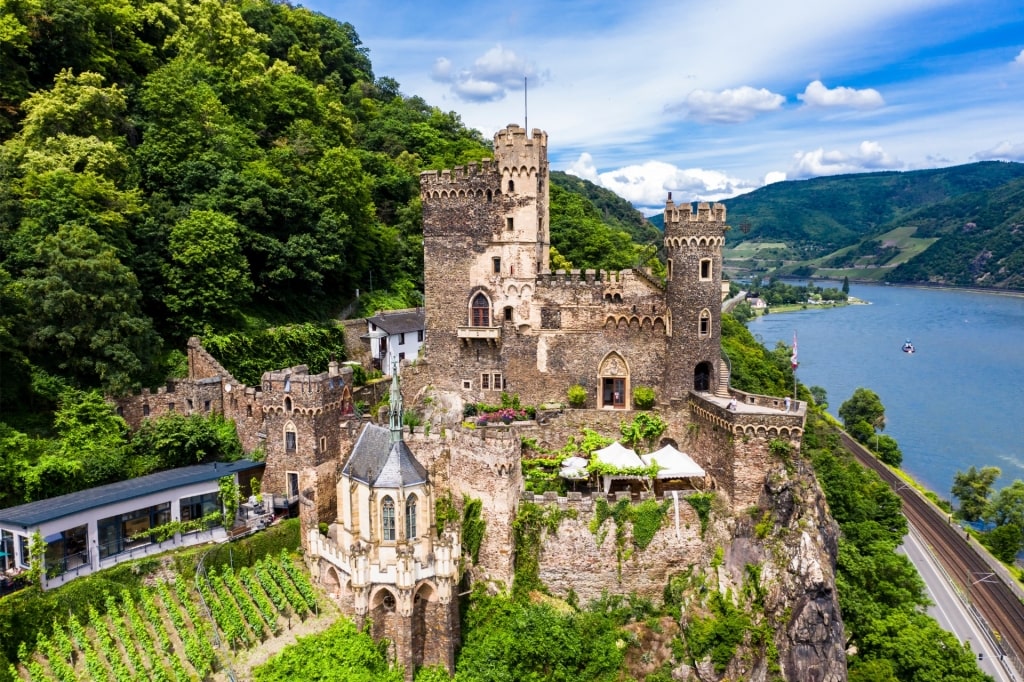
Burg Rheinstein, Mainz
Perched dramatically almost 300 feet above the Rhine near Trechtingshausen, Burg Rheinstein was built between 1306 and 1320. That makes it one of the oldest castles on the Rhine river.
Its original purpose—as with many of these castles—was to control river traffic but it was also a residence. Falling into disuse, it was then bought in the 19th century by Prince Frederick of Prussia who restored it in Romantic style.
That restoration includes a working drawbridge and portcullis, and rooms filled with period furniture and armor. A highlight is the neo-Gothic chapel—where Prince Frederick is buried—with a carved altarpiece that depicts the Last Supper.
Burg Klopp, Mainz
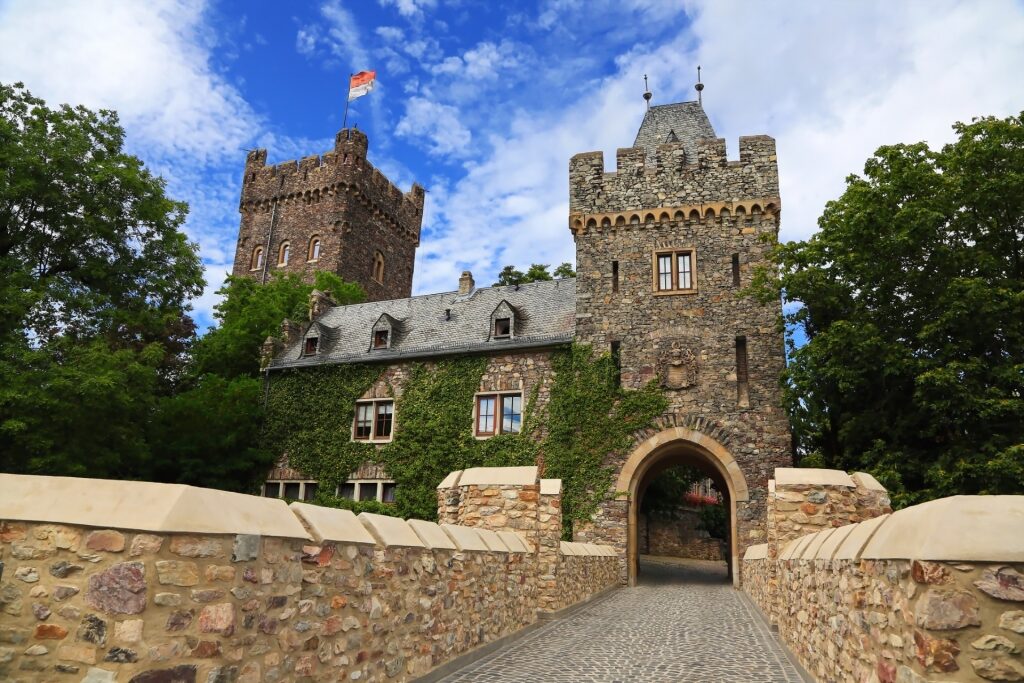
Burg Klopp, Mainz
Burg Klopp is the oldest castle of the Middle Rhine, with origins in a Roman fort built around 10 CE. It controlled river traffic at the strategic point where the Nahe River joins the Rhine.
Sitting on a hill above Bingen am Rhein, the castle was restored in the 1850s in neo-Gothic style. The distinctive crenelated tower gives you great views over the Rhine Valley.
Still used as offices by the local government, Klopp Castle has a fine dining restaurant but is otherwise usually closed to the public during the day. Burg Rheinstein is the nearest Rhine castle open to visitors.
Burgruine Ehrenfels, Rüdesheim
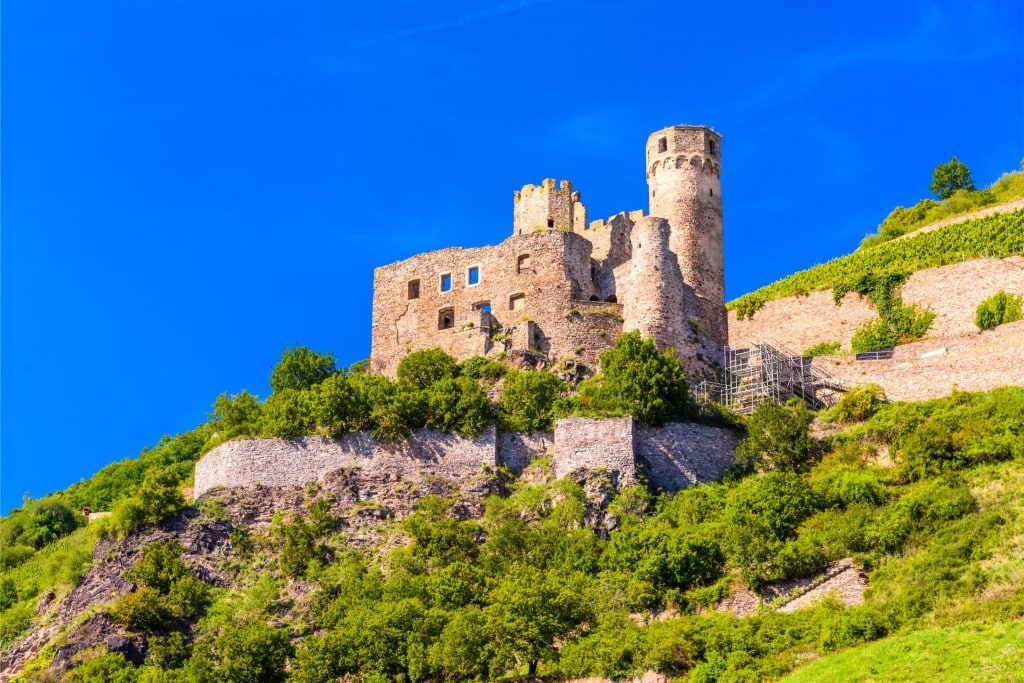
Burgruine Ehrenfels, Rüdesheim
Ehrenfels stands in ruins—“Burgruine” means “ruined castle”—above Rüdesheim, overlooking the strategic Bingen Gap in the river. It’s opposite Burg Klopp at a point where the slow-moving Upper Rhine enters the dramatic, much narrower Middle Rhine gorge.
The castle was built in 1210 by the Archbishops of Mainz as a toll station for river traffic. Its defenses included the nearby Mäuseturm, or Mouse Tower, from which a chain was stretched across the water.
This key position made it a major prize during regional power struggles and it was destroyed by the French in 1689. Never rebuilt, its evocative ruins feature heavily in German Romantic literature and Rhine tourism promotion.
Schloss Heidelberg, Speyer
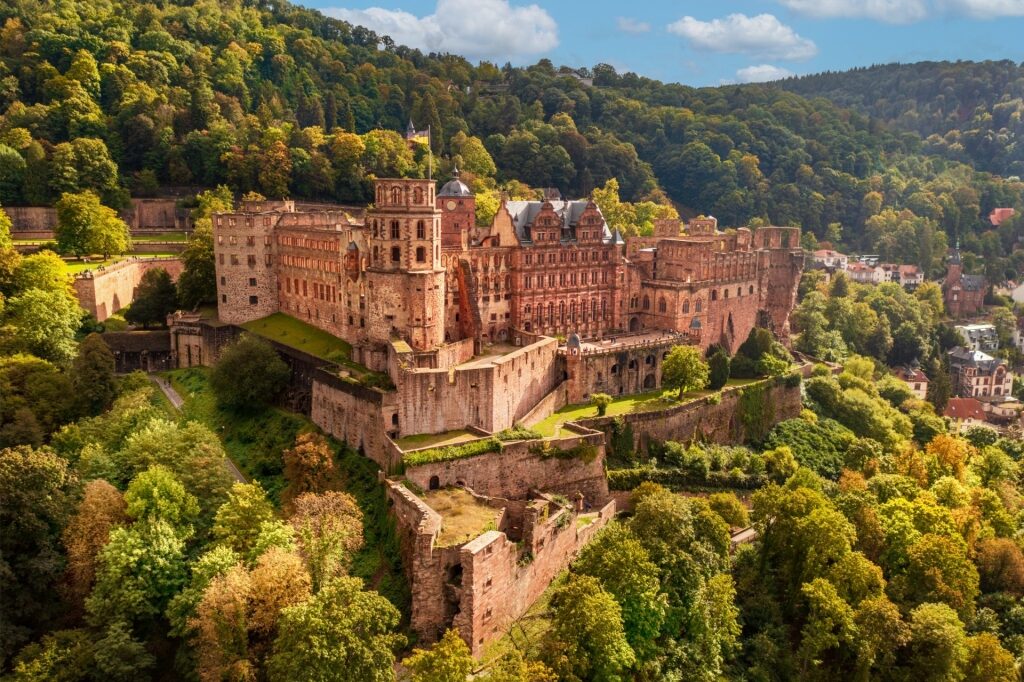
Schloss Heidelberg, near Speyer
Mark Twain was awestruck by the beauty of Heidelberg Castle when he first saw it in 1878. A masterpiece of Renaissance architecture, dating to the 13th century, it towers 250 feet above the Neckar River, a tributary of the Rhine, some 45 minutes from Speyer.
The castle took several centuries to build, starting in the 13th century, but was destroyed by the French in the late 1600s. Its ruins form a picturesque sight from Heidelberg Old Town, and the panoramic views from it over the town’s red roofs are equally impressive.
The Great Hall, which once could hold 1,000 people, is a highlight of any visit. In the cellars, the Heidelberg Tun dates to 1751 and is the world’s largest wine barrel.
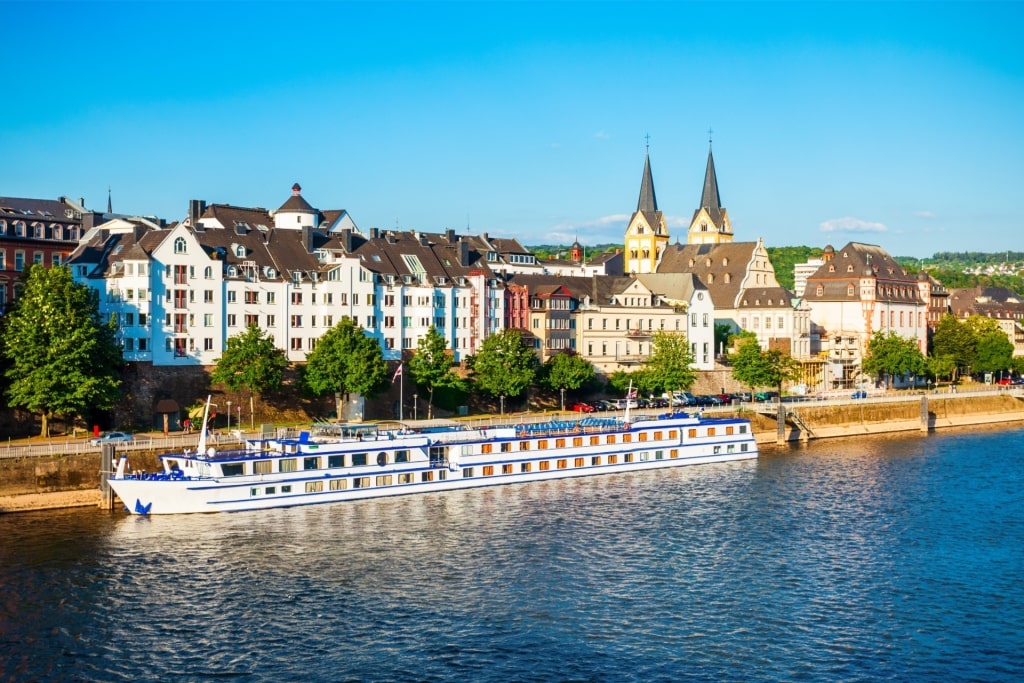
Koblenz
Has this guide to beautiful Rhine river castles tempted you to visit this historic river? Browse Celebrity’s Rhine River cruises and book your next thrilling vacation.