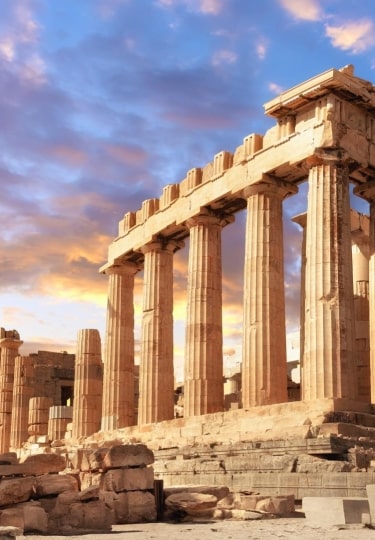
The world of Greek mythology has inspired art and storytelling for thousands of years, with legendary weapons and magical objects wielded by gods, goddesses, and heroes playing central roles in many ancient tales. Items like Poseidon’s trident and Pandora’s jar symbolize the connection between the mortal world and the divine realm.
While these legendary objects may not physically exist, ancient depictions of them have survived through sculptures, pottery, and other works of art. Today, mythology and archaeology enthusiasts can discover these representations in museums around the world, including destinations featured on Celebrity Cruises® itineraries through Greece and the Mediterranean.
Famous Mythic Artifacts: Pandora’s Jar and the Shield of Achilles
Many ancient depictions of Greek mythology have withstood the test of time, but a handful of legendary objects have remained especially well-known for thousands of years. From Poseidon’s trident to the Shield of Achilles, here are some of the most famous mythological artifacts and where you can find ancient depictions of them.
Pandora’s Jar
In Greek mythology, Pandora was the first woman, created by the god Hephaestus. She possessed a jar that, when opened, released human ills and miseries into the world. Pandora managed to close the lid before everything escaped, trapping only hope inside.
At the British Museum in London, visitors can view a red-figure calyx-krater, a vessel used for mixing water and wine, also known as Pandora’s vase. Dating to around 450 BC, it depicts the creation of Pandora.
Poseidon’s Trident
Poseidon’s trident is a three-pronged spear that served as the main weapon of Poseidon, the ancient Greek god of the sea, earthquakes, and horses. According to Greek mythology, a single strike of the trident could trigger massive tidal waves, violent storms, and catastrophic earthquakes.
There are several depictions of this powerful weapon in museums around the world, including at the National Archaeological Museum in Athens. There, a Hellenistic-era statue known as Poseidon of Melos depicts the god with a raised arm that once held a trident. The museum also displays ancient Greek vases and bronze statuettes of Poseidon with his mythical weapon.
The Shield of Achilles
A legendary piece of divine armor from Homer’s epic poem The Iliad, the Shield of Achilles was crafted by the god Hephaestus for the Greek warrior Achilles. It is described as a massive, five-layered circular shield adorned with images of the cosmos, daily life, and nature.
The shield is meant to illustrate the breadth of human experience, including both peace and the brutality of war. The National Archaeological Museum in Athens displays ancient Greek artifacts related to Achilles and the Mycenaean culture described in Homer’s works.
For travelers visiting Athens on cruises to Greece, the National Archaeological Museum offers an opportunity to discover ancient artworks inspired by these legendary figures. Other destinations featured on Mediterranean cruises also provide opportunities to explore the influence of Greek mythology on art, history, and culture.
The Best Museums To Visit for Greek Artifacts
Ancient depictions of Greek mythology can be found in some of the world’s most renowned museums. Their collections include priceless sculptures, carvings, pottery, statues, and reliefs that offer insight into ancient Greek culture and beliefs. These museums and cities are the ideal destinations for those seeking a mythology-themed cultural journey.
National Archaeological Museum
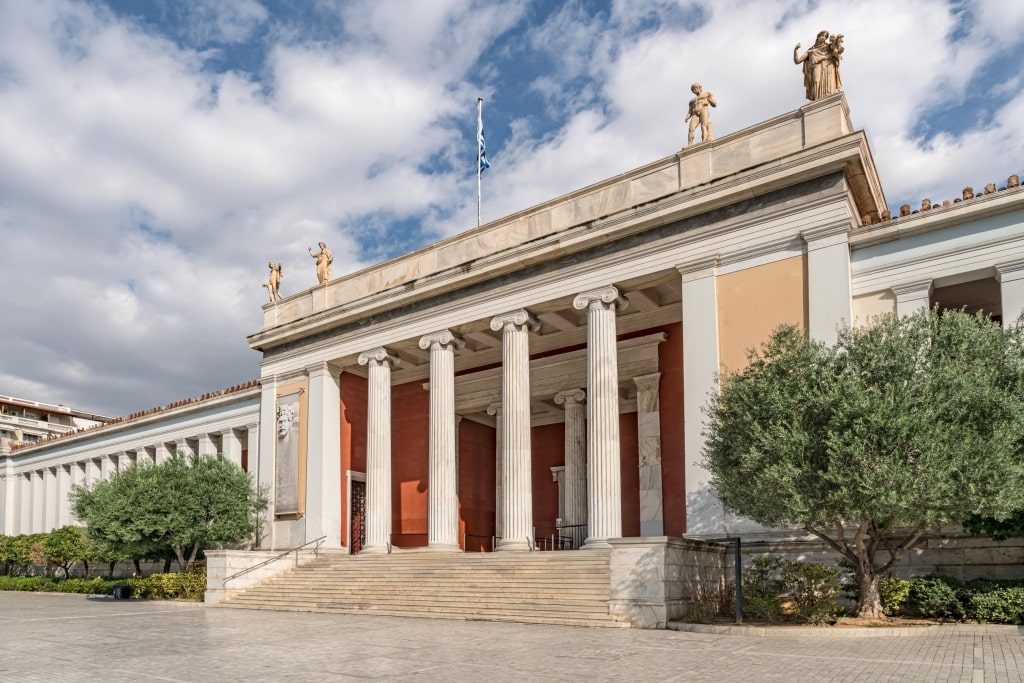
Entrance of the National Archaeological Museum in Athens, Greece, the largest archaeological museum in the country.
Located in Athens, the National Archaeological Museum is the largest of its kind in Greece and houses one of the world’s most significant collections of ancient Greek art and mythology-related artifacts. This includes prehistoric antiquities from Aegean civilizations, featuring Mycenaean gold treasures, and an extensive sculpture collection that contains roughly 16,000 works spanning from the 7th century BC to the 5th century AD.
British Museum
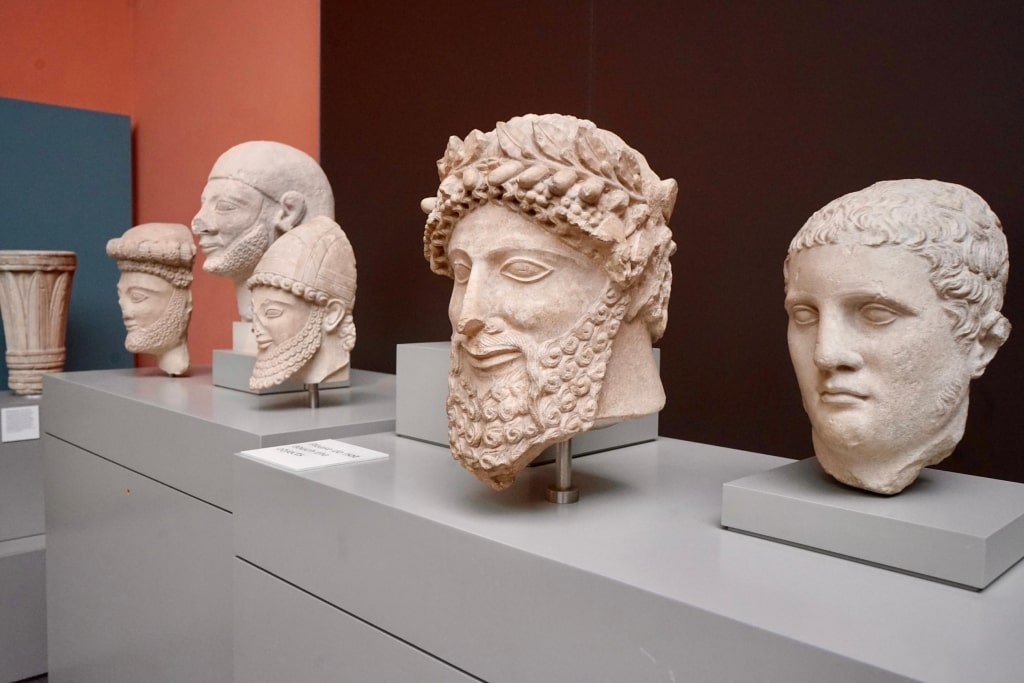
A row of ancient Cypriot and Greek stone sculptures, with a prominent crowned, bearded head in the Archaic style, showcased at the British Museum in London, England.
The British Museum in London houses one of the largest collections of ancient Greek art, spanning from the Bronze Age to the Hellenistic period, or roughly from 3,000 BC to the 1st century BC. Here, guests can soak in sculptures, architecture, and smaller items including bronzes, terracottas, gems, glass, and jewelry.
Capitoline Museums
While this complex of art galleries on the Capitoline Hill in Rome may be primarily known for hosting a vast collection of ancient Roman art, its ancient Greek collection is nothing to scoff at. The museums feature over 100 ornamental sculptures and copies of Greek masterpieces, as well as busts and reliefs reflecting Greek stylistic influences during the ancient Roman imperial era.
The Louvre
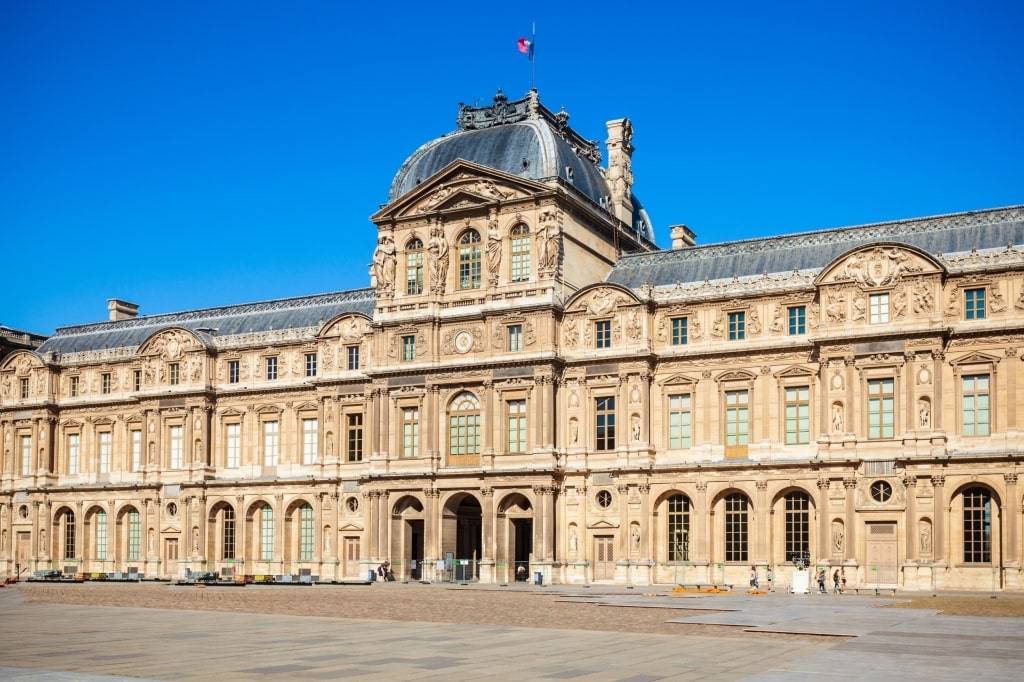
The ornate French Renaissance architecture of the Pavillon de l’Horloge in the Cour Carrée at the Louvre Museum in Paris, France.
The Louvre in Paris needs little introduction. Its collection of ancient Greek art reflects centuries of collecting and acquisitions, spanning from the prehistoric Cycladic period to the Hellenistic era. Highlights include marble figurines, freestanding statues, and vases illustrating mythological tales and everyday life.
Soaking in Greek Mythology in Athens
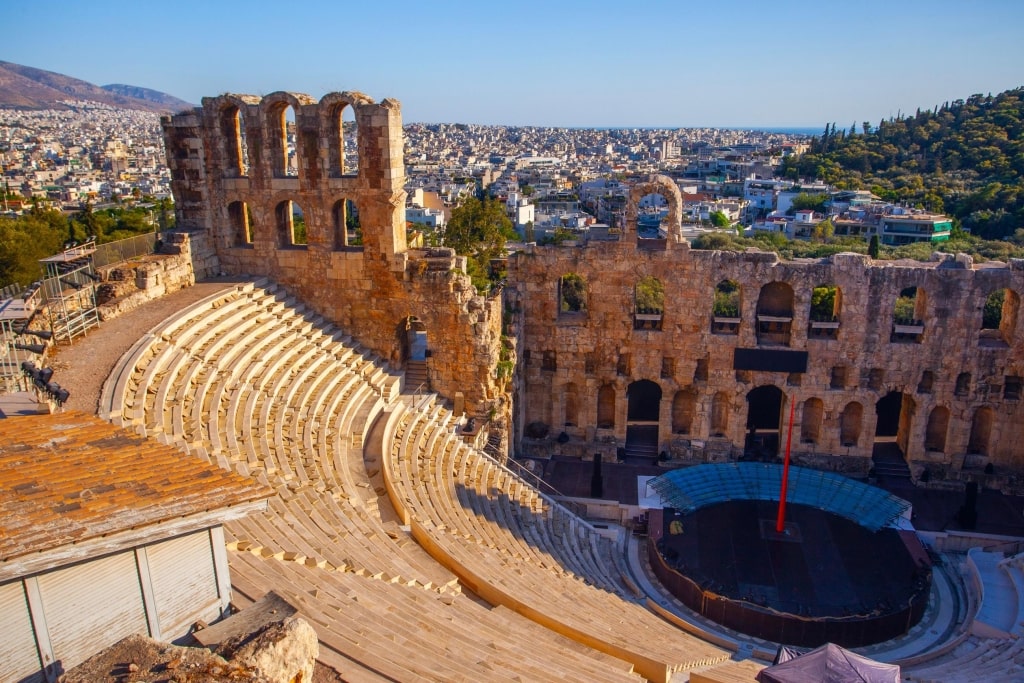
The ancient marble tiers and arched stone facade of the Odeon of Herodes Atticus offer a sweeping view over the urban expanse at the foot of the Acropolis in Athens, Greece.
During the Classical period, Athens was one of the most important and powerful cities in Greece. It was a center of democracy, philosophy, the arts, and military power. The city became the capital of modern Greece in 1834 and remains a premier destination for travelers interested in Greek history and mythology.
When in Athens, guests can visit the National Archaeological Museum, the largest of its kind in Greece and home to one of the world’s most significant collections of ancient Greek art and artifacts. There is also the Acropolis Museum, an archaeological museum that displays every finding discovered at the Acropolis and on its surrounding slopes, from the Greek Bronze Age to Roman and Byzantine Greece.
No trip to Athens is complete without visiting the Acropolis itself, an ancient citadel perched high on a rocky hill overlooking the city. It holds a central role in Greek mythology, most famously as the setting for the contest between Athena and Poseidon, who competed to become the city’s patron deity.
At the Athens Living Museum, guests can indulge in ancient Greek theater performances that reenact ancient texts revolving around the gods, monsters, and mythical creatures that have defined Greek life for millennia. Soak in performances based on the Iliad or Odyssey to deepen your understanding of mythic stories and their importance to Greek culture.
Dive Deeper Into Greek Mythology in Crete
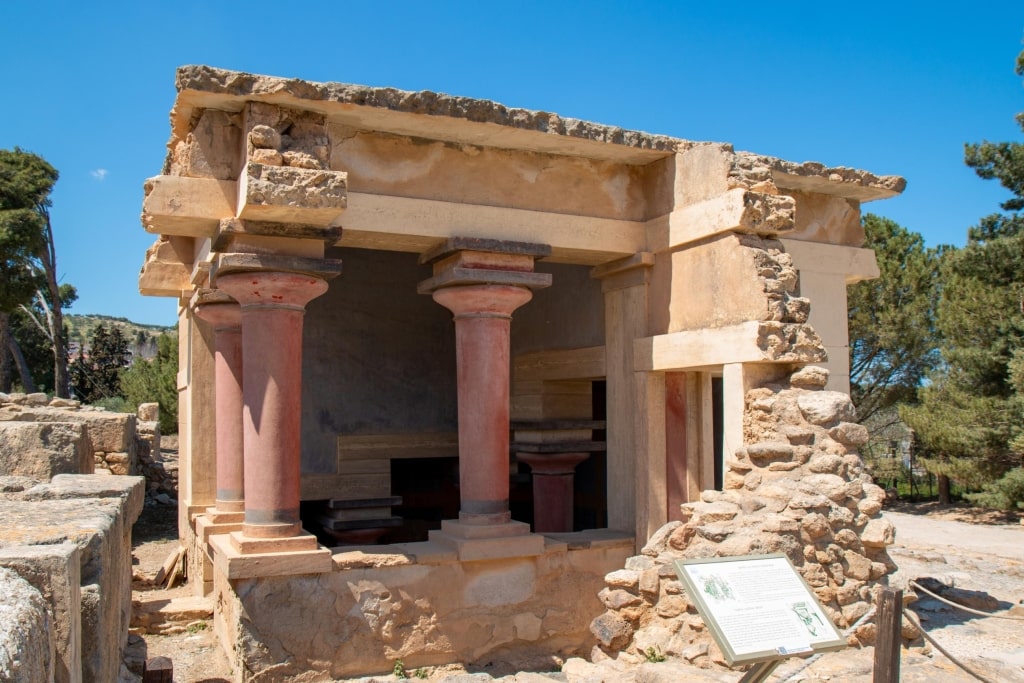
The restored Minoan stone portico featuring distinctive red downward-tapering columns at the Palace of Knossos in Crete, Greece.
While Athens is a hotbed for Greek mythology, other Greek landmarks and destinations offer more specific forms of Greek mythology, particularly Minoan and Knossos-linked stories and museum collections. These experiences, museums, and archaeological sites provide an even deeper exploration of the country’s long legacy of mythology.
In Heraklion, the capital of the island of Crete, guests can visit the Palace of Knossos. It was the center of the Minoan civilization, one of the earliest Aegean civilizations, and is directly tied to the myth of the demigod King Minos, the Minotaur, and the Labyrinth.
The birthplace of Zeus is claimed by two famous and sacred caves on the island: Psychro Cave, also known as the Dikteon Cave, and Ideon Cave. Both of these caves, complete with lakes and dangling stalactites and stalagmites, can be visited. For those seeking to deepen their understanding of Minoan civilization and mythology, the Heraklion Archaeological Museum, which houses the world’s most significant collection of Minoan artifacts, are worth a visit.
Frequently Asked Questions
What are some of the most famous Greek mythology artifacts?
Some of the most legendary artifacts from Greek mythology include Poseidon’s Trident, Pandora’s Jar, the Shield of Achilles, and Zeus’s Thunderbolt, which granted the god supreme control over lightning and storms.
Where can you see Greek mythology-related artifacts today?
Greek mythology-related artifacts and works of art can be found in museums across the world, including at the Louvre in Paris, the British Museum in London, and the National Archaeological Museum in Athens.
Which museum in Athens is best for Greek mythology-related artifacts?
The National Archaeological Museum is the best place in Athens to see Greek mythology-related artifacts. It’s the largest museum of its kind in Greece, and houses one of the world’s most significant collections of ancient Greek art, many of which are inspired by mythology.
What kind of Greek mythology artifacts depict gods and heroes?
The Ancient Greeks primarily immortalized their gods and heroes on pottery, marble and bronze sculptures, and bronze and terracotta votive figurines.
Discover Greece Through Its Mythology
The richness of Greek mythology is worth a trip to Greece alone. This legacy can be discovered by viewing ancient artworks inspired by gods, heroes, and mythical creatures. These items are spread out across several museums in Greece and the Mediterranean, which is why a cruise with Celebrity is one of the best ways to immerse yourself in the bridge between the mortal and divine realms.
Browse cruises to Greece and discover its mythology with Celebrity.