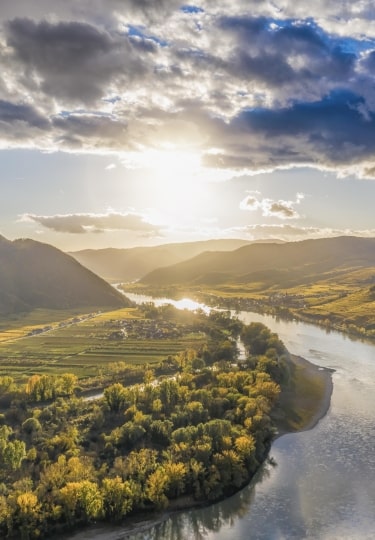
Choosing between an Upper and Lower Danube River cruise isn’t about finding the “best” itinerary. It’s about finding the one that best matches your travel style.
Stretching for nearly 1,800 miles from Germany’s Black Forest to the Black Sea, the Danube flows through or borders 10 countries, making it one of Europe’s most fascinating waterways. While some itineraries focus on the elegant capitals and vineyard-covered valleys of Central Europe, others venture into Southeastern Europe, where dramatic gorges, medieval fortresses, and lesser-known destinations reveal a different side of the river.
The Upper Danube River Cruise is the classic route, sailing between cities such as Budapest, Vienna, and Passau while showcasing UNESCO World Heritage Sites and scenic wine regions. The Lower Danube extends beyond Hungary into Serbia, Bulgaria, Romania, and sometimes the Danube Delta or Black Sea. This route offers a deeper look at the cultures and landscapes of Eastern Europe.
Whether you’re planning your first Danube River cruise itinerary or looking for a new adventure after cruising Europe, understanding the differences between these routes can help you choose the perfect sailing.
Upper vs. Lower Danube at a Glance
While both itineraries follow the same legendary river, they offer distinctly different experiences. The Upper Danube highlights many of Central Europe’s most recognizable cities and landscapes, while the Lower Danube introduces travelers to destinations that remain less visited but equally rewarding.
| Feature | Upper Danube | Lower Danube |
| Typical Route | Passau or Vilshofen to Budapest (or reverse) | Budapest to Bucharest, the Black Sea, or reverse |
| Countries | Germany, Austria, Slovakia, Hungary | Hungary, Serbia, Croatia (some itineraries), Bulgaria, Romania |
| Highlights | Passau, Regensburg, Vienna, Bratislava, Budapest | Budapest, Novi Sad, Belgrade, Vidin, Rousse, Bucharest |
| Signature Scenery | Wachau Valley vineyards, castle-lined hillsides, Baroque towns | Iron Gates Gorge, broad river plains, medieval fortresses, wetlands of the Danube Delta |
| Typical Length | 7–10 nights | 7–11 nights (longer for Black Sea itineraries) |
| Best Time to Go | Spring through fall; autumn wine harvest; Christmas market cruises in late November and December | Late spring through early fall, when warmer weather is ideal for exploring Southeastern Europe |
| Best For | First-time river cruisers, history lovers, Christmas market enthusiasts | Repeat European travelers, culture seekers, travelers looking beyond the traditional highlights |
The Upper Danube River Cruise Itinerary
The Upper Danube River Cruise is the route many travelers picture when they imagine sailing Europe’s second-longest river. Connecting four countries and some of Central Europe’s most celebrated capitals, it combines grand architecture, vineyard-covered hillsides, medieval towns, and centuries of imperial history into one seamless journey.
It’s also the most popular Danube itinerary, and for good reason. Whether you’re planning your first river cruise or returning to explore more of Europe, this route offers many of the region’s best-known landmarks while allowing you to experience multiple countries without unpacking more than once.
Most Upper Danube itineraries sail between Passau or Vilshofen in Germany and Budapest in Hungary, although the direction varies. Since river ships travel day and night, the experience is largely the same whether sailing eastbound or westbound. Typical voyages range from seven to 10 nights, with some longer itineraries that include additional ports in Germany or extend farther along the Danube.
Along the way, you’ll visit elegant capitals, UNESCO World Heritage Sites, celebrated wine regions, and some of the most beautiful cities in Central Europe.
Budapest
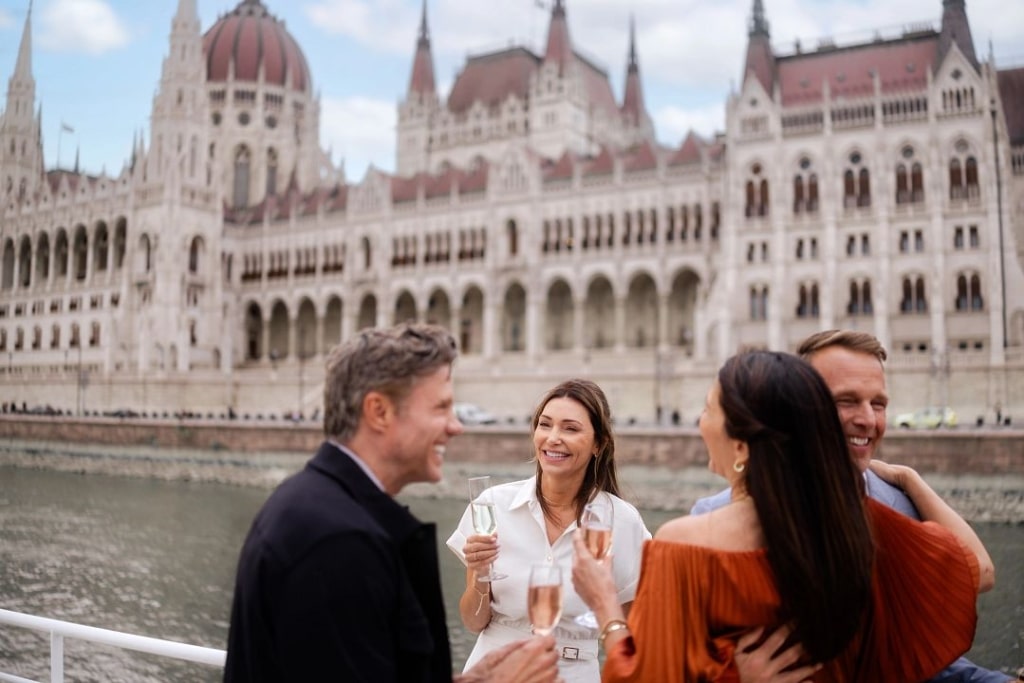
A group of friends enjoys champagne on a river cruise deck, framed by the grand Hungarian Parliament Building along the Danube in Budapest.
Many Upper Danube cruises begin or end in Budapest, one of Europe’s most striking capitals. Divided by the Danube into historic Buda and lively Pest, the city rewards exploration both on foot and from the water.
It’s difficult not to be astounded by the Hungarian Parliament Building, which dominates the Pest riverfront with its Gothic Revival architecture. Across the river, the Fisherman’s Bastion and Buda Castle provide panoramic views. Together, they create one of the Danube’s most iconic skylines, particularly after sunset when both landmarks are beautifully illuminated.
Budapest is also known as the “City of Spas,” thanks to its many thermal springs and bathhouses, including the historic and colorful Széchenyi Thermal Bath and Gellért Thermal Bath.
Bratislava
Slovakia’s compact capital is often one of the Upper Danube’s most delightful surprises. Its historic center is remarkably walkable, with cobblestone streets leading past colorful squares, cafés, and Baroque palaces.
Perched atop a hill overlooking the Danube is Bratislava Castle. The restored fortress offers sweeping views across Slovakia, Austria, and Hungary on a clear day. Below it, the Old Town invites you to wander between churches, local boutiques, and outdoor terraces.
Vienna
Few cities capture Europe’s imperial grandeur quite like Vienna. For centuries, the Habsburg dynasty ruled from here, leaving behind gilded palaces, elegant boulevards, and world-renowned museums.
Schönbrunn Palace, the Habsburgs’ enormous summer residence, remains one of Austria’s most visited attractions. Its opulent rooms and formal gardens offer a glimpse into royal life, while Vienna’s historic center showcases architectural masterpieces including St. Stephen’s Cathedral, the Hofburg Palace, and the grand Ringstrasse.
The city is equally celebrated for its café culture, classical music heritage, and vibrant food scene, making it one of the highlights of any Upper Danube itinerary.
Wachau Valley
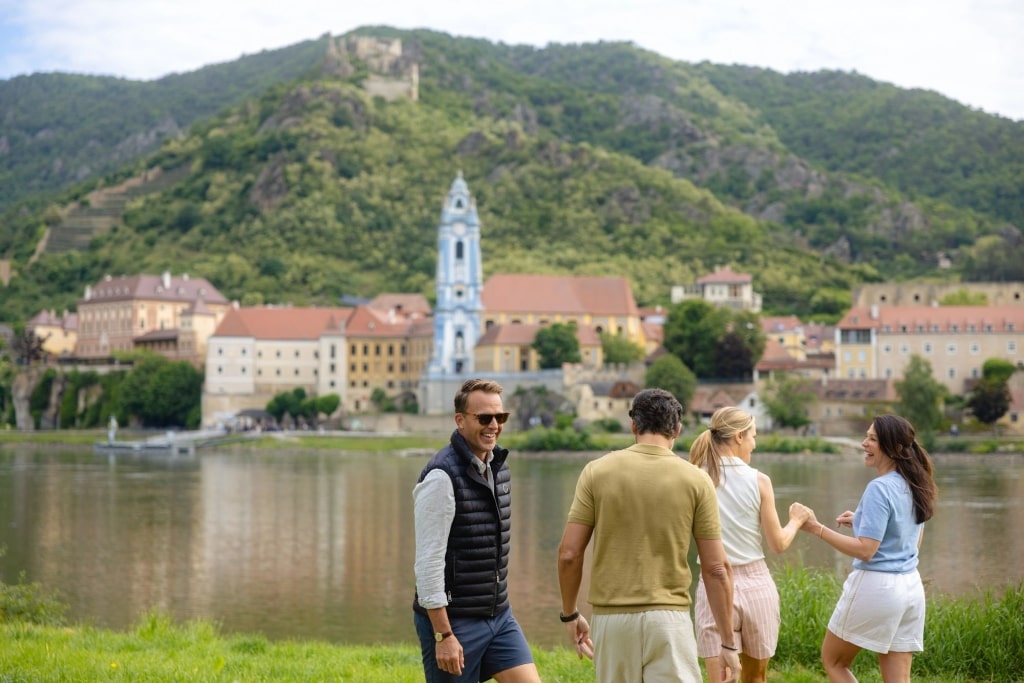
Friends enjoy a stroll along the Danube River, with the iconic blue tower of Dürnstein Abbey and hilltop castle ruins rising behind them in the Wachau Valley.
Between Melk and Krems, the Danube winds through one of its most scenic stretches: Austria’s UNESCO-listed Wachau Valley.
Steep hillsides covered with terraced vineyards rise above the river, punctuated by medieval villages, castle ruins, and apricot orchards that have flourished here for centuries. During harvest season in early autumn, the valley is especially beautiful as vineyards turn shades of gold and crimson.
For many travelers, simply watching the scenery drift past from the ship’s sun deck becomes one of the most memorable moments of the cruise.
Melk & Dürnstein
Two of the Wachau Valley’s best-known stops offer very different glimpses into Austria’s history.
Towering above the river, Melk Abbey is one of Europe’s finest examples of Baroque architecture. Founded in 1089, the Benedictine monastery is renowned for its ornate church, magnificent library, and views over the valley below.
Farther downstream, the charming village of Dürnstein is famous for the blue tower of its abbey church and the ruins of the medieval castle where England’s King Richard the Lionheart was imprisoned in 1192 while returning from the Crusades. Today, its narrow streets, local wine taverns, and riverside setting make it one of the Upper Danube’s most picturesque ports.
Regensburg
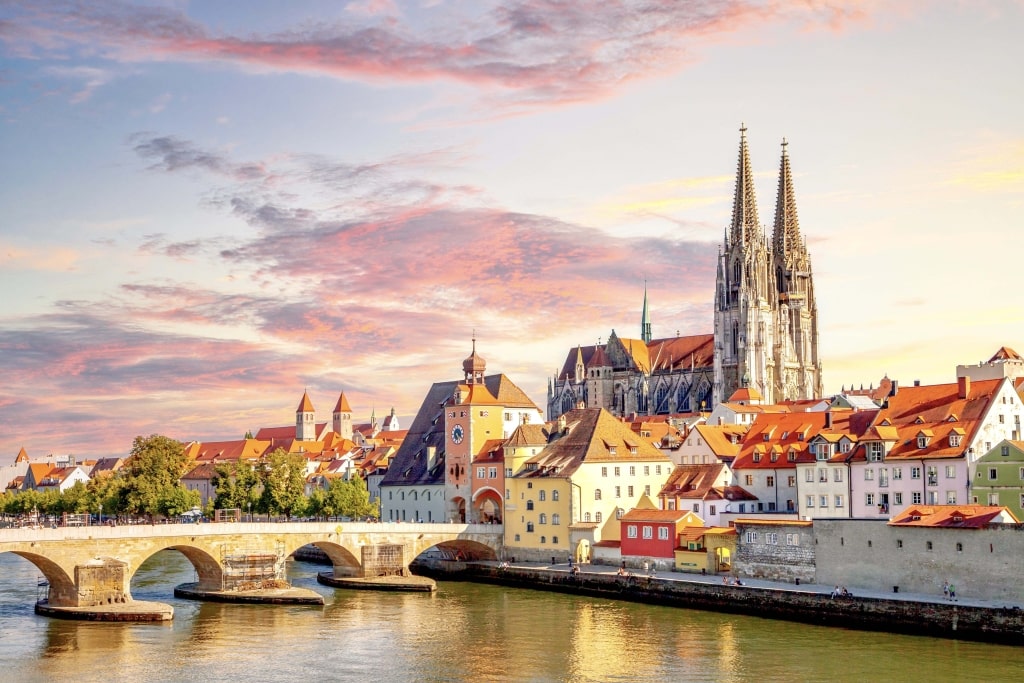
The historic Stone Bridge spans the Danube River toward the colorful waterfront of Regensburg, dominated by the twin spires of St. Peter’s Cathedral beneath a glowing sunset sky.
With more than 2,000 years of history, Regensburg boasts one of Germany’s best-preserved medieval centers and has earned UNESCO World Heritage status for its collection of Gothic, Romanesque, and medieval architecture.
Walking through the Old Town feels like stepping back in time. Stone towers and centuries-old churches line narrow streets, while the 12th-century Stone Bridge continues to span the Danube as it has for nearly 900 years.
Passau or Vilshofen
Known as the “City of Three Rivers,” Passau sits at the meeting point of the Danube, Inn, and Ilz rivers. Its colorful Old Town, elegant squares, and hilltop fortress make it well worth exploring before or after your cruise.
Just downstream, Vilshofen offers a quieter introduction to Bavaria, with charming streets, local beer gardens, and easy access to the surrounding countryside.
The Lower Danube River Cruise Itinerary
If the Upper Danube is the river’s best-known journey, the Lower Danube river cruise is its hidden side. Sailing beyond Budapest into Southeastern Europe, these itineraries reveal destinations that many travelers haven’t yet explored.
For travelers who have already experienced Central Europe or who simply prefer less-touristed destinations, the Lower Danube offers a different perspective on the continent.
Most Lower Danube itineraries sail between Budapest and Bucharest, although some continue farther east to the Danube Delta or the Black Sea. Cruises may operate in either direction, with seven- to 11-night itineraries being the most common.
If you’re wondering whether the Lower Danube is worth visiting, the answer is a resounding yes. It showcases a quieter, less familiar side of Europe while delivering many of the same advantages that make a river cruise so appealing.
Budapest
Although Budapest is often the grand finale of an Upper Danube sailing, it also serves as the gateway to Southeastern Europe. As you leave Hungary’s capital behind, the scenery begins to change as elegant imperial architecture gradually gives way to quieter countryside, riverside villages, and destinations that receive far fewer international visitors.
Novi Sad
Serbia’s second-largest city combines relaxed charm with a rich cultural heritage. Its colorful pedestrian streets are lined with cafés, galleries, and elegant Austro-Hungarian architecture.
Here, the Petrovaradin Fortress is an imposing 17th-century stronghold often called the “Gibraltar on the Danube.” From its ramparts, sweeping views stretch across the river and the city’s historic center below.
Belgrade
One of Europe’s oldest continuously inhabited cities, Belgrade sits at the confluence of the Danube and Sava rivers. Here, Roman, Byzantine, Ottoman, and Austro-Hungarian influences have all left their mark.
Kalemegdan Fortress is the city’s defining landmark and has guarded this portion of the river for centuries.
Iron Gates Gorge
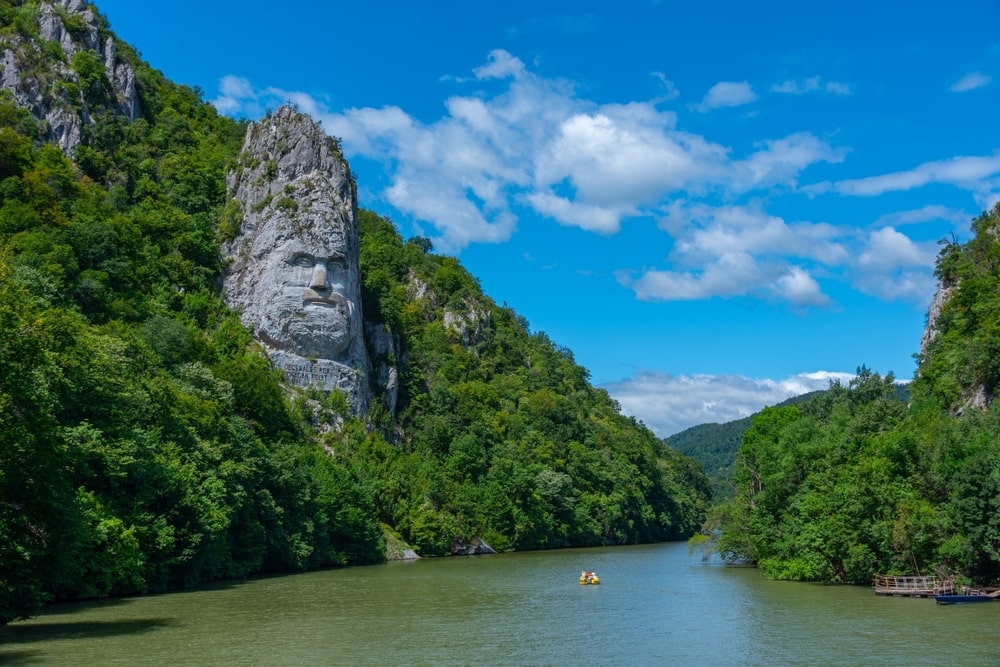
The colossal Rock Sculpture of Decebalus, carved into a high cliff face, overlooks the tranquil Danube River as it flows through the lush Iron Gates Gorge.
For many travelers, cruising through the Iron Gates Gorge is the defining experience of the Lower Danube.
This spectacular series of narrow gorges forms part of the natural border between Serbia and Romania. Towering limestone cliffs rise dramatically from the water, creating one of the river’s most scenic passages. At its narrowest point, the Danube squeezes between steep canyon walls before widening again into tranquil stretches of river.
The region is equally significant for its history. Roman Emperor Trajan built roads through these cliffs nearly 2,000 years ago to support his military campaigns, and visitors can still spot the famous Tabula Traiana, a carved Roman memorial preserved high above the river.
Vidin
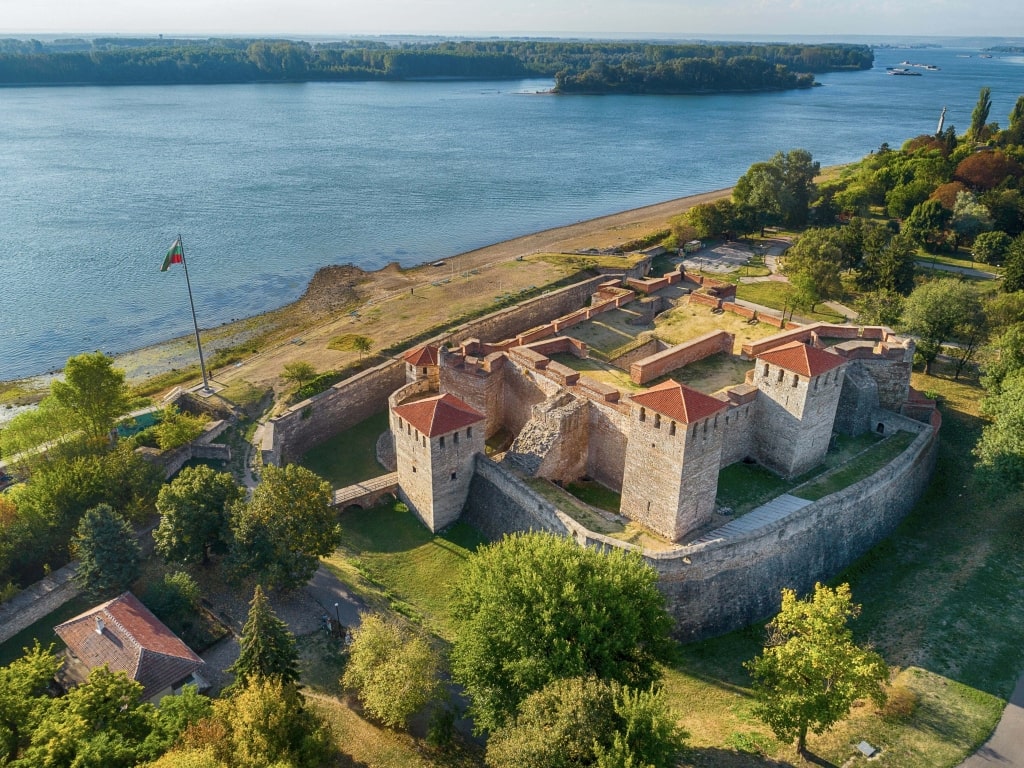
An aerial view captures the medieval Baba Vida Fortress and its stone towers situated along the banks of the Danube River in Vidin, Bulgaria, illuminated by warm sunlight.
Located in northwestern Bulgaria, Vidin’s best-known landmark is Baba Vida Fortress, Bulgaria’s only fully preserved medieval castle. Surrounded by defensive walls and towers overlooking the Danube, the fortress provides insight into centuries of regional history while offering excellent river views.
Beyond the castle, Vidin’s quiet streets and Orthodox churches reveal a destination that remains largely untouched by mass tourism.
Rousse
Often called “Little Vienna” for its elegant architecture, Rousse is one of Bulgaria’s most sophisticated river cities.
Today, Rousse serves as the gateway to Bulgaria’s interior, with many excursions heading to nearby monasteries and the UNESCO-listed Ivanovo Rock Churches.
Bucharest
Although Bucharest lies about an hour’s drive from the Danube, it serves as the embarkation or disembarkation point for many Lower Danube cruises.
Romania’s capital blends grand Belle Époque architecture with striking Communist-era landmarks and a growing culinary and cultural scene. Visitors often explore Revolution Square, the Romanian Athenaeum, and the immense Palace of the Parliament, one of the world’s largest administrative buildings.
The city’s leafy parks, sidewalk cafés, and revitalized Old Town make it well worth spending an extra day before or after your cruise.
Danube Delta or Black Sea
Some Lower Danube itineraries continue beyond Bucharest toward one of Europe’s greatest natural treasures: the Danube Delta.
The delta marks the point where the Danube empties into the Black Sea after traveling nearly 1,800 miles across Europe, forming a maze of channels, lakes, and reed beds. It’s home to more than 300 bird species, along with wild horses.
Other itineraries conclude at the Black Sea coast, providing a memorable finale to a river cruise that spans much of the European continent.
Which Danube River Cruise Is Right for You?
Both Upper and Lower Danube river cruises showcase the beauty and history of the river, but they appeal to different travel styles. The best choice depends on whether you’re looking for Europe’s iconic highlights or hoping to venture beyond the traditional path.
Choose the Upper Danube if you:
- Are planning your first river cruise
- Want to visit celebrated capitals such as Budapest, Vienna, and Bratislava
- Enjoy grand palaces, medieval towns, and UNESCO World Heritage Sites
- Love vineyard landscapes, charming villages, and scenic river valleys
- Dream of visiting Europe’s famous Christmas markets or traveling during the autumn wine harvest
Choose the Lower Danube if you:
- Have already cruised or traveled extensively through Central Europe
- Prefer destinations with fewer crowds and a strong sense of discovery
- Want to experience the cultures of Serbia, Bulgaria, and Romania
- Are fascinated by dramatic landscapes like the Iron Gates Gorge
- Enjoy itineraries that combine history, nature, and lesser-known ports
Find Your Perfect Danube River Cruise
From the vineyard-covered hills of Austria’s Wachau Valley to the towering cliffs of the Iron Gates Gorge, every stretch of the Danube offers something different. The Upper Danube is ideal for travelers seeking Europe’s iconic cities, grand architecture, and classic river cruising experience, while the Lower Danube rewards those looking to explore beyond the familiar with remarkable scenery, fascinating history, and destinations that remain refreshingly uncrowded.
Whether you’re planning your first journey along the Danube or returning to discover a new side of the river, comparing itineraries is the best way to find the voyage that’s right for you.
View Danube River cruises to explore available itineraries and start planning your journey through one of Europe’s most captivating regions.