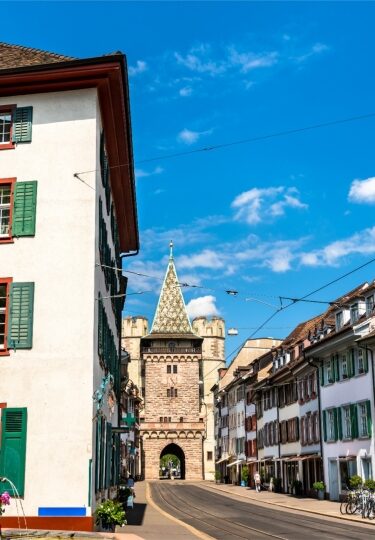
If you’ve visited other major Swiss cities, it can feel like Basel has been gifted with all the character, something that’s most apparent in the “Altstadt,” or Basel Old Town. This is the aged, cobblestone kernel of Switzerland’s cultural capital. With the pale blue Rhine dividing the old town’s two districts—Grossbasel and Kleinbasel—it’s a place of rich history, charming idiosyncrasies, and addictive gingerbread.
With France and Germany just over the border, a sense of internationalism adds layers to this city of the arts. Slip on your walking shoes—this is mountainous Switzerland, after all—and prepare for Old Town Basel’s warren of lanes and often unexpected treasures.
Attractions in Basel’s Old Town
Basel Minster

Basel Minster
The Basel Minster is the warmly hued emblem of the Basel skyline, once a Catholic cathedral and now a Protestant church. Its twin Gothic towers, one dedicated to Saint George and the other to Martin of Tours, help pinpoint the Rhine-side location of Basel’s Old Town.
A mishmash of Romanesque and Gothic styles, the cathedral, solidly constructed from red sandstone like most significant edifices in the city, was built between 1019 and 1500. That period also involved renovations when a massive earthquake in 1356 destroyed the city.
The grand interior has a high ceiling laced with exquisite ribbed vaults. Queen Anna of Habsburg, who died in 1281, is one of the more illustrious figures laid to rest here—her sarcophagus is in the crypt, although her remains have been transferred to Vienna.

Basel Minster
There’s also a cloister within that frames a rectangle of contemplative green grass where you can get a closer look at the Minster’s intricate roof tiles. Get even closer to those roof tiles by climbing the 250 steps up the towers, named Georgsturm and Martinsturm.
Marktplatz and Rathaus

Rathaus
A centerpiece of Grossbasel—the name for the larger, older portion of the Altstadt located on the Rhine’s southern bank—the Marktplatz is a market square encircled by haughty guild houses and the eye-catching Renaissance Rathaus, or town hall.
Using the same building materials as the Basel Minster, the 16th-century town hall is a flamboyant edifice of Triassic Buntsandstein, or red sandstone. And the showiness doesn’t stop there. Amid the interior’s gold-fringed arcades, you’ll find the history of the city depicted through exuberant frescoes, paintings, and intriguing symbols.
In front of the Rathaus, sleek green trams slip past daily markets, their stalls laden with wedges of fresh flowers, vegetables, and wheels of Swiss cheese.
Tinguely Fountain

Tinguely Fountain
An art installation that cuts to the heart of Basel’s—and Switzerland’s—quirky side, the Tinguely Fountain was the brainchild of Swiss sculptor Jean Tinguely.
It’s almost better to happen across this unusual sight than to seek it out, imagining it to be some kind of Victorian-era experiment with hydropower, of which Switzerland is a world leader.

Tinguely Fountain
A hypnotically weird series of moving sculptures in a pool of water, the elegantly wrought machines are each different in style and operation. Set in the footprint of an old city theater, it was this former artistic center that inspired Swiss sculptor Jean Tinguely to create his modern kinetic sculpture in 1977.
The machines are intended to represent the creative interaction of the actors and dancers who once graced the stage here. If you’re entranced by his work, one of Basel’s many museums is dedicated to the sculptor.
Kunstmuseum Basel

Kunstmuseum Basel Photo by Taxiarchos228 on Wikimedia Commons, licensed under the Free Art License
This stout cream edifice marks the outer edge of Old Town Basel, but the Kunstmuseum should nevertheless be on every Grossbasel browser’s itinerary.
It’s the bar by which Basel’s artistic credentials are set—a world-class art museum founded in 1661, and which has since acquired an impressive collection. Among the many works are Monet’s “Water Lilies,” multiple Picassos, and Van Gogh self-portraits vibrating with sensitivity.
With so much art to exhibit, the Kunstmuseum has spread to three locations, with the Hauptbau as its main gallery. Across the street is its striking concrete extension, connected to the Hauptbau by an underground tunnel.
Things to Do in Basel Old Town
Wander the Passageways

Grossbasel
Exploring both Grossbasel and Kleinbasel—with stops for coffee and kirsch-laced läckerli honey cookies—should take upward of two hours. Of course, lingering amid the medieval guild houses, sitting within the cool of the Minster, or gazing at the view from the Pfalz terrace, is where the true enjoyment of a place comes in.
In the shadow of medieval spires and baroque townhouses, set yourself on a course through charming lanes lined with forest-green shutters, overflowing window boxes, and little rounded doorways. Tiny junctions, such as in Gemsberg, navigate around marble fountains filled with limpid water.
While wandering the streets, you’ll spot the occasional gold cobblestone—known as Stolpersteine or “stumbling blocks”—part of an international project to commemorate victims of Nazism.

Käppelijoch
The midpoint between Grossbasel and Kleinbasel is the ornate Käppelijoch on the Middle Bridge—it also marks the spot where convicts used to be drowned in centuries past. Continue over the bridge to Kleinbasel, the more modern, boho side of Basel’s Old Town.
It’s known for its buzzy, less traditional restaurant and bar scene, while the steps that line the Unterer Rheinweg, a riverside promenade, are a popular spot for sundowners in the summer.

Pfalz terrace
Be sure to include the Pfalz terrace on your itinerary. Tucked behind the ruddy hulk of the cathedral, it offers views of the bending river, the city across the water, and the nubby hills of the Black Forest beyond.
Find Basel’s Indie Streak at the Spalentor

Spalentor
When I first visited Basel’s Spalentor, the most dramatic of the city’s trio of medieval gates, I couldn’t help but wonder: Is this gate intended to put off invaders or pique their curiosity?
The Spalentor is in keeping with the more flamboyant medieval flourishes that ornament Basel’s Old Town. Squashed between two austere fortified towers is a blush-colored gatehouse with a pointed roof decorated in forest green and daisy yellow tiles. From the outside, it looks like a wealthy person in a fancy hat peering fearfully from between two minders.
Once you’ve admired the Spalentor’s unique style, you’ll find yourself on Spalenberg. One of the most characterful streets of Old Town Basel, it has a superb selection of cafés, ateliers, and little bookshops such as Bider & Tanner, which also has an English language collection.
Ride the Münster Ferry

Münster ferry
Of course, you could walk across one of the bridges connecting Grossbasel and Kleinbasel, but why walk when you can float?
The Münster ferries, of which four still operate, move between the two sides of Old Town Basel, propelled only by the Rhine’s current. Ensuring you don’t end up in Strasbourg are the tethered lines that keep the ferry on course.
The service began in 1854, when only the Middle Bridge was available for crossing. The traditional nickname of these handsome, skiff-like boats is the “Flying Bridges.”
Restaurants
Gasthof zum Goldenen Sternen
The riverside terrace of Gasthof zum Goldenen Sternen, with the sparkling Rhine beside you and the buildings of Kleinbasel regarding you across the water, is one of the finest places to dine in the warmer months.

Wiener Schnitzel
This upscale restaurant has been in the same spot since the 14th century, and has a strong case for its claim as “Basel’s oldest guesthouse.” If you can’t get a seat on the tree-shaded terrace, the interior—wood-paneled and white-linened—offers just as memorable an experience. Expect traditional Swiss dishes such as Wiener Schnitzel executed with flair.
Ufer7
Cross the Middle Bridge to Kleinbasel, and you’ll quickly spot Ufer7, a stylish restaurant with a little walled terrace raised above street level.
This Kleinbasel favorite leads with dishes such as coq au vin or flavorful steamed trout, but also offers outstanding burgers and rich, gooey fondue. Its chef, Cyrill Baumann, is becoming a minor local celebrity with his onscreen appearances on “The Taste.”
It’s essential to book ahead in summer, especially for those tables with a view of Grossbasel.
Safran Zunft
On the ground floor of the grand, 17th-century Zunft zu Safran guild house, the Safran Zunft restaurant is a gloriously atmospheric place to dine. The Zunft zu Safran is the headquarters of one of Basel’s most influential guilds, with a history dating back to the 13th century.
With the portraiture on the walls, glittering chandeliers, and delightful little artisan water glasses you immediately want to steal, it’s little surprise to find a traditional Swiss menu featuring things like veal with a creamy mushroom sauce, crunchy rösti, and seasonal game. These traditional flavors are interwoven with modern flourishes that elevate the cuisine.
Should you wish to see more of the guild house, it’s possible to arrange tours in the daytime, or to get accidentally lost on your way to the bathroom during dinner.
Travel Tips

Basel Old Town
Basel Old Town, especially Grossbasel, is a maze of little corners and quirky finds that flesh out the city’s strong sense of character. Lose yourself amid the narrow guild passages and back-courtyards, finding new viewpoints and places to linger, such as the benches near Gothic Leonhardskirchhof with their views across the Altstadt rooftops.
Basel is famous for its printing and book-binding tradition, dating back to the 15th century. A hand-bound notebook, therefore, is a wonderful souvenir from this culturally rich city. Pick something up at Buchbinderei Beat Gschwind on Gemsberg, one of the loveliest little streets in Grossbasel.
FAQs
What is Basel Old Town known for?

Spalentor
Basel’s Old Town is the city’s beautifully preserved medieval core, a tightly-wound maze of lanes, steep cobblestone alleys, and elegant patrician houses. Anchoring it all is the red-sandstone Rathaus, a Renaissance masterpiece, and the twin-towered Basel Minster.
Despite being small and walkable, the Old Town feels richly layered and full of life, with artisan shops and little galleries tucked here and there.
How do I get around?

Spalentor
Basel Old Town is best explored on foot. Its narrow medieval streets were designed for pedestrians rather than cars. For longer distances or tired legs, there are e-bikes available to rent, or the streetcar network is excellent—Swiss-reliable, clean, and easy to navigate. Most central routes converge near the Marktplatz.
To cross the river, you can walk, take a tram, or glide across on one of the four remaining Münster ferries.
What are the restaurants like in Basel Old Town?

Restaurant in Basel
Basel Old Town may be small, but it punches above its weight on the culinary front. Traditional brasseries slot in alongside contemporary European kitchens, wine bars serving superb Swiss pinot, and creative fine-dining restaurants.
Expect high-quality seasonal ingredients, a strong farm-to-table ethos, and menus that blend Alpine flavors with French and German influences.
The area around Spalenberg and the Munster hill is dotted with softly lit bistros, cafés with riverside terraces, and bakeries serving Basel’s ever-popular läckerli cookies. Restaurant prices are relatively high in this non-EU country, but the service, atmosphere, and gooey, wine-laced fondues mean that you generally leave highly satisfied.
Is it safe to swim in the river?

Rhine
Yes. Swimming in the Rhine—or “Rheinschwimmen”—is one of the best things to do in Basel in the summer, and it’s considered safe when you follow local guidelines. Strong currents mean you should enter at designated points and drift downstream rather than actively swim.
Most locals use a waterproof Wickelfisch bag for buoyancy and to keep their belongings dry. Always exit before the bridges, avoid the shipping lanes, and only swim during daylight hours in good conditions.

Basel Old Town
Are you ready to discover the history, culture, and Wickelfisch of Old Town Basel? Browse Celebrity’s river cruises to Basel and plan your European adventure.