In addition to some of the world’s most magnificent scenery—ice-blue glaciers, thundering waterfalls, and peaceful fjords—you could also marvel at Iceland’s midnight sun on a summer vacation. Witnessing the midnight sun in Iceland is a bucket-list experience. Occurring in midsummer, Iceland’s midnight sun takes place when the sun doesn’t set within—and close to—the Arctic Circle.
Iceland is one of the best places to witness the midnight sun, especially in northern areas, such as Akureyri and Isafjordur. Grimsey, an island north of the mainland, straddles the Arctic Circle and is the best place in Iceland to see the midnight sun. From the best time to visit and tips on seeing it, here’s everything you need to know about the midnight sun in Iceland.
What Is the Midnight Sun?
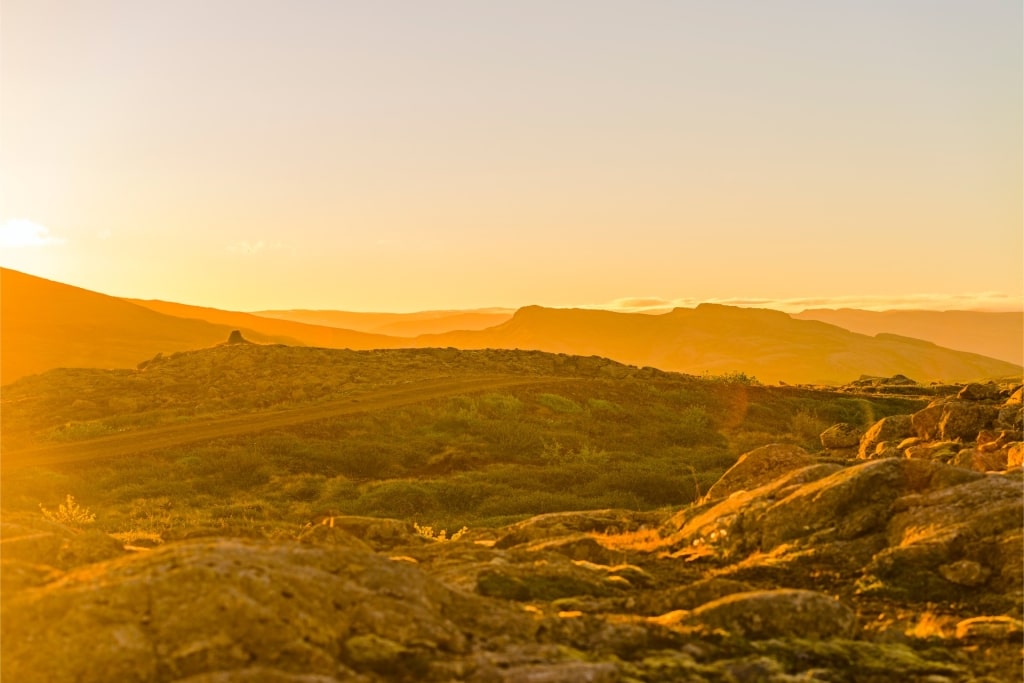
Midnight sun in Iceland
The midnight sun is a natural phenomenon that occurs during summertime within the Arctic Circle. It’s visible in northern Scandinavia, including Iceland, Alaska, Canada, and Greenland.
Since the earth is tilted at an axis of 23.5 degrees, during summer, when we orbit the sun, this area within the Arctic Circle never gets dark, with continuous sunlight around the summer solstice, on June 21. Hence it is known as the midnight sun—with the sun remaining above the horizon through the night.
The further north you go, the more hours of daylight you will get—and the opposite happens during winter. This is not to say that nighttimes are warm and the sun is blazing. It is a magical experience to witness the midnight sun, though bear in mind, just like during the day, clouds may cover the sun and the temperature can also dip.
Best Time to Visit Iceland to Experience the Midnight Sun
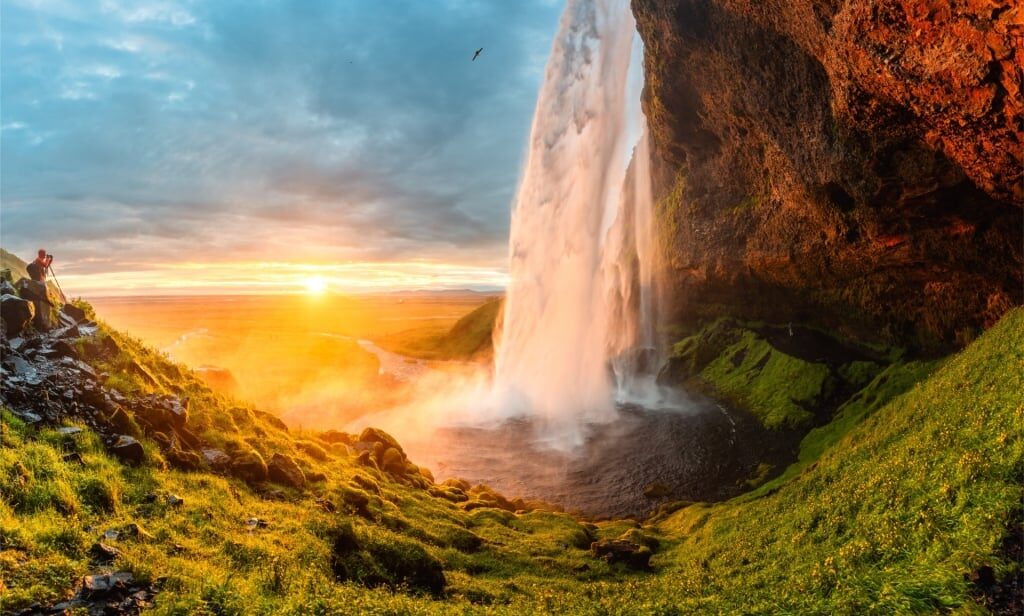
Seljalandsfoss, near Reykjavik
The best time to visit Iceland to experience the midnight sun is June. The midnight sun peaks during the summer solstice, when the sun never sets, on June 21. That said, the midnight sun is also visible before and after this date, when soft, golden daylight lights up Iceland’s cinematic landscape for longer periods, from early June into July.
In 2026, you’ll be able to see the midnight sun and a very special phenomenon, as Iceland will be in the path of totality of a full solar eclipse.
This celestial spectacle will take place on August 12, a little past the peak for seeing the midnight sun—but what’s exciting is that it’ll be the last time a total eclipse of the sun will be visible from Europe’s far north until 2090. Position yourself in or near Reykjavik and watch the moon pass across the sun, as viewed from Earth, plunging Iceland into temporary darkness.
Cultural & Local Perspective of the Midnight Sun
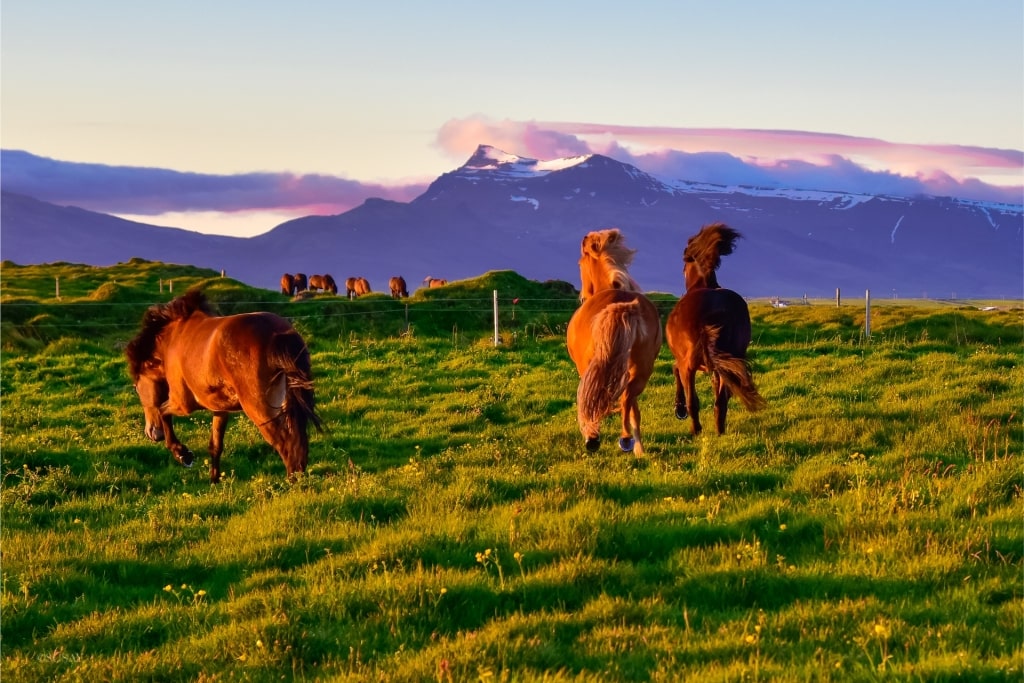
Icelandic horses
The Vitamin D-boosting midnight sun is part of daily life during summer in the Arctic and sub-Arctic. In Iceland, the midnight sun is widely celebrated, particularly after a long, dark winter. Naturally, many people find the period around the midnight sun to be uplifting, energizing, and mood-boosting.
Just as visitors are able to, locals also take advantage of hiking, swimming, and socializing late into the night. Late-night barbecues, bathing in Icelandic hot springs, outdoor concerts, and social gatherings are all common. Iceland’s famous Blue Lagoon often hosts an outdoor concert that takes place amid the steaming outdoor pools during the summer solstice.
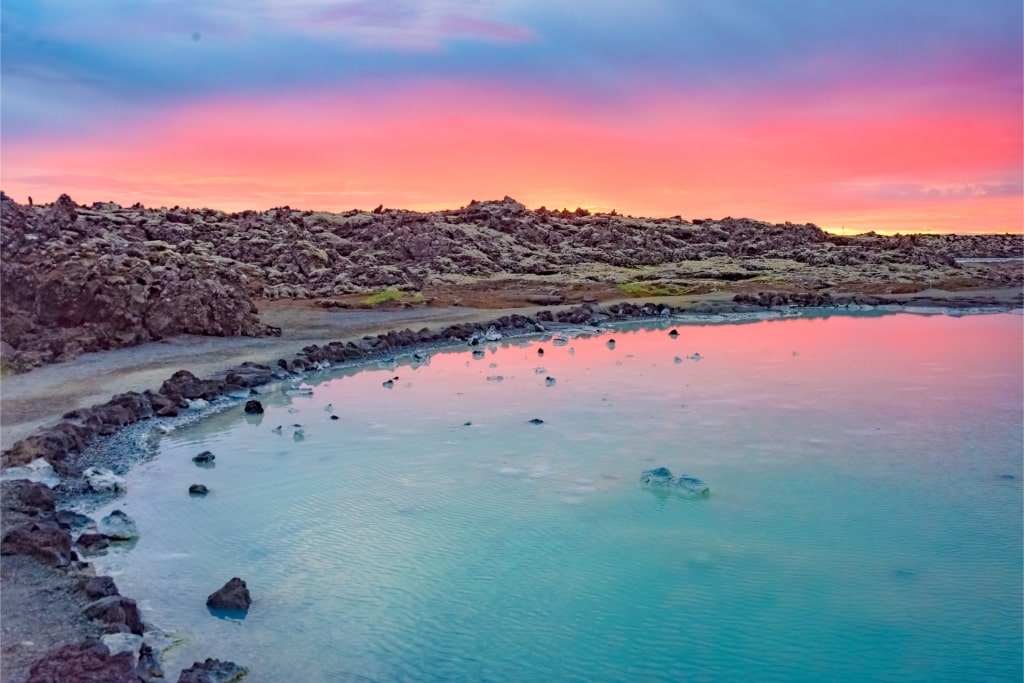
Blue Lagoon
Festivals are held to celebrate the summer solstice, including Reykjavík’s Secret Solstice Festival, with musical performances taking place outside, beneath the midnight sun.
In other parts of Iceland, particularly smaller towns and villages, you might find joyous community feasts, midnight swims, bonfires, and outdoor concerts, illuminated by the sun.
Icelanders also take June 24 as a public holiday in celebration of Jónsmessa, which translates as midsummer, when according to local folklore, “cows gain the powers of speech, seals become human, and it is healthy to roll naked in the dew-covered grass.”
Where to Experience It Best
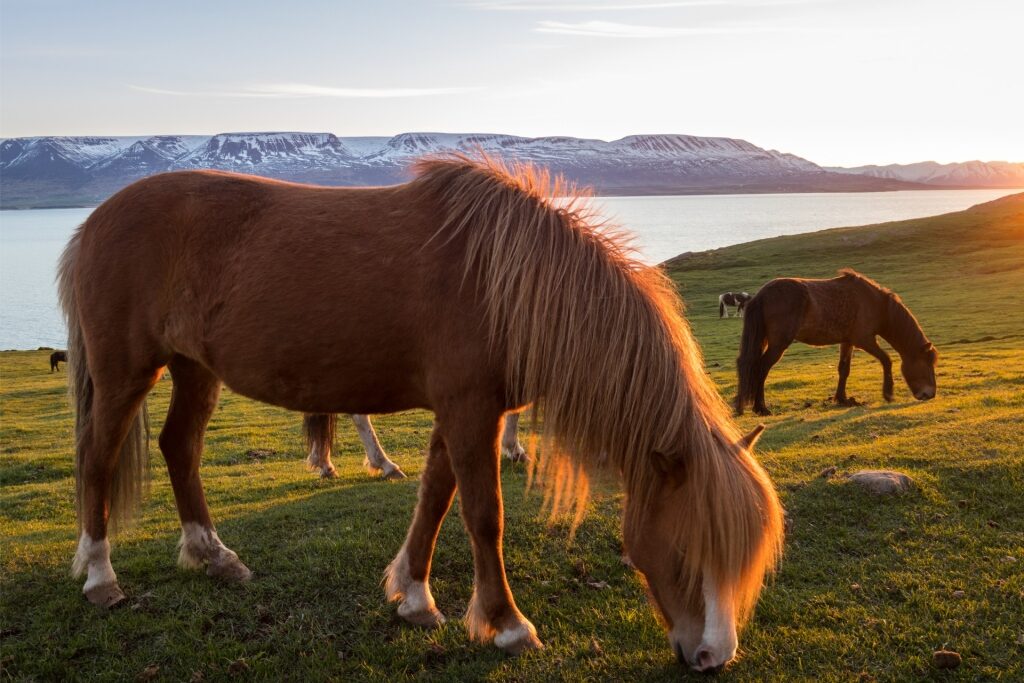
Akureyri
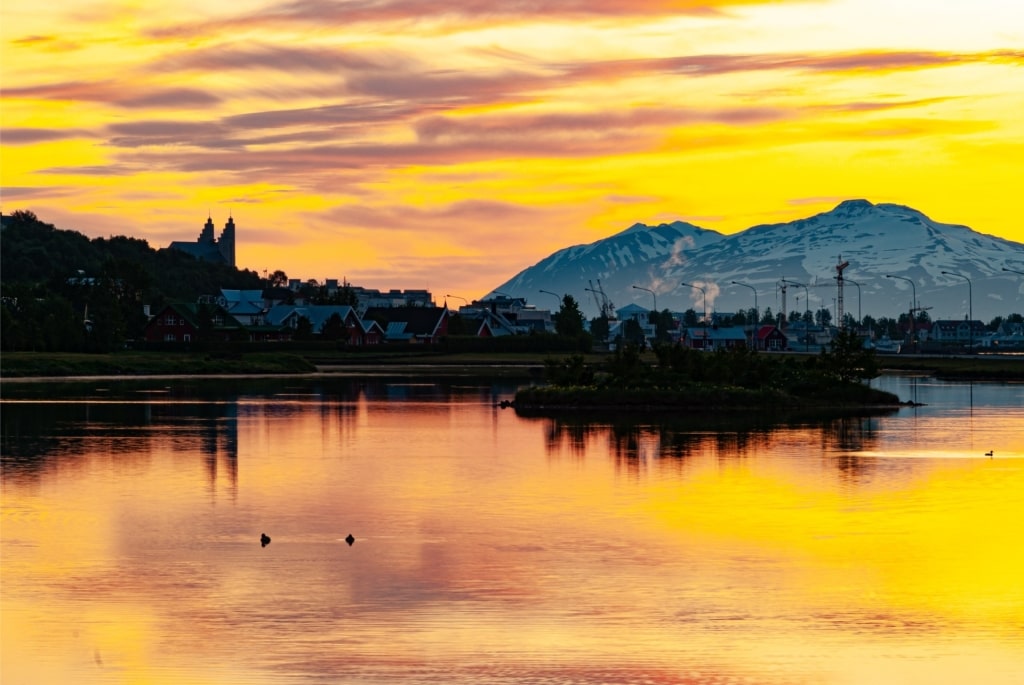
Though all of Iceland experiences extended hours of daylight during summertime, the best places to experience the midnight sun include the remote Westfjords in the northwest and Akureyri, right in the center of the north coast.
The best place to go to truly experience Iceland’s midnight sun is Grimsey Island. At 25 miles off the north coast, this green-covered island is 66° north, straddling the Arctic Circle.
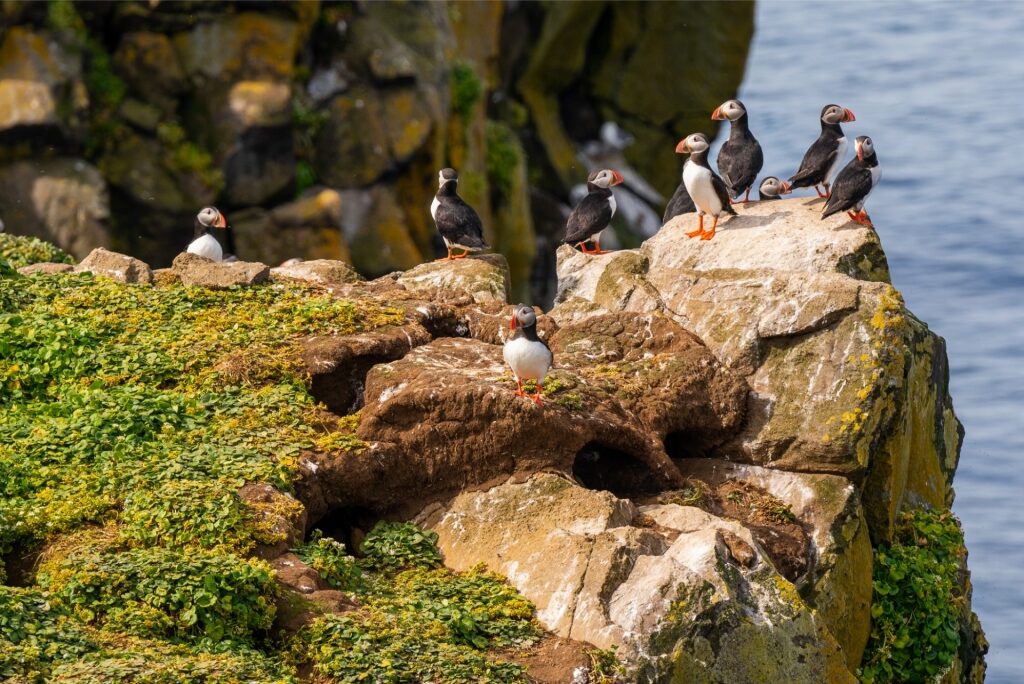
Atlantic puffins
But even if you can’t be there overnight, Grimsey is still one of the best places in Iceland to enjoy a nature-filled coastal hike, with rugged cliffs teeming with birdlife during summertime. Spot Atlantic puffins, Arctic terns, razorbills, kittiwakes, and guillemots as you step into the Arctic Circle.
A giant concrete orb, Orbis et Globus, Latin for circle and sphere, marks the Arctic Circle’s location on Grimsey. Visitors hike here from the tiny harbor, Sandvík; a three-hour return walk, featuring endless Arctic vistas.
Best Things to Do During the Midnight Sun in Iceland
Go Whale Watching
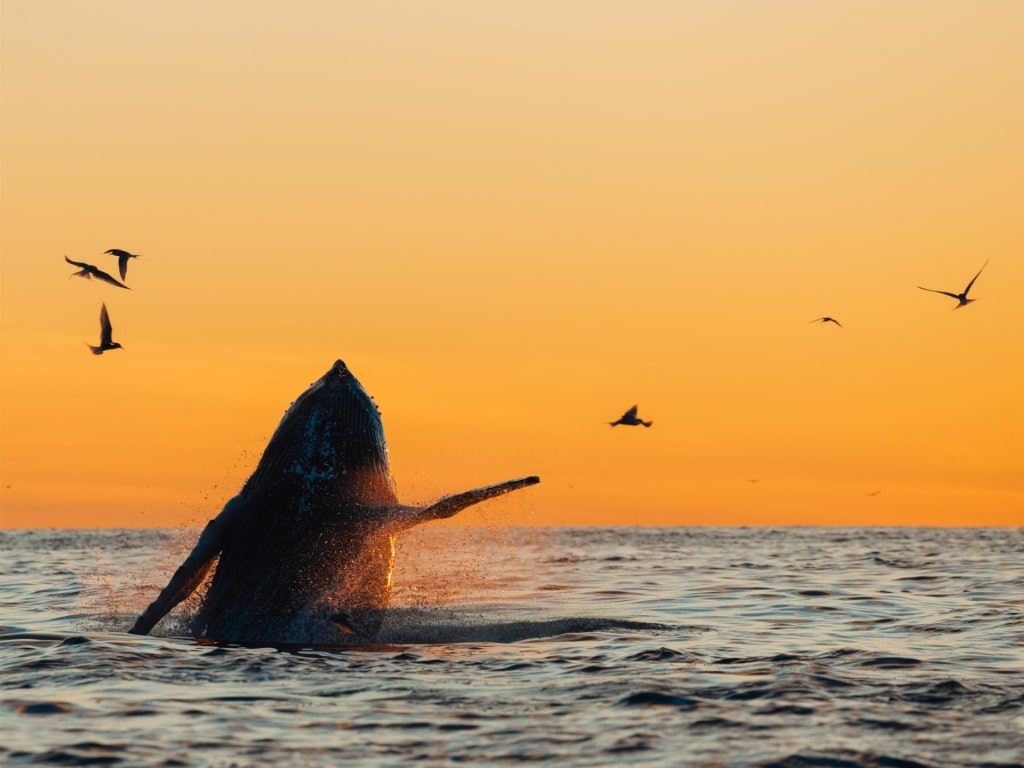
Humpback whale
Picture the scene: It’s late at night and there’s a cool breeze and a warm, orange glow above the horizon when you spot a humpback whale breaching in the Atlantic Ocean. Of course, cetacean sightings are never guaranteed, but you stand a very good chance of seeing them in Iceland.
Minke whales, harbor porpoises, and jaw-dropping blue whales—known as the giants of the ocean for their colossal size—can also be spotted.
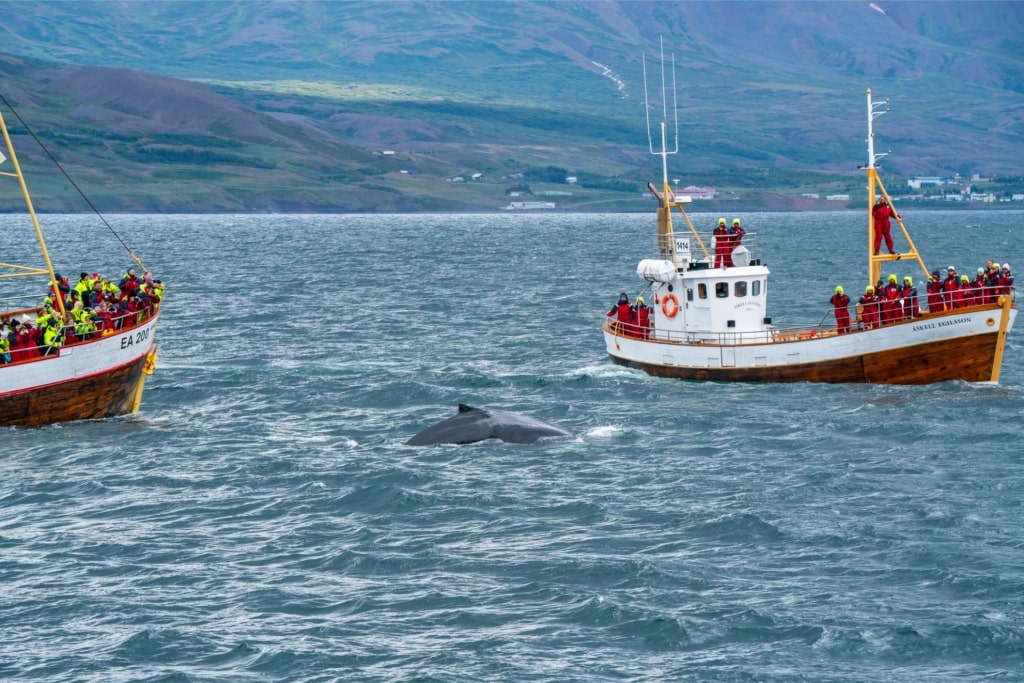
Whale watching in Akureyri
Join an evening trip from Reykjavik’s harbor into Faxaflói Bay, between the Reykjanes and Snӕfellsnes peninsulas. Here you might also see fin whales, with an estimated 40,000 of them in the North Atlantic in summer.
Pack binoculars to search for pods of dolphins leaping from the water with a number of species—including orca, white-beaked, common, and bottlenose—around Iceland.
Read: What to Pack for Iceland
See an Active Volcano
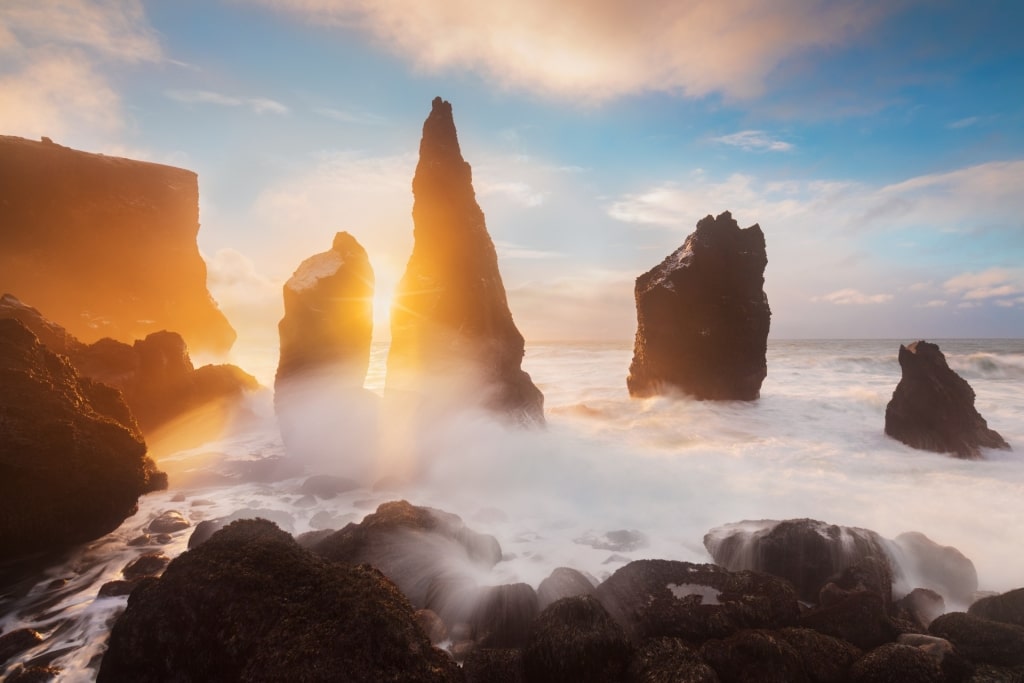
Reykjanes Peninsula
With around 30 active volcanic systems, and around 100 more inactive, it’s possible to witness several volcanoes and even safely catch an eruption in Reykjanes Geopark on the Reykjanes Peninsula.
Home to some of Iceland’s most beautiful places, the Reykjanes Peninsula has been shaped by volcanic activity thanks to its location on the mid-Atlantic Ridge, which separates the North American and Eurasian tectonic plates. Embark on an evening trip from Reykjavik to this otherworldly region to gaze at jagged rock formations and open fissures.
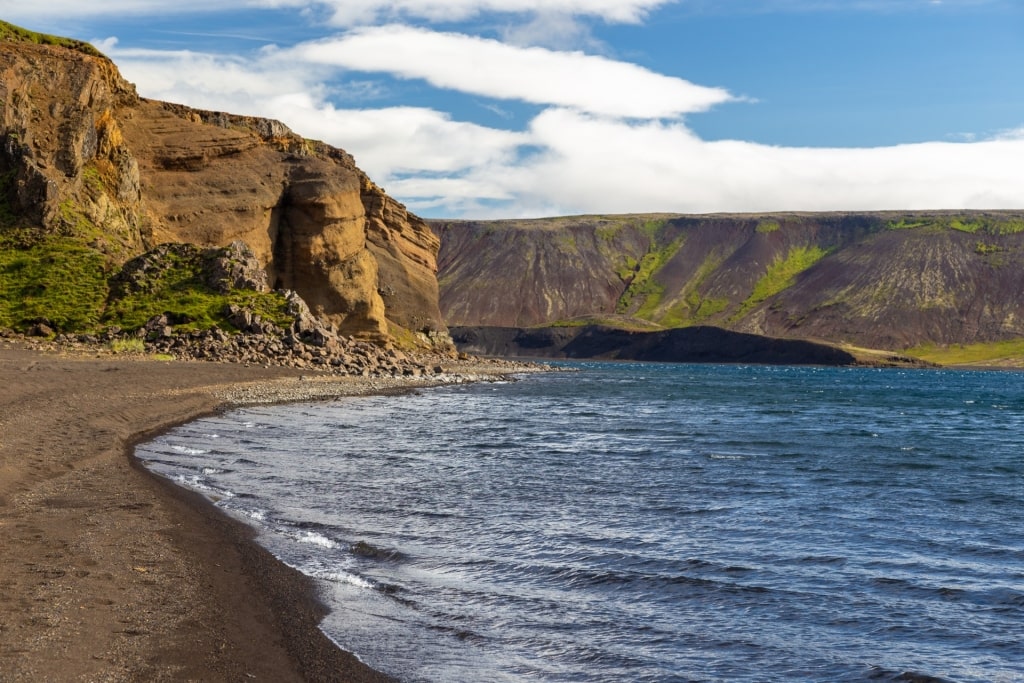
Kleifarvatn
A 40-minute drive south of the capital is the region’s largest lake, Kleifarvatn, with steaming hot springs and moss-covered lava fields adding to the mind-blowing scenery.
A short distance south-southwest of Kleifarvatn is the site of one of Iceland’s most recent eruptions, the Fagradalsfjall Volcano, and the Sundhnukagigar Craters, with safe viewing areas set up several miles from the sites, where visitors can watch the sky glow with the midnight sun as the ground bubbles with fresh lava.
Embark on a Late-Night Hike
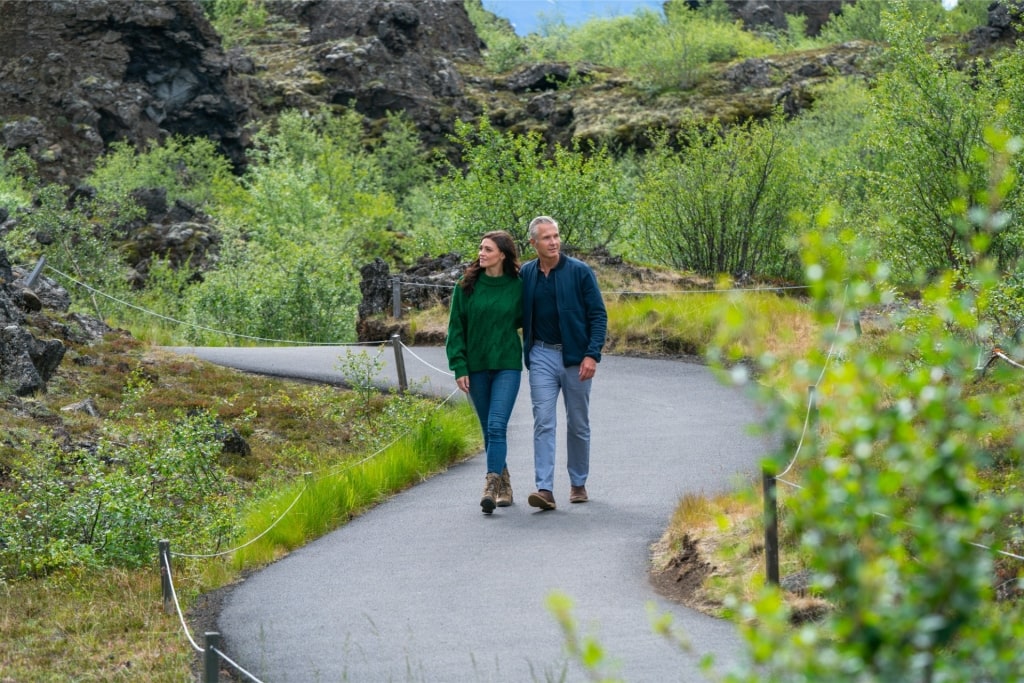
Thingvellir National Park
Iceland has some of the most achingly beautiful hikes in the world, including in Thingvellir National Park, a UNESCO World Heritage Site on the Golden Circle route. Thingvellir is home to two famous fissures, Almannagjá and Silfra, and the Silfra dive site, known for its crystal-clear water and exceptional visibility.
Pick one of the several hiking trails that criss-cross the park. This is the birthplace of Iceland’s first parliament, Alþingi, and you could see the ancient assembly site, plus the abandoned farms of Hrauntún, Skógarkot, and Vatnskot, and Öxarárfoss waterfall. Maps are available from Thingvellir National Park’s visitor center near Þingvellir church.
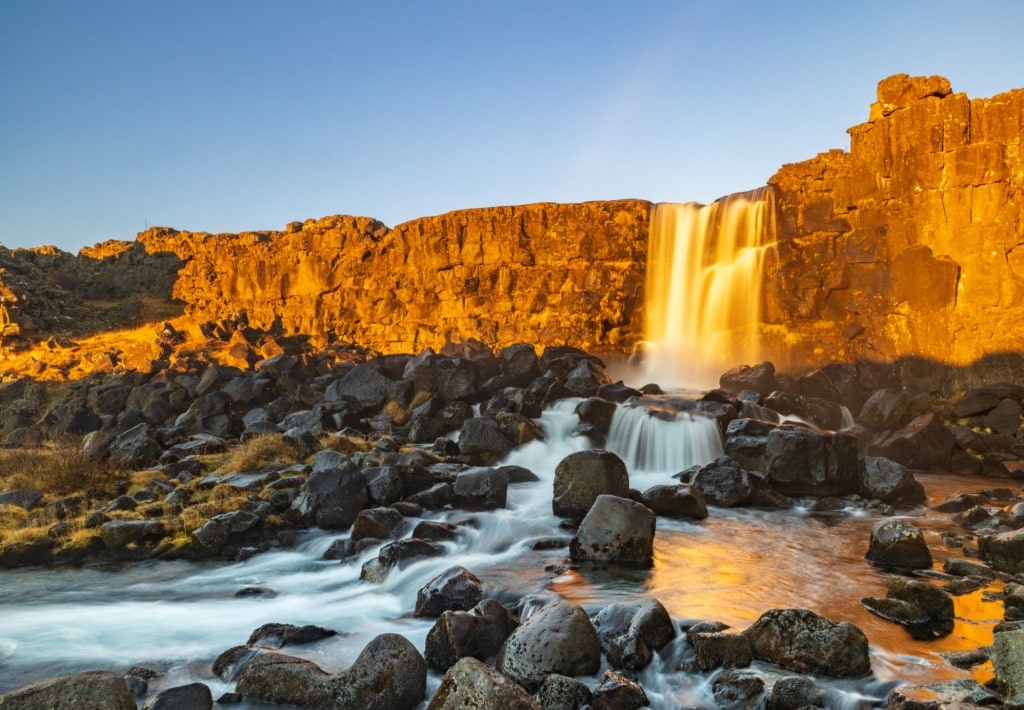
Öxarárfoss Waterfall
Check the tide times before hiking to Grótta Island Lighthouse in Reykjavik. Located on a small peninsula, it’s cut off at hide tide, but is walkable at low tide and is one of most popular places to view the midnight sun in Reykjavik.
Alternatively, take a hike up Mt. Esja, in Kjalarnes. Esja forms the dramatic backdrop of Reykjavík, rising almost 3,000 feet, with plenty of signposted routes to choose from, around a 35-minute drive from the city.
See Spectacular Waterfalls
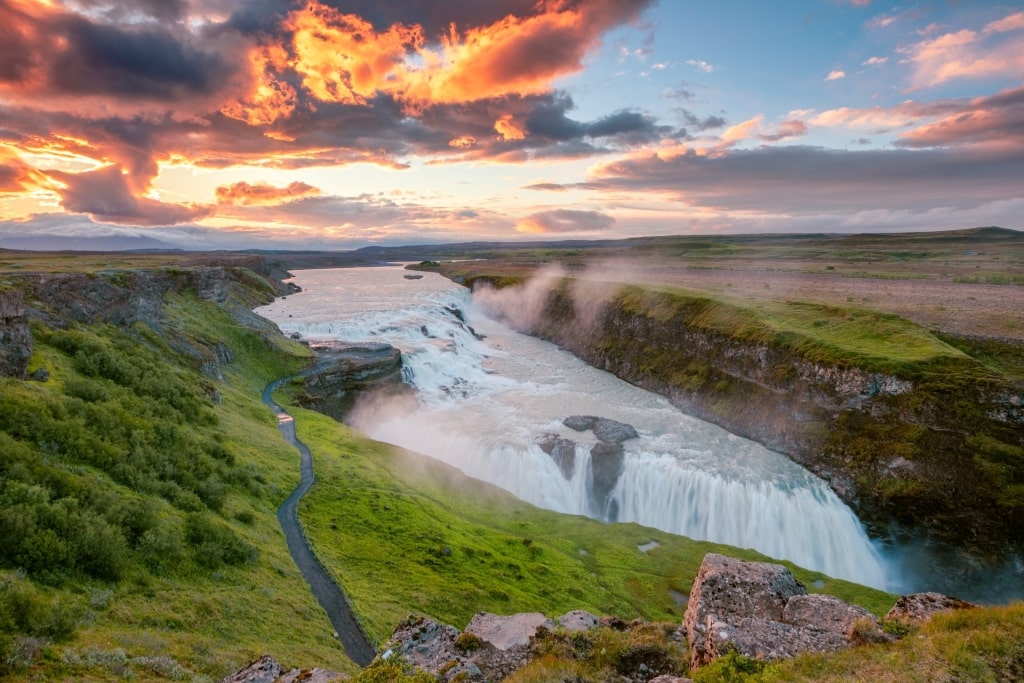
Gullfoss Waterfall
Look for rainbows forming over wonderful waterfalls under the glare of Iceland’s midnight sun, with thousands at their most powerful during summer.
Gullfoss Waterfall, also on the Golden Circle route, is a big draw for its natural beauty and easy-to-reach location, around 90 minutes from Reykjavik. Watch as this two-tier waterfall plunges around 105 feet into a canyon below.
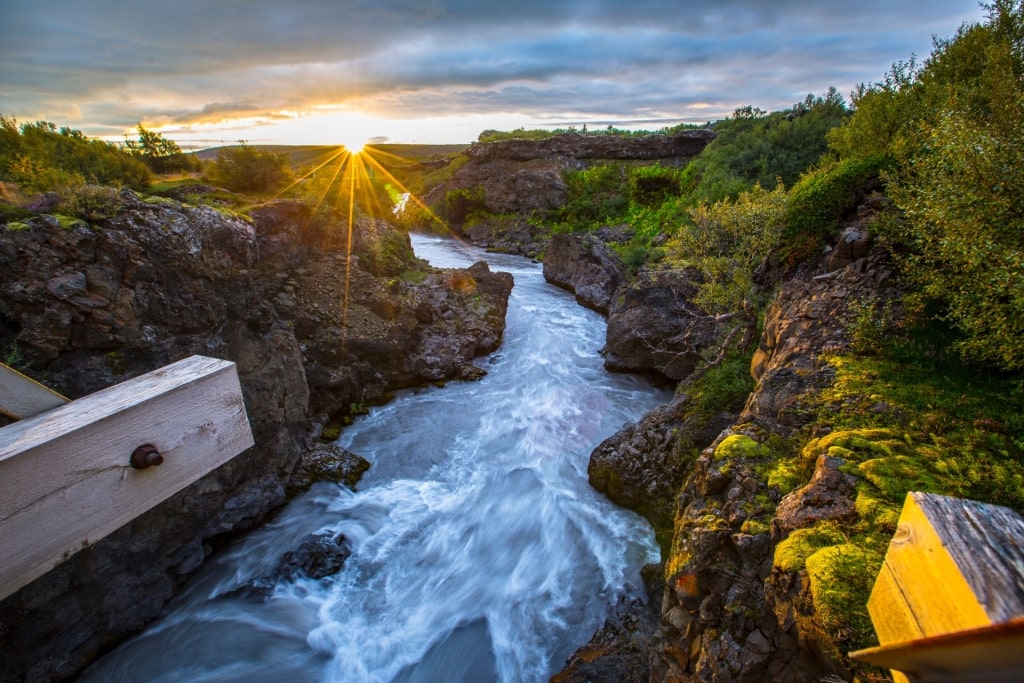
Barnafoss Waterfall
Hraunfossar and Barnafoss are two fantastic falls to see close together, around 80-miles northwest of the capital. In the south, the beautiful Skógafoss tumbles 197 feet into the salmon-filled river Skógá, not far from the black-sand Icelandic beaches of the south coast.
Bathe in the Blue Lagoon

Blue Lagoon
One of the best things to do under Iceland’s midnight sun is to relax in a healing hot spring. These geothermally heated pools are set amid barren lava fields and against unspoiled fjords and are dotted all over Iceland.
The most famous is the Blue Lagoon, a rugged milk-blue pool cradled in the volcanic Reykjanes Peninsula that’s naturally heated to around 98°F–104°F. Lather the lagoon’s silica-rich mud onto your skin and order a drink from the lagoon bar.
You’ll want to pre-book a timed ticket to the Blue Lagoon. Though it can get busy, the Blue Lagoon’s ticket system helps keep crowds down and it’s perfectly easy to find space to enjoy the deliciously warm water and gaze at the low-hanging midnight sun as you soak.
Read: Best Lagoons in Iceland
Tips for Experiencing the Midnight Sun
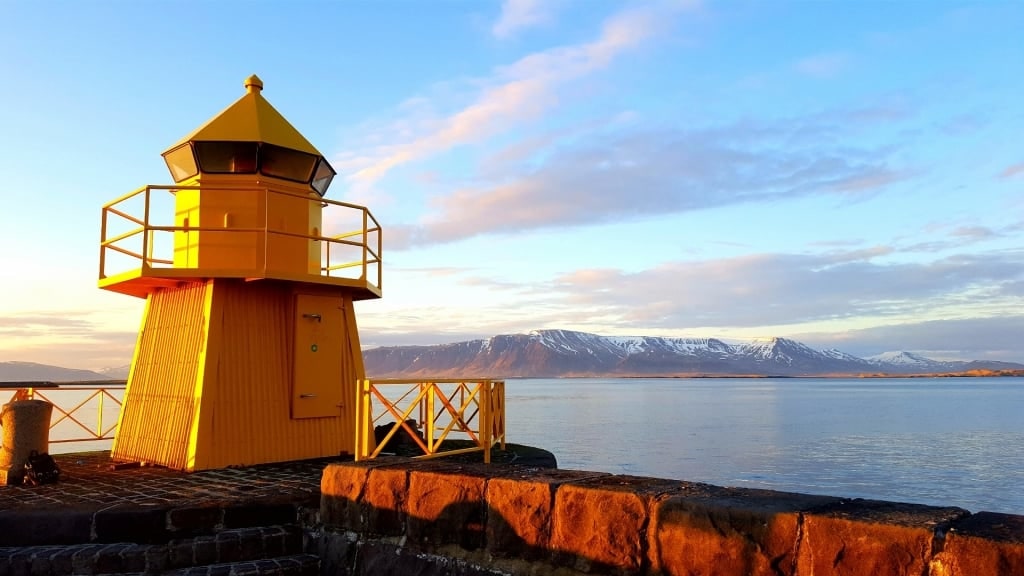
Reykjavik
If your goal is to witness the midnight sun, you should first plan to visit Iceland from early June to early July, which will mean you get to experience the country’s famously long summer days.
Plan to expand your trip outside of Reykjavik. Though the thrilling capital experiences longer daylight hours during summertime, the sun remains higher in the sky further north.
Iceland’s weather might be unpredictable, and sometimes cool, even during summer, but you should still wear SPF—ideally factor 50—and pack sunglasses.
Check the weather forecast in the area that you are traveling and plan your wardrobe accordingly. If you plan to enjoy Reykjavik’s thrilling nightlife late into the night, casual or more fashionable clothing is suitable. If your intention is to hike late into the night, layers, hiking boots, and a waterproof jacket are essential to ensure you keep dry and warm.
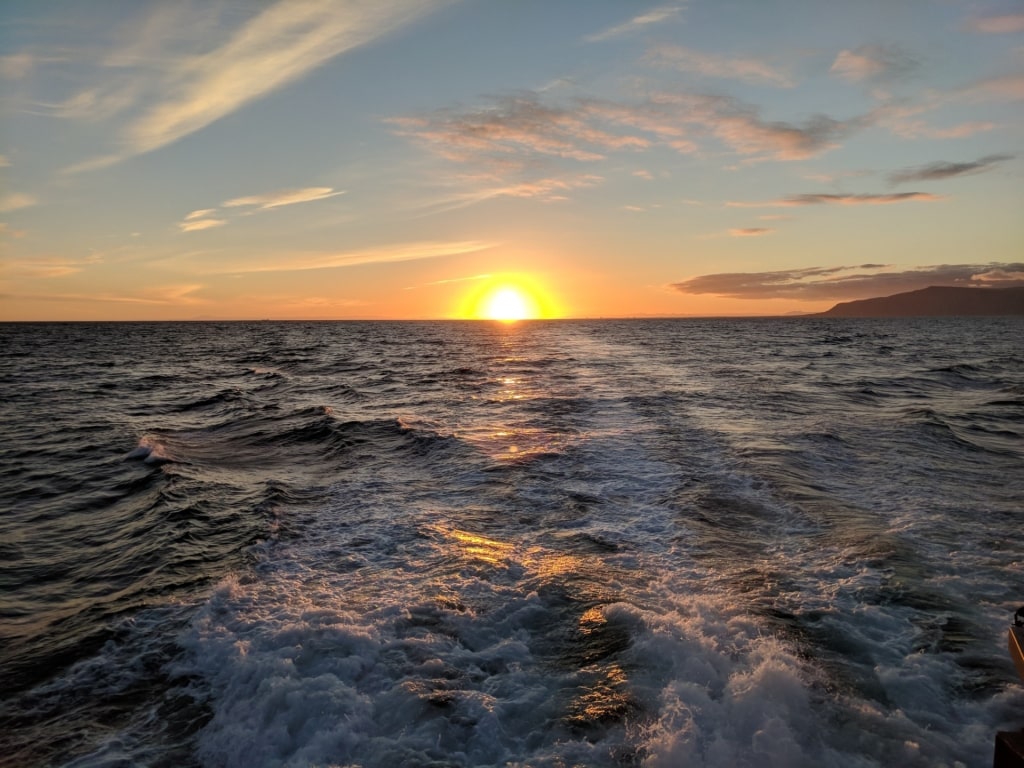
Midnight sun in Iceland
It’s worth upgrading your camera on a trip to Iceland, or at the very least, learn how to make the most of your existing camera. Consider taking a tripod to help steady your lens and take clearer photographs, too.
With soft, low-lighting later in the day, the midnight sun is perfect for long exposures—when you use a slow-shutter speed to take a photograph.
The best time to shoot Iceland’s breathtaking landscape during the midnight sun is between 12 a.m. and 2 a.m., when the sun is just above the horizon and there is a delicate, almost pastel orange and pink glow.
You’ll see that the quality of the light is different at night; while it may appear to be full daylight, there’s actually a lot less light around and you’ll need to adjust your camera settings accordingly.
Read: Iceland Travel Tips
Midnight Sun FAQs
When and where is best to view the midnight sun in Iceland?
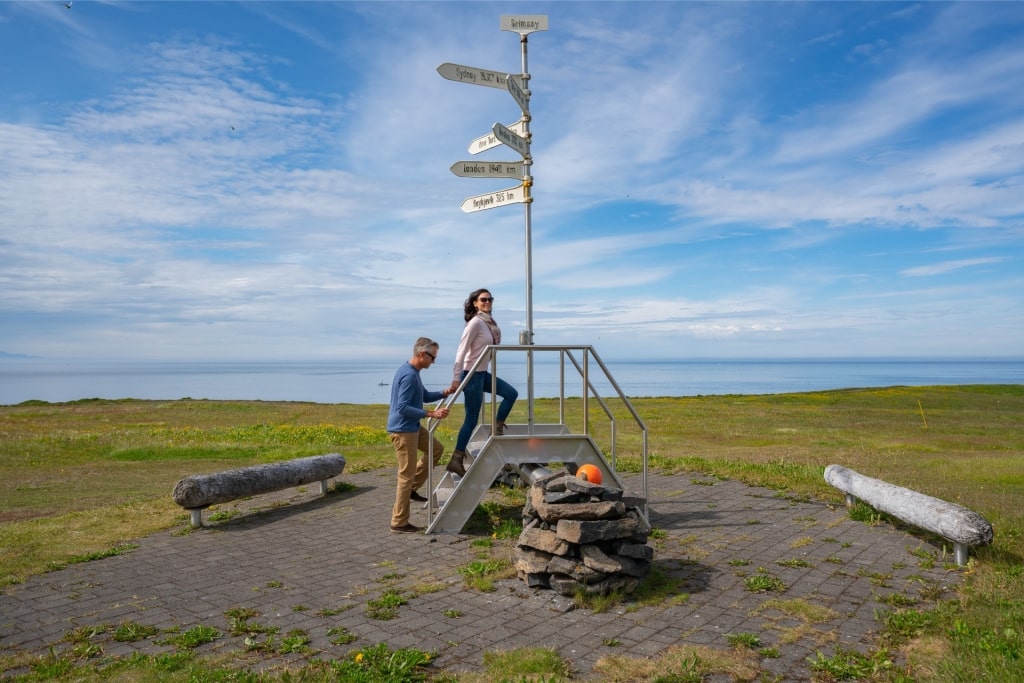
Grimsey Island
Iceland experiences long days of sunlight through summer. The longest day, when the sun doesn’t set, is June 21, and the best place to see the midnight sun is closer to the Arctic Circle, in northern Iceland, including Grimsey Island.
Can you see stars or the moon during the midnight sun?

Akureyri
It is usually not possible to see stars and rarely possible to see the moon during the midnight sun. Similarly, you will not see the northern lights during the midnight sun, since this requires clear, dark skies. Once you’re a few days beyond the solstice, it may be possible to see planets like Venus, which is always bright, low on the horizon.
Is it safe to drive or hike at night?
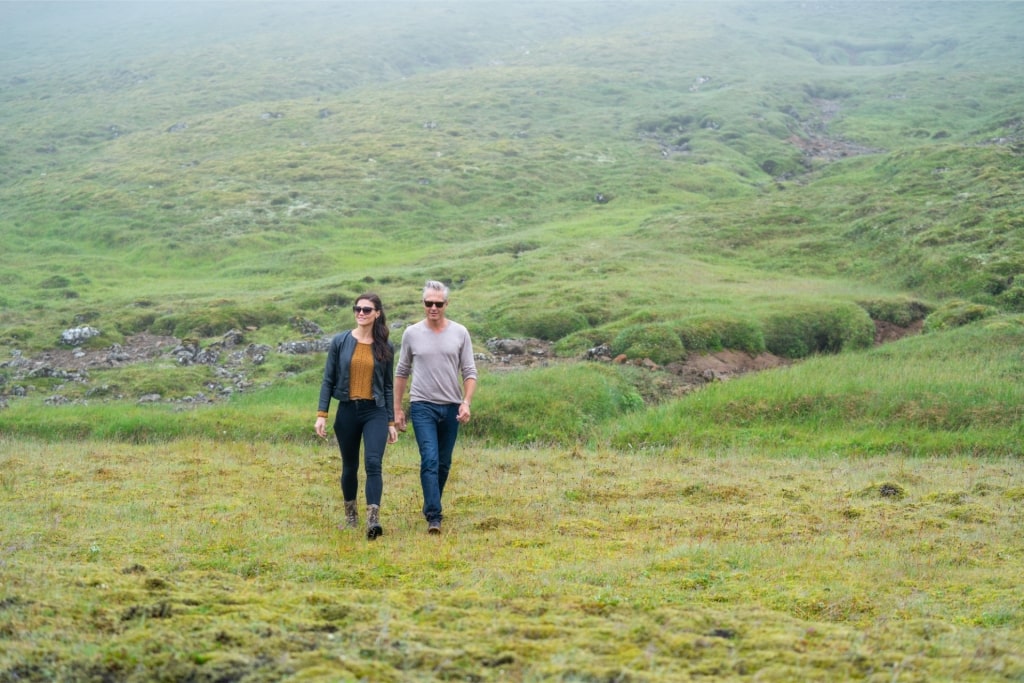
Hiking in Iceland
Yes, it is safe to drive and hike at night when viewing the midnight sun in Iceland. Highways, national parks, and hiking trails remain well-lit thanks to the long hours of daylight.
Be aware, though, that Iceland is deceptively large. What may look like a short distance as the crow flies can be much further in reality, as roads curve around fjord-indented coastlines.
Be aware, too, that the midnight sun can play havoc with your body clock, and if you’re driving late at night, you may be more tired than you realize.
Will the weather still be cold during this time?
Akureyri
The weather in Iceland is mild and bright during summertime, when the midnight sun is visible. Bear in mind that Iceland’s weather is also unpredictable, even during summer.
The sky might sometimes be cloudy, showers are common, though sun-filled days are, too. Expect average temperatures of around 59°F, with highs of 68°F and lows of 50°F.
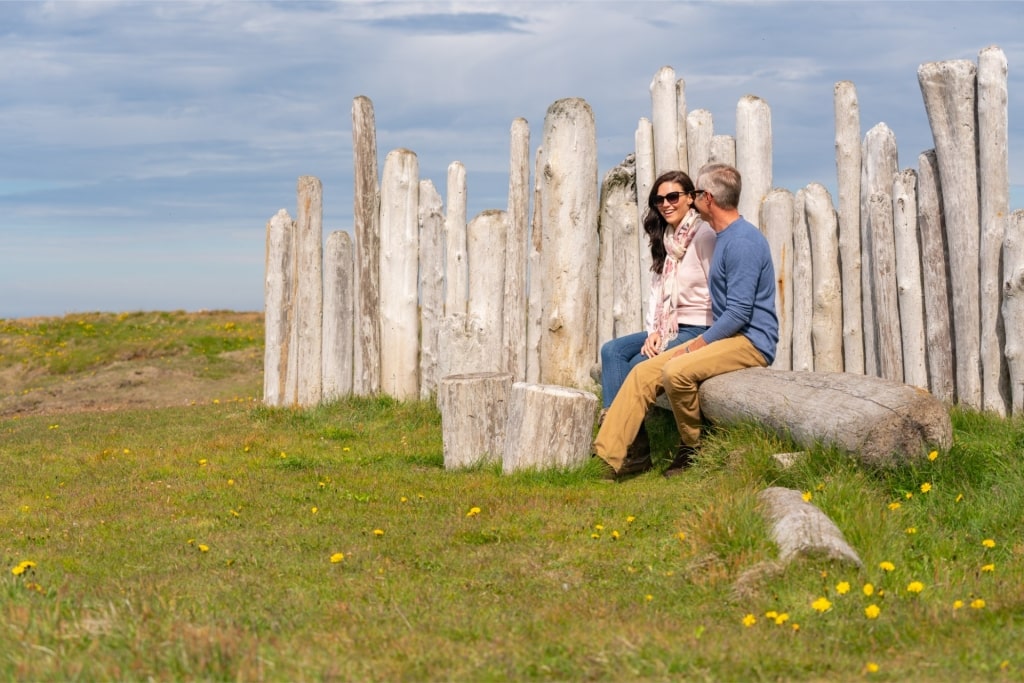
Grimsey Island
Now that you know everything there is to know about midnight sun in the Land of Fire and Ice, browse Celebrity’s thrilling cruises to Iceland and book your summer getaway.